Skip to content
Epomedicine

Mnemonics, Simplified Concepts & Thoughts

Epomedicine

Mnemonics, Simplified Concepts & Thoughts

Garden Classification for Neck of Femur fractures

Epomedicine, May 14, 2026May 14, 2026

History

  • Given by a British Orthopedic surgeon Dr. Robert Symon Garden in 1961
  • Based on original review of 80 patients which he classified into 4 types and followed for 12 months:
    • Type I and II fractures: had 100% union rate
    • Type III: had 93% union rate
    • Type IV: had 57% union rate

Classification

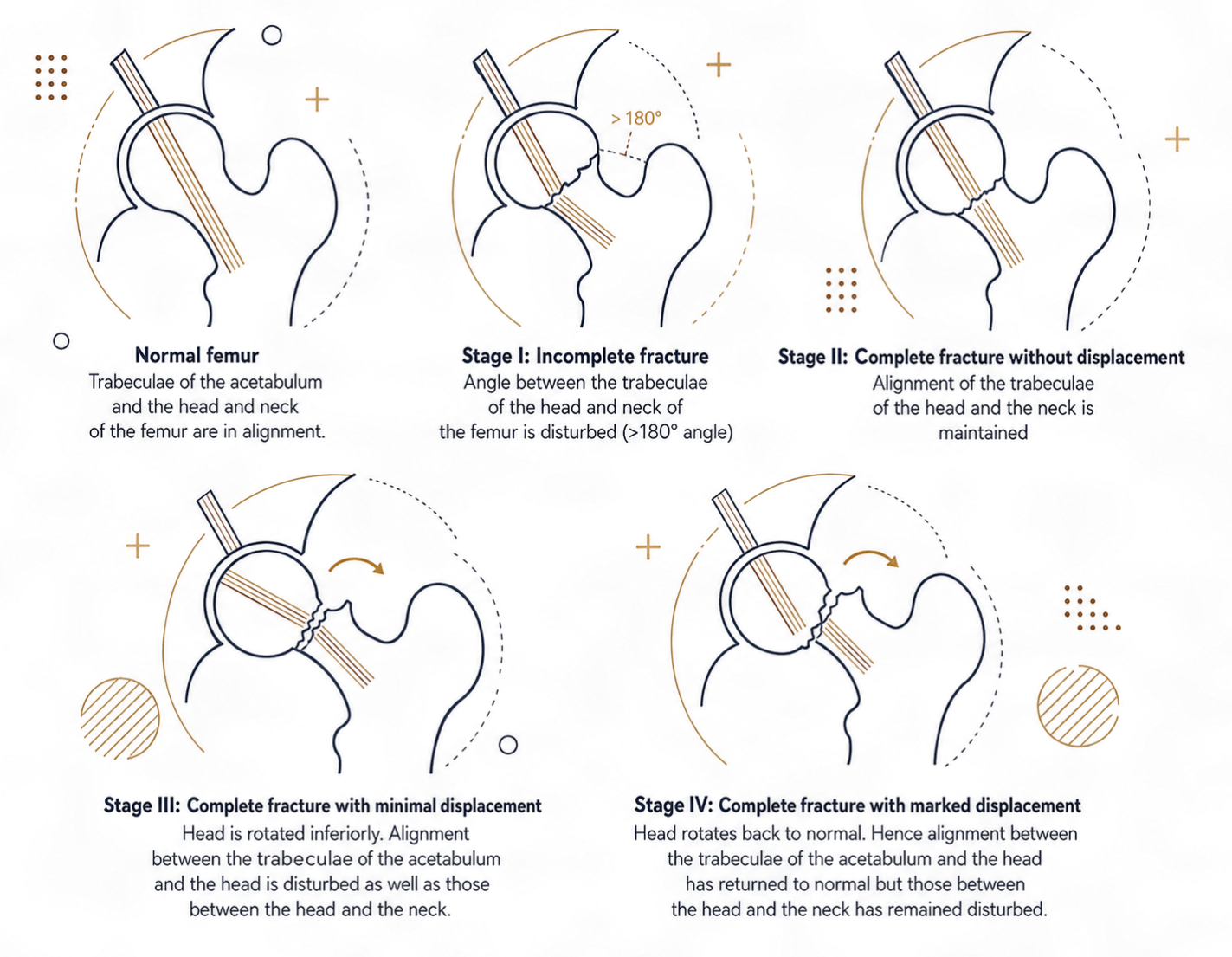
The Garden classification incorporates displacement, fracture completeness, and relationship of bony trabeculae in the femoral head and neck.
Garden IGarden IIGarden IIIGarden IV
DisplacementNoneNonePartialComplete
Fracture completenessIncomplete (medial cortex intact)CompleteCompleteComplete
Relation of bony trabeculaeHead and neck trabeculae malaligned (valgus impaction)All trabeculae aligned and parallelAll trabeculae malaligned (varus impaction)All trabeculae parallel but:
acetabular & head trabeculae aligned and neck trabeculae malaligned
  • Facebook
  • Twitter
PGMEE, MRCS, USMLE, MBBS, MD/MS OrthopedicsTrauma

Post navigation

Previous post

Related Posts

PGMEE, MRCS, USMLE, MBBS, MD/MS lactational amenorrhea mechanism

Management of Puerperium

Apr 3, 2016

Normal puerperium has been already discussed earlier here. A) Immediately after labor within 1 hour Blood pressure and heart rate atleast every 15 minutes Monitor amount of vaginal bleeding Palpate fundus to ensure amount adequate contractions (if relaxed – massage uterus to enhance oxytocin release) B) 1st several hours 1….

Read More
PGMEE, MRCS, USMLE, MBBS, MD/MS choledochocele todani

Choledochal Cysts : Mnemonic for Todani Classification

Mar 2, 2018Mar 2, 2018

  Todani Classification of Choledochal cysts Mnemonic: Consider I is “Extrahepatic” and V is “Intrahepatic”, then – Type I, II and III = Extrahepatic Type IV = Extrahepatic + Intrahepatic Type V = Intrahepatic Most common: Type I 2nd most common: Type IV Type I-III: Extrahepatic Mnemonic: 123 EDC Type…

Read More
PGMEE, MRCS, USMLE, MBBS, MD/MS

Foot muscles – Layers and Compartments

Sep 3, 2020Sep 3, 2020

Deep to the plantar fascia, muscles of plantar foot exist in 4 different layers. Extensor digitorum brevis makes dorsal layer of foot and remaining 18 muscles and 4 tendons make the 4 layers of plantar aspect or sole of foot. In general: Layer 1 and 3: 3 muscles each that…

Read More

Leave a Reply Cancel reply

Your email address will not be published. Required fields are marked *

This site uses Akismet to reduce spam. Learn how your comment data is processed.

Epomedicine. Garden Classification for Neck of Femur fractures [Internet]. Epomedicine; 2026 May 14 [cited 2026 May 14]. Available from: https://epomedicine.com/medical-students/garden-classification-for-neck-of-femur-fractures/.

Pre-clinical (Basic Sciences)

Anatomy

Biochemistry

Community medicine (PSM)

Embryology

Microbiology

Pathology

Pharmacology

Physiology

Clinical Sciences

Anesthesia

Dermatology

Emergency medicine

Forensic

Internal medicine

Gynecology & Obstetrics

Oncology

Ophthalmology

Orthopedics

Otorhinolaryngology (ENT)

Pediatrics

Psychiatry

Radiology

Surgery

RSS Ask Epomedicine

  • What to study for Clinical examination in Orthopedics?
  • What is the mechanism of AVNRT?

Epomedicine weekly

  • About Epomedicine
  • Contact Us
  • Author Guidelines
  • Submit Article
  • Editorial Board
  • USMLE
  • MRCS
  • Thesis
©2026 Epomedicine | WordPress Theme by SuperbThemes