Skip to content
Epomedicine

Mnemonics, Simplified Concepts & Thoughts

Epomedicine

Mnemonics, Simplified Concepts & Thoughts

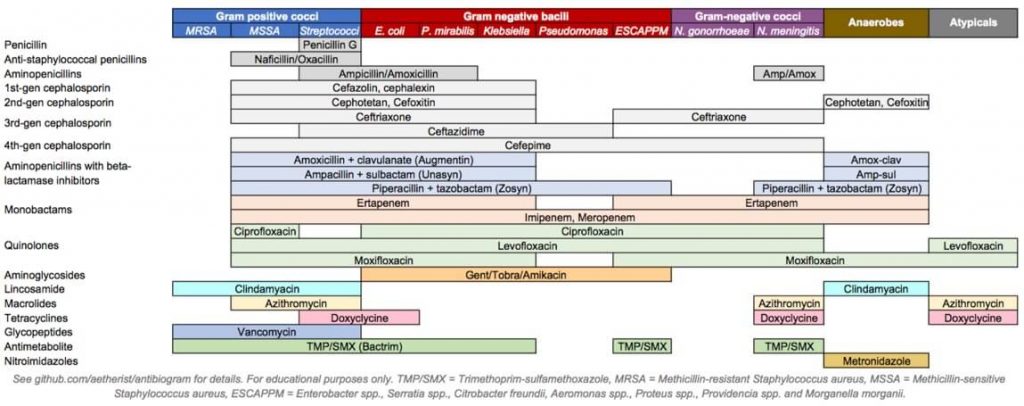
Antibiotic Spectrums : Cheat sheet

Epomedicine, May 20, 2020May 20, 2020
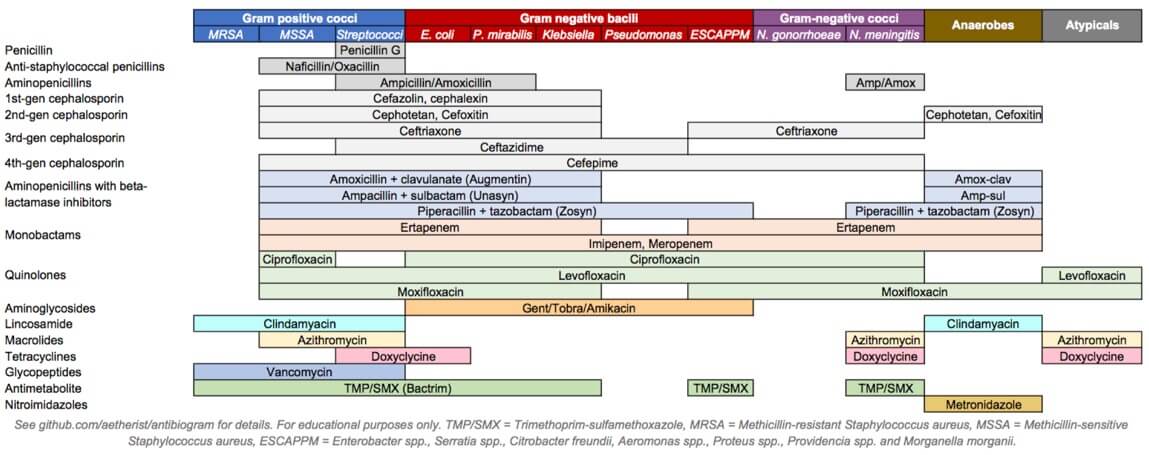
Antibiotic coverage
Akinesia / CC BY-SA

Gram positive and Gram negative

  1. Amoxicillin-clavulanate
  2. Tazobactam-piperacillin
  3. Carbapenem: Ertapenen, Imipenem, Meropenem
  4. Cefuroxime
  5. Cefotaxime
  6. Ceftriaxone

Anaerobes

  1. Amoxicillin-clavulanate
  2. Tazobactam-piperacillin
  3. Carbapenems
  4. Clindamycin
  5. Metronidazole

Pseudomonas

  1. Tazobactam-piperacillin
  2. Carbapenems (except Ertapenem)
  3. Ceftazidime, Cefoperazone, Cefepime
  4. Gentamicin, Amikacin, Tobramycin
  5. Ciprofloxacin
  6. Colistin
  7. Aztreonam

Only gram positive

  1. Vancomycin
  2. Teicoplanin
  3. Linezolid
  4. Daptomycin

Only gram negative

  1. Ceftazidime
  2. Colistin
  3. Aztreonam

“Non-culturable” bacteria

  1. Macrolides: Erythromycin, Clarithromycin, Azithromycin
  2. Fluoroquinolones: Ciprofloxacin, Ofloxacin
  3. Doxycycline
100 shares
  • Facebook76
  • Twitter
PGMEE, MRCS, USMLE, MBBS, MD/MS General conceptsPharmacology

Post navigation

Previous post
Next post

Related Posts

PGMEE, MRCS, USMLE, MBBS, MD/MS glass prescription slip

Understanding Eye Glass Prescription Slip

Aug 12, 2015Aug 17, 2015

A phoropter/refractor is an instrument commonly used by eye care professionals during an eye examination, containing different lenses used for refraction of the eye during sight testing, to measure an individual’s refractive error and determine his or her eyeglass prescription. Retinoscopy is done instead in children who are unable to…

Read More
PGMEE, MRCS, USMLE, MBBS, MD/MS anemia mcv-rdw

Understanding Red cell indices

Feb 4, 2017

Rule of 3s The measured hemoglobin concentration is 3 times the RBC count, and the calculated hematocrit is 3 times the Hb level. A significant deviation means artifacts in the value estimated or the RBCs are smaller or larger than the normal. HCt = 3 X Hb RBC count =…

Read More
PGMEE, MRCS, USMLE, MBBS, MD/MS

Heart Sounds – Abnormal

Apr 24, 2019May 23, 2020

The basic clinical examination of the Cardiac System is by Auscultation (listening to the sounds made by the heart). As explained in the previous article physiological sounds made in each cardiac cycle viz. S1 and S2 due to the closure of the Atrio-Ventricular Valves and Outlet Valve in synchrony. Please…

Read More

Leave a Reply Cancel reply

Your email address will not be published. Required fields are marked *

This site uses Akismet to reduce spam. Learn how your comment data is processed.

Pre-clinical (Basic Sciences)

Anatomy

Biochemistry

Community medicine (PSM)

Embryology

Microbiology

Pathology

Pharmacology

Physiology

Clinical Sciences

Anesthesia

Dermatology

Emergency medicine

Forensic

Internal medicine

Gynecology & Obstetrics

Oncology

Ophthalmology

Orthopedics

Otorhinolaryngology (ENT)

Pediatrics

Psychiatry

Radiology

Surgery

RSS Ask Epomedicine

  • What to study for Clinical examination in Orthopedics?
  • What is the mechanism of AVNRT?

Epomedicine weekly

  • About Epomedicine
  • Contact Us
  • Author Guidelines
  • Submit Article
  • Editorial Board
  • USMLE
  • MRCS
  • Thesis
©2026 Epomedicine | WordPress Theme by SuperbThemes