Skip to content
Epomedicine

Mnemonics, Simplified Concepts & Thoughts

Epomedicine

Mnemonics, Simplified Concepts & Thoughts

Oxygen Hemoglobin Dissociation Curve : Mnemonic

Epomedicine, Aug 28, 2021Aug 28, 2021

The oxygen hemoglobin dissociation curve is sigmoidal in shape because the binding of 1st oxygen molecule is difficult, however once bound, they facilitate the binding of subsequent molecules until the saturation is reached (plateau). This is called the allosteric interaction (cooperativity).
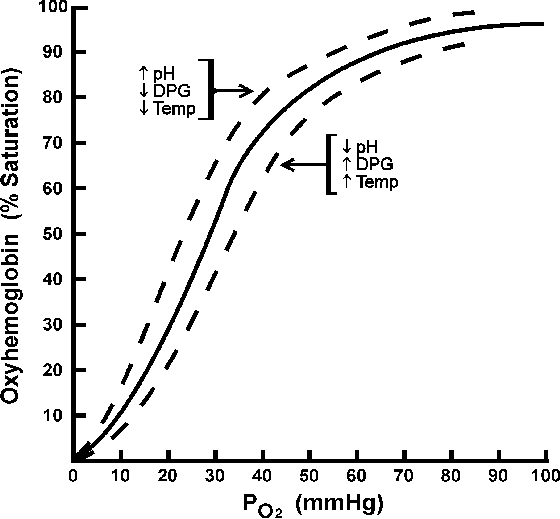
oxygen hemoglobin dissociation curve

Lets come to the mnemonics now.

The curve can either shift:

  1. Left: Oxygen is Locked up
  2. Right: Oxygen is Released

Now for the factors affecting the curve:

  1. Left: Lessening
  2. Right: Rising

The commonly used mnemonic for remembering the factors is

  1. CO2
  2. Acid (H+)/Altitude
  3. DPG
  4. Exercise
  5. Temperature

CADET face Left when all these are Lessening and lead to Locking up of Oxygen.

CADET face Right when all these are Rising and lead to Release of Oxygen.
1 shares
  • Facebook
  • Twitter
PGMEE, MRCS, USMLE, MBBS, MD/MS AnesthesiaPhysiologyRespiratory system

Post navigation

Previous post
Next post

Related Posts

PGMEE, MRCS, USMLE, MBBS, MD/MS Anterior and posterior epistaxis

Epistaxis Basics : Anatomy, Physiology and Pathology

May 3, 2014

Synonyms: Nosebleed, Nasal bleeding Definition: Epistaxis is defined as bleeding from the nasal cavity. It ranges from minor blood-tinged mucus when blowing the nose to life-threatening hemorrhage. Epidemiology: Age: Bimodal distribution – common in <10 years and >60 years Season: Winter Anatomy and Physiology: Why is the nose prone to…

Read More
PGMEE, MRCS, USMLE, MBBS, MD/MS

Crowe Classification in Adult Hip Dysplasia

Jun 4, 2025Apr 16, 2026

Crowe Classification Crowe classification (1979) is based on 3 easily identifiable anatomic landmarks: Reference line: drawn joining the inferior margins of each tear drop Degree of dysplasia: distance from reference line to medial head–neck junction The normal ratio of vertical diameter of the femoral head to the height of the…

Read More
PGMEE, MRCS, USMLE, MBBS, MD/MS

Urea Cycle and Defects with Mnemonics

Jan 30, 2016Aug 11, 2018

Mnemonic for Urea Cycle Intermediates Orange Cola, Coffee, Alcohol of Argentina For Aggressive Urine Orange: Ornithine Cola: Carbamoyl Phosphate Coffee: Citrulline Alcohol: Aspartate (enters cycle) Argentina: Arginosuccinate For: Fumarate (leaves cycle) Aggressive: Arginine Urine: Urea (leaves cycle) Structure of Urea NH2-CO-NH2 (1 amide from aspartate and 1 from ammonia) Amide…

Read More

Leave a Reply Cancel reply

Your email address will not be published. Required fields are marked *

This site uses Akismet to reduce spam. Learn how your comment data is processed.

Epomedicine. Oxygen Hemoglobin Dissociation Curve : Mnemonic [Internet]. Epomedicine; 2021 Aug 28 [cited 2026 Jun 12]. Available from: https://epomedicine.com/medical-students/oxygen-hemoglobin-dissociation-curve-mnemonic/.

Pre-clinical (Basic Sciences)

Anatomy

Biochemistry

Community medicine (PSM)

Embryology

Microbiology

Pathology

Pharmacology

Physiology

Clinical Sciences

Anesthesia

Dermatology

Emergency medicine

Forensic

Internal medicine

Gynecology & Obstetrics

Oncology

Ophthalmology

Orthopedics

Otorhinolaryngology (ENT)

Pediatrics

Psychiatry

Radiology

Surgery

RSS Ask Epomedicine

  • What to study for Clinical examination in Orthopedics?
  • What is the mechanism of AVNRT?

Epomedicine weekly

  • About Epomedicine
  • Contact Us
  • Author Guidelines
  • Submit Article
  • Editorial Board
  • USMLE
  • MRCS
  • Thesis
©2026 Epomedicine | WordPress Theme by SuperbThemes