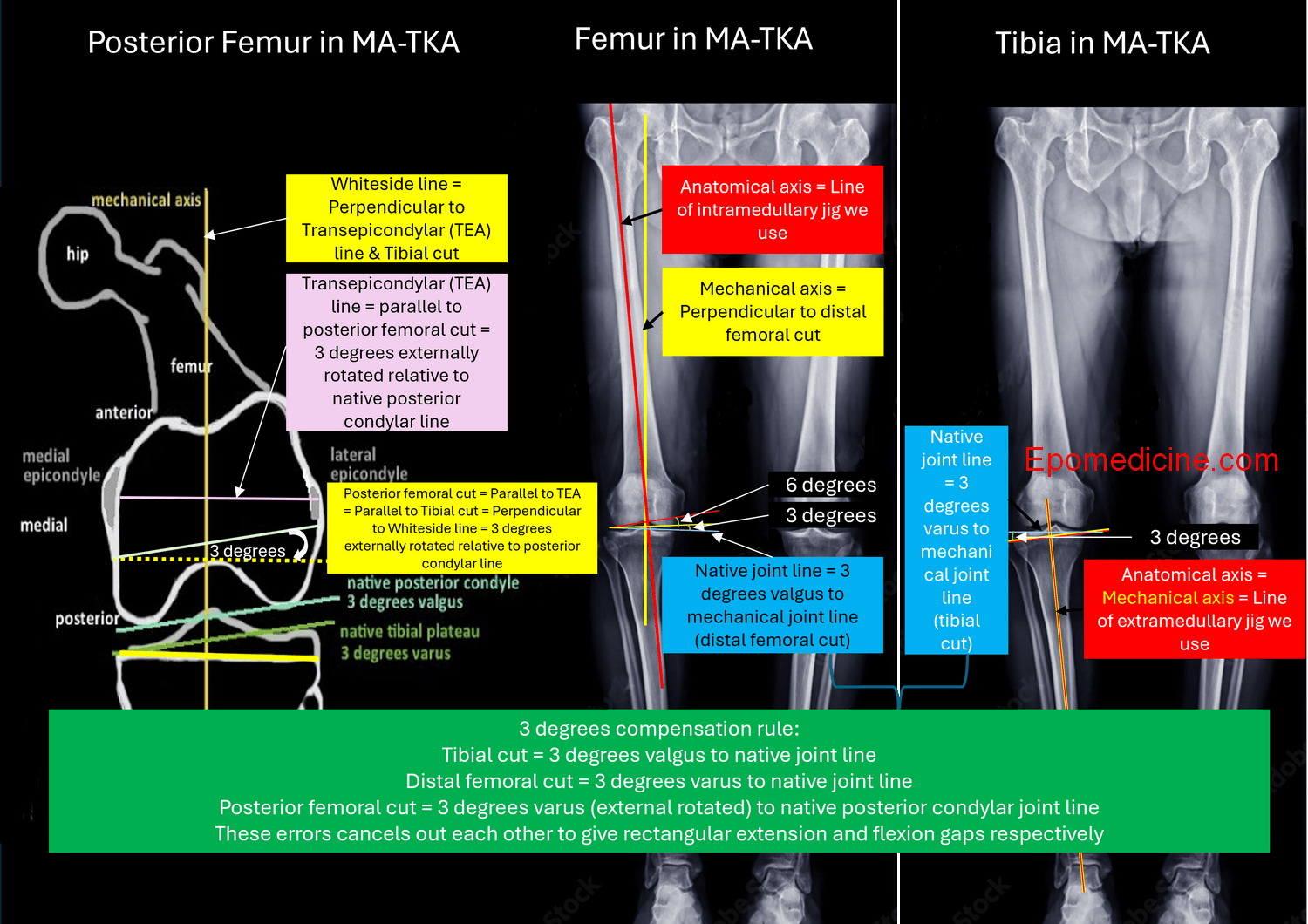
The goal of MA-TKA is to restore the normal mechanical axis. In contrast to kinematic axis alignment, which attempts to recreate native knee joint line (3° tibial varus and 3° femoral valgus), in MA-TKA, the distal femur and the tibia are cut to be perpendicular (0°) to the mechanical axis.
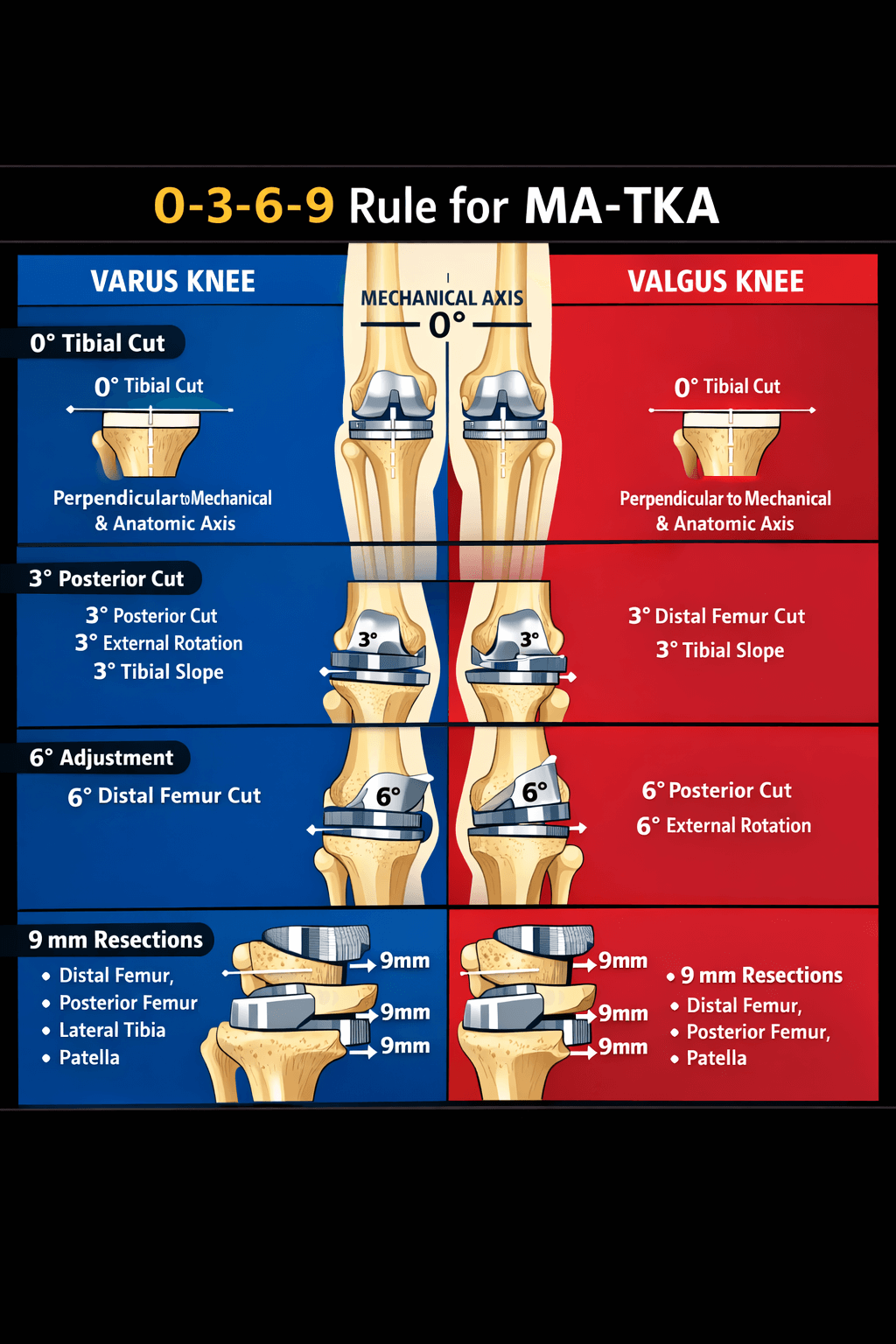
Here is a simple 0-3-6-9 rule for MA-TKA. The numbers are arbitrary and may defer according to implant provider and surgical scenario.
| Rule | Varus Knee | Valgus Knee |
| a. 0 degrees | Tibial cut relative to both the mechanical axis and the anatomic axis (they are parallel) | Tibial cut relative to both the mechanical axis and the anatomic axis (they are parallel) |
| b. 3 degrees | Posterior femoral cut made using posterior referencing system – 3 degrees external rotation 3 degrees posterior tibial slope | Distal femoral cut set to 3 degrees valgus relative to intramedullary guide as opposed to 6 degrees in varus knee (to avoid under-correction of deformity) 3 degrees posterior tibial slope |
| c. 6 degrees | Distal femoral cut set to 6 degrees valgus relative to intramedullary guide (difference between anatomical axis & mechanical axis) | Posterior femoral cut made using posterior referencing system – 6 degrees external rotation (to compensate for lateral condyle hypoplasia and prevent internal rotation of component) |
| d. 9 mm | Size of: a. Distal femur cut b. Posterior femur cut c. Tibial cut from lateral side d. Patellar cut | Size of: a. Distal femur cut b. Posterior femur cut c. Patellar cut |

He is the section editor of Orthopedics in Epomedicine. He searches for and share simpler ways to make complicated medical topics simple. He also loves writing poetry, listening and playing music. He is currently pursuing Fellowship in Hip, Pelvi-acetabulum and Arthroplasty at B&B Hospital.