Skip to content
Epomedicine

Mnemonics, Simplified Concepts & Thoughts

Epomedicine

Mnemonics, Simplified Concepts & Thoughts

spleen percussion

Percussion of Spleen

Epomedicine, Jan 31, 2017

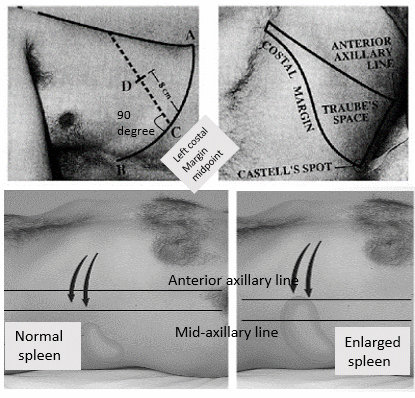
Traube’s semilunar space

Borders:

  1. Superiorly: Left 6th rib superiorly
  2. Laterally: Left midaxillary line or Left anterior axillary line
  3. Inferiorly: Left costal margin

Method:

  1. Patient’s position: supine with left arm slightly abducted.
  2. Percuss: from medial to lateral

Interpretation: Resonance (Normal) and Dullness (Splenomegaly)

  • Also: Pleural effusion or mass in stomach may cause dullness in Traube’s space.

Castell’s method

Patient’s position: Supine

Percuss: In the lowest intercostal space in the anterior axillary line (8th or 9th)

Interpretation:

  1. Resonant percussion note on expiration or full inspiration: normal
  2. Dull percussion note on full inspiration: splenomegaly
spleen percussion
Top-left: Nixon’s method; Top-right: Traube’s space and Castell’s method; Bottom: Line of splenic enlargement

Nixon’s method

Patient’s position: Right lateral decubitus (rationale: spleen comes to lie above colon and stomach).

Percuss: start percussing midway along the left costal margin and proceed in a line perpendicular to left constal margin

Interpretation: Upper limit of dullness >8 cm above costal margin: Splenic enlargement
25 shares
  • Facebook23
  • Twitter
Clinical Skills and Approaches Clinical examinationGastrointestinal systemInternal medicine

Post navigation

Previous post
Next post

Related Posts

Clinical Skills and Approaches

Eliciting Primitive Neonatal Reflexes

Mar 8, 2023Mar 8, 2023

Neonatal reflexes are the reflexes which are present at birth and have a predictable course of appearance and disappearance. A normally developing newborn should respond to certain stimuli with these reflexes, which eventually become inhibited as the child matures. The list of reflexes that can be elicited in normal newborn…

Read More
Clinical Skills and Approaches

Communication Module for dealing with an Angry patient or relative

May 26, 2024May 26, 2024

The basic structure for communication skills remains the same. Recall the mnemonic P I CX3. Take into considerations of following points during consultation. Mnemonic: AARRR! Mnemonic Heading Comment A Acknowledge 1. Acknowledge the problem2. Acknowledge the concerns3. Acknowledge and validate the emotions of the patient/relative A Apologize and Empathize Apologize for the…

Read More
Clinical Skills and Approaches

History Taking : A Basic Clinical Skill

Jun 11, 2020Jun 11, 2020

As a Doc. whenever you treat a patient, the success of treatment depends upon whether you come up with the right diagnosis or at least a right set of differential diagnoses. To achieve the above mention goal the KEY is EFFECTIVE COMMUNICATION. And I can talk to you for an…

Read More

Comments (3)

  1. nagabushana m.v. says:
    Dec 18, 2022 at 4:53 pm

    As for Nixon’s method- if dullness is beyond 8cms on a perpendicular line from middle of left costal margin,it means spleen is enlarged upto costal margin.This can be easily picked up by hooking method or Medleton’s manuare.Nixon’s method becomes superfluous.
    Well ,dullness lower anterior chestwall may indicate pleural effusion or pleural thickening or even a fundal growth in the stomach .We need to ponderon that.

    Reply
  2. Purusottam Misra says:
    Mar 17, 2023 at 3:00 pm

    A simple ultrasound
    Willsufice for 100 percent diagnosis

    Reply
    1. Epomedicine says:
      Mar 17, 2023 at 4:21 pm

      1. Physical examination for splenomegaly have sensitivity ranging from 11 to 85 % and specificity from 32 to 99 %. Physical examination plus POCUS had a sensitivity of 100 % and specificity of 74 %.

      Reference: Olson AP, Trappey B, Wagner M, Newman M, Nixon LJ, Schnobrich D. Point-of-care ultrasonography improves the diagnosis of splenomegaly in hospitalized patients. Crit Ultrasound J. 2015 Dec;7(1):13. doi: 10.1186/s13089-015-0030-8. Epub 2015 Sep 17. PMID: 26383010; PMCID: PMC4574040.

      2. Sonographic versions of traditional physical examination maneuvers have greater diagnostic accuracy than the physical examination maneuvers from which they are derived but may take longer to perform. We recommend a combination of traditional physical examination and sonographic techniques when evaluating for splenomegaly at the bedside.

      Reference: Cessford T, Meneilly GS, Arishenkoff S, Eddy C, Chen LYC, Kim DJ, Ma IWY. Comparing Physical Examination With Sonographic Versions of the Same Examination Techniques for Splenomegaly. J Ultrasound Med. 2018 Jul;37(7):1621-1629. doi: 10.1002/jum.14506. Epub 2017 Dec 8. PMID: 29219201.

      Reply

Leave a Reply to nagabushana m.v. Cancel reply

Your email address will not be published. Required fields are marked *

This site uses Akismet to reduce spam. Learn how your comment data is processed.

Pre-clinical (Basic Sciences)

Anatomy

Biochemistry

Community medicine (PSM)

Embryology

Microbiology

Pathology

Pharmacology

Physiology

Clinical Sciences

Anesthesia

Dermatology

Emergency medicine

Forensic

Internal medicine

Gynecology & Obstetrics

Oncology

Ophthalmology

Orthopedics

Otorhinolaryngology (ENT)

Pediatrics

Psychiatry

Radiology

Surgery

RSS Ask Epomedicine

  • What to study for Clinical examination in Orthopedics?
  • What is the mechanism of AVNRT?

Epomedicine weekly

  • About Epomedicine
  • Contact Us
  • Author Guidelines
  • Submit Article
  • Editorial Board
  • USMLE
  • MRCS
  • Thesis
©2026 Epomedicine | WordPress Theme by SuperbThemes