Skip to content
Epomedicine

Mnemonics, Simplified Concepts & Thoughts

Epomedicine

Mnemonics, Simplified Concepts & Thoughts

cheilitis and glossitis

Hematological Signs – Angular Stomatitis and Atrophic Glossitis

Epomedicine, Jun 14, 2015

ANGULAR STOMATITIS/CHEILITIS

Definition: Maculopapular and vesicular lesions grouped on the skin at the corners (or ‘angles’) of the mouth and the mucocutaneous junction. It is made worse by licking the lips.

Causes: 

1. Oral candidiasis

2. Poorly fitting dentures

3. Bacterial infection

4. Less common

  • Nutritional deficiencies (especially riboflavin, iron and pyridoxine)
    • Iron and other nutrients are necessary in gene transcription for essential cell replication, repair and protection. Nutrient deficiency leads to impeded protection, repair and replacement of the epithelial cells on the edges of the mouth.
  • Human immunodeficiency virus (HIV)
  • Inflammatory Bowel Disease
  • Contact allergy
  • Seborrheic or Atopic dermatitis
  • Oral retinoid medications
cheilitis and glossitis
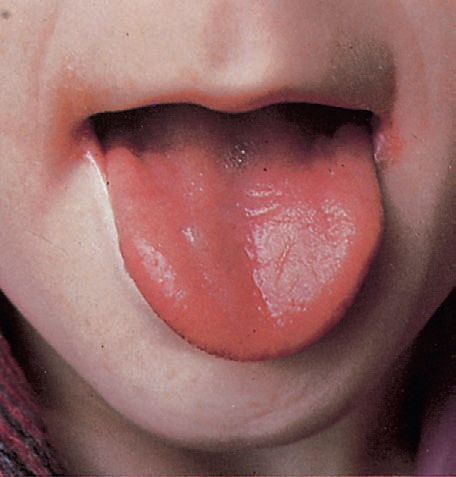
Angular cheilitis and Atrophic glossitis

ATROPHIC GLOSSITIS

Definition: The absence or flattening of the filiform papillae of the tongue – the tongue appears smooth and erythematous “beefy”. In later stages, there may be shallow ulceration.

Causes: 

  1. Associated with micronutrient deficiency, including:
    • Iron deficiency
    • Vitamin B12 deficiency
    • Folic acid deficiency
    • Thiamine deficiency
    • Niacin deficiency
    • Vitamin E deficiency
  2. Amyloidosis
  3. Sjögren’s syndrome

As cells of the tongue papillae have a high rate of turnover, deficiencies in micronutrients needed for cell proliferation or cell membrane stabilisation may lead to depapillation. Nutritional deficiency is also thought to change the pattern of microbial flora, thus contributing to glossitis.

  • Facebook
  • Twitter
Clinical Skills and Approaches Clinical examinationDermatologyInternal medicinePediatrics

Post navigation

Previous post
Next post

Related Posts

Clinical Skills and Approaches

Diabetes Made Easy : Epomedicine Series

Aug 7, 2020Feb 23, 2023

Approach to Uncomplicated Diabetes Mellitus : Simplified Management of Diabetes – GLUCOSE BAD mnemonic DKA : Mnemonic Approach and Clinical Aspects GIK Regimen – Rule of Ten Simplified Guide to Statin Therapy Diabetic Ketosis without Acidosis Diabetic Foot Management

Read More
Clinical Skills and Approaches

History Taking : Sequence and Mnemonics

Oct 9, 2023Oct 10, 2023

Introduction Mnemonic: WIPER General information Mnemonic: DNA SORAN Presenting Complaint (PC) A good opening question might be “What seems to be the problem today?”. It must be recorded: It can be recorded as: History of Presenting Complaint (HPC) Start in the order of PC, i.e. reverse chronological order. The HPC…

Read More
Clinical Skills and Approaches signs of meningeal irritation

Meningeal signs

Aug 18, 2014Oct 15, 2016

Meningitis refers to the inflammation of leptomeninges and underlying subarachnoid cerebrospinal fluid (CSF). Meningism or meningismus is a morbid state characterized by a meningitic syndrome (a triad of headache, photophobia and nuchal rigidity) without intracranial inflammation. Some authors, have also used the term “meningism” or “meningismus” to describe the characteristic signs…

Read More

Leave a Reply Cancel reply

Your email address will not be published. Required fields are marked *

This site uses Akismet to reduce spam. Learn how your comment data is processed.

Epomedicine. Hematological Signs – Angular Stomatitis and Atrophic Glossitis [Internet]. Epomedicine; 2015 Jun 14 [cited 2026 Jan 21]. Available from: https://epomedicine.com/clinical-medicine/hematological-signs-angular-stomatitis-and-atrophic-glossitis/.

Pre-clinical (Basic Sciences)

Anatomy

Biochemistry

Community medicine (PSM)

Embryology

Microbiology

Pathology

Pharmacology

Physiology

Clinical Sciences

Anesthesia

Dermatology

Emergency medicine

Forensic

Internal medicine

Gynecology & Obstetrics

Oncology

Ophthalmology

Orthopedics

Otorhinolaryngology (ENT)

Pediatrics

Psychiatry

Radiology

Surgery

RSS Ask Epomedicine

  • What to study for Clinical examination in Orthopedics?
  • What is the mechanism of AVNRT?

Epomedicine weekly

  • About Epomedicine
  • Contact Us
  • Author Guidelines
  • Submit Article
  • Editorial Board
  • USMLE
  • MRCS
  • Thesis
©2026 Epomedicine . All rights reserved.