Skip to content
Epomedicine

Mnemonics, Simplified Concepts & Thoughts

Epomedicine

Mnemonics, Simplified Concepts & Thoughts

Subacromial Injection

Epomedicine, Feb 11, 2023Feb 11, 2023

Indications: Diagnostic and therapeutic purposes of –

  1. Shoulder impingement
  2. Supraspinatus tendinitis
  3. Subacromial bursitis

Syringe preparation:

  1. Size: 5-10 ml
  2. Needle: 21 G
  3. Steroid: 0.5-1 ml Methylprednisolone (Depomedrol) 40 mg/ml
  4. Local anesthesia: 5-10 ml Lignocaine 1% or Bupivacaine 0.5%
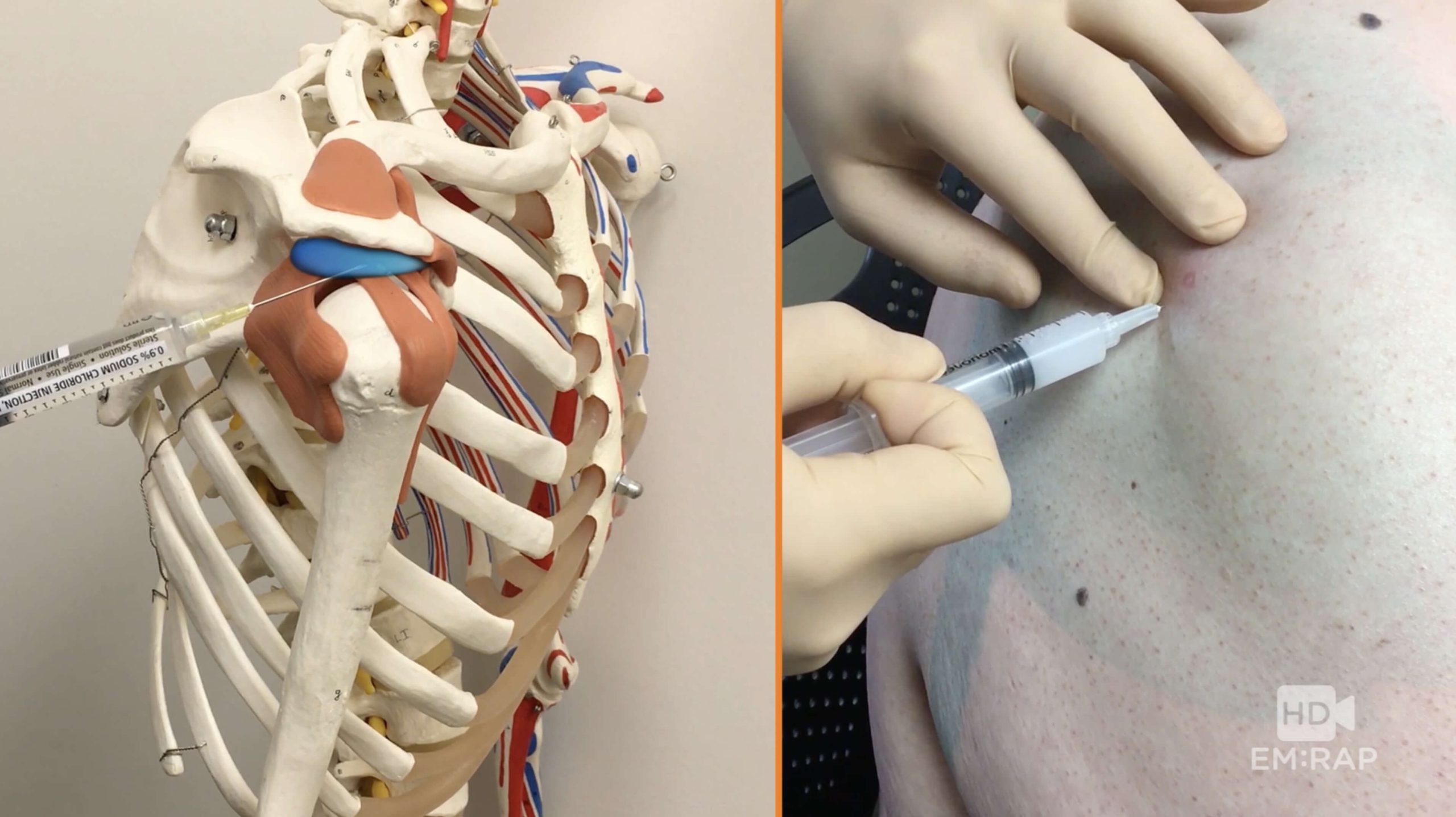
subacromial injection technique

Position:

Comfortably seated with the arm at the side and the hands resting on the lap.

Posterior approach:

  1. Identify posterolateral corner of the acromion.
  2. The needle should be inserted just inferior and lateral to the posterolateral corner of the acromion aiming slightly up and medial, toward the acromioclavicular joint.
  3. The needle should be felt to pass just beneath the acromion, and when placed within the bursa, it should be possible to gently sweep medial and lateral with little resistance.
  4. Aspirate prior to injection
  5. Fluid should flow freely into the bursal space when injecting, if not the needle is withdraw slightly to remove its tip from soft tissue while injecting.

Lateral approach:

  1. Identify and mark inferolateral margin of acronion.
  2. The needle should be inserted 1-1.5 inches below the middle of the acromion aiming slightly upwards. If the humeral head is contacted, withdraw and reinsert in a more superior direction.
  3. Direct the needle perpendicularly until the bone is reached and withdraw the needle 1-2 mm. At approximately 1 inch deep, needle should be in the subacromial bursa. To aim around supraspinatus tendon, position the needle over the anterior edge of the acromion.
  4. As in posterior approach, confirm the position of needle by aspirating and feeling of no resistance while injecting.
  • Facebook
  • Twitter
Clinical Skills and Approaches Musculoskeletal systemOrthopedicsProcedures

Post navigation

Previous post
Next post

Related Posts

Clinical Skills and Approaches relative bradycardia enteric fever

Relative Bradycardia

Nov 1, 2017

Synonyms: Faget sign, Sphygmo-thermic dissociation, Sphygmo-thermal dissociation Definition of Relative Bradycardia Physiologically, for each 1 °F rise in body temperature, there is a commensurate increase in the heart rate of 10 beats/min . When temperature elevations are not accompanied by a physiologic increase in the pulse, the patient is said…

Read More
Clinical Skills and Approaches

Eliciting Primitive Neonatal Reflexes

Mar 8, 2023Mar 8, 2023

Neonatal reflexes are the reflexes which are present at birth and have a predictable course of appearance and disappearance. A normally developing newborn should respond to certain stimuli with these reflexes, which eventually become inhibited as the child matures. The list of reflexes that can be elicited in normal newborn…

Read More
Clinical Skills and Approaches

Digital Clubbing

Dec 15, 2013Oct 8, 2023

Synonyms: Hippocratic fingers, Acropachy, Dysacromelia, Drumstick fingers, Watch glass nails, Parrot beak fingers, Serpent head nails, Lovibond’s sign Definition Focal and bulbous enlargement of the distal phalanges due to proliferation of connective tissue between the fingernail and the bone with increase in both the longitudinal and transverse curvatures of the…

Read More

Leave a Reply Cancel reply

Your email address will not be published. Required fields are marked *

This site uses Akismet to reduce spam. Learn how your comment data is processed.

Pre-clinical (Basic Sciences)

Anatomy

Biochemistry

Community medicine (PSM)

Embryology

Microbiology

Pathology

Pharmacology

Physiology

Clinical Sciences

Anesthesia

Dermatology

Emergency medicine

Forensic

Internal medicine

Gynecology & Obstetrics

Oncology

Ophthalmology

Orthopedics

Otorhinolaryngology (ENT)

Pediatrics

Psychiatry

Radiology

Surgery

RSS Ask Epomedicine

  • What to study for Clinical examination in Orthopedics?
  • What is the mechanism of AVNRT?

Epomedicine weekly

  • About Epomedicine
  • Contact Us
  • Author Guidelines
  • Submit Article
  • Editorial Board
  • USMLE
  • MRCS
  • Thesis
©2026 Epomedicine | WordPress Theme by SuperbThemes