Skip to content
Epomedicine

Mnemonics, Simplified Concepts & Thoughts

Epomedicine

Mnemonics, Simplified Concepts & Thoughts

New Ballard Score: How to use it correctly?

Dr. Pedchrome, Sep 18, 2019Jan 11, 2022

Assessment of gestational age can be made postnatally by either Dubowitz Score or New Ballard Scoring system. In sick infants, examination of Anterior lens canpsule vascularity with a +20D lens can be useful in assessing gestation and it needs to be carried out within 24 hours of birth.

Dr Jeanne L Ballard developed a scoring system based on neurological maturity and physical maturity to assess gestational age of babies. We are all well aware of the charts and scoring system but still many of us are not able to score appropriately and assign gestation age accurately.

Here is the chart –
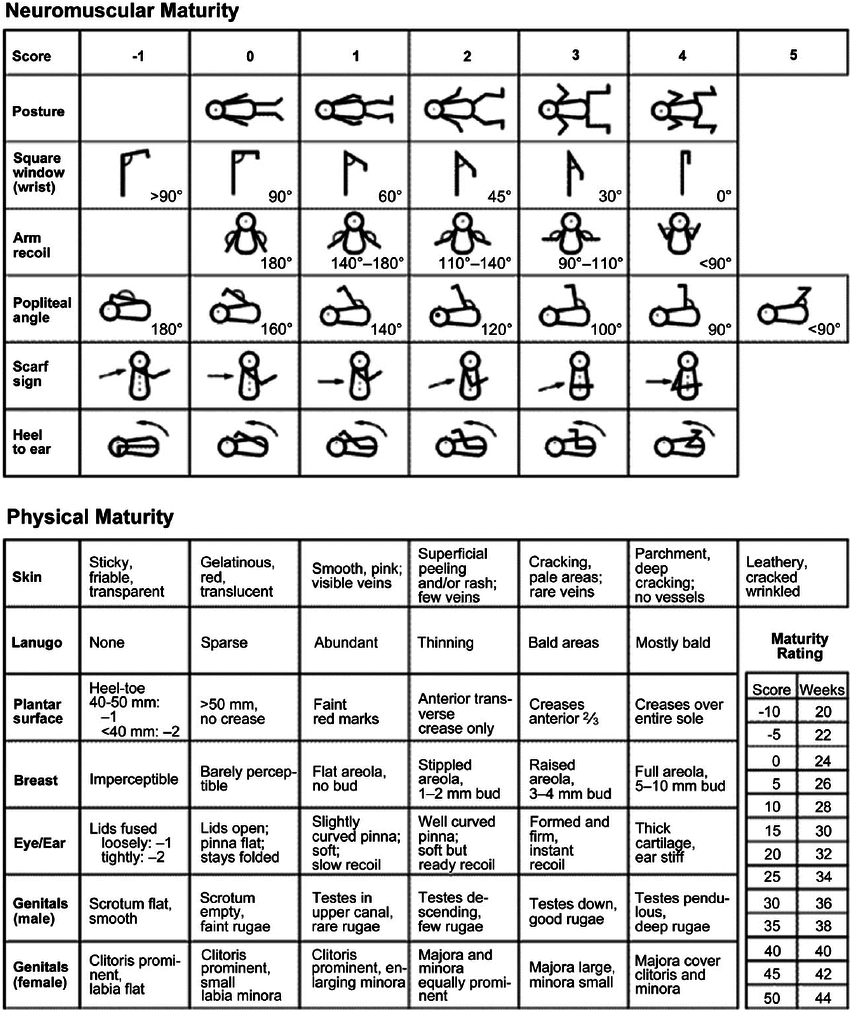
You can use online calculator as well.

The video below demonstrates the procedure of assessment.

When is the appropriate time to perform New Ballard score?

Performed between 30 minutes to 96 hours, ideally within 24 hours. However, studies have debated its validity up to 7 days.
For preterm babies < 26 weeks, it must be done in first 24 hours because on second day babies may suffer from consequences of prematurity.

In such a case, you have two options: Perform the remainder of the neuromuscular criteria, then assign a similar score to the popliteal angle and heel to ear. Wait 24 to 48 hours or until flexor tone has returned to the hamstrings and gluteus muscles, and repeat the assessment. For breech deliveries, there may be flexor fatigue in 1st 24 hours so, NBS is performed after 24-48 hours to avoid lower score for lower limbs.

Assigning score and gestational age

For scores between numbers on the grid, we interpolate as follows:
25 = 34 weeks
26 = 34 weeks
27 = 34 weeks
28 = 35 weeks
29 = 35 weeks
30 = 36 weeks

Record only completed weeks of gestation and not partial weeks.
If weeks by exam fall within 2 weeks of KNOWN maternal dates, preferably confirmed by early ultrasound, then the maternal dates are more likely correct.

If weeks by exam are greater than 2 weeks outside of maternal dates in either direction, then the clinical gestational assessment is more likely correct.

References:

New Ballard Score, expanded to include extremely premature infants. Ballard JL et Al. http://www.ballardscore.com/

Essential Neonatology- Mathur Validity of New Ballard Score until 7th day of postnatal life in moderately preterm neonates. Sasidharan K et Al

Pediatric doctor
Dr. Pedchrome

MD Pediatrics and Fellowship Neonatology, he chooses to stay anonymous. He often writes his views online as well as share few important topics for medical students, doctors and specially parents. He does research in pediatrics.
1 shares
  • Facebook
  • Twitter
Clinical Skills and Approaches Clinical examinationNeonatesPediatrics

Post navigation

Previous post
Next post

Related Posts

Clinical Skills and Approaches bedbug diseases

Medical Significance of Bedbugs

Sep 1, 2017Oct 26, 2022

Two species of bedbugs bite people: the common bedbug (Cimex lenticularis) and the tropical bedbug (Cimex hemipterous). These bugs are called udus (उडुस) in Nepali and khatmal (खटमल) in Hindi language. The adult bedbug is the approximate size, shape, and color of an apple seed. They are more commonly associated…

Read More
Clinical Skills and Approaches stethoscope murmur

Murmurs Made Easy

Jun 5, 2019May 20, 2023

Mnemonic: SSSS Stenotic lesion of Semilunar valve and Septal defect cause Systolic murmur. From this, you should also be able to remember that regurgitant lesions of semilunar valve causes Diastolic murmur. The stenotic lesions of atrio-ventricular valve causes diastolic murmur and regurgitant lesions cause systolic murmur. Causes of systolic murmur:…

Read More
Clinical Skills and Approaches

Bulbocavernosus Reflex (BCR)

Jun 14, 2020Jun 14, 2020

Synonyms: Bulbospongiosus reflex (BSR), Osinski reflex Reflex arc: a. Stimulus: Briskly squeezing glans penis or clitoris or Tugging Foley’s catheter (pulling the balloon of foley’s catheter against the bladder neck) b. Afferent: Sensory fibers of pudendal nerve c. Reflex center: S2-S4 spinal segments (Polysynaptic) d. Efferent: Motor fibers of pudendal…

Read More

Leave a Reply Cancel reply

Your email address will not be published. Required fields are marked *

This site uses Akismet to reduce spam. Learn how your comment data is processed.

Pre-clinical (Basic Sciences)

Anatomy

Biochemistry

Community medicine (PSM)

Embryology

Microbiology

Pathology

Pharmacology

Physiology

Clinical Sciences

Anesthesia

Dermatology

Emergency medicine

Forensic

Internal medicine

Gynecology & Obstetrics

Oncology

Ophthalmology

Orthopedics

Otorhinolaryngology (ENT)

Pediatrics

Psychiatry

Radiology

Surgery

RSS Ask Epomedicine

  • What to study for Clinical examination in Orthopedics?
  • What is the mechanism of AVNRT?

Epomedicine weekly

  • About Epomedicine
  • Contact Us
  • Author Guidelines
  • Submit Article
  • Editorial Board
  • USMLE
  • MRCS
  • Thesis
©2026 Epomedicine | WordPress Theme by SuperbThemes