Skip to content
Epomedicine

Mnemonics, Simplified Concepts & Thoughts

Epomedicine

Mnemonics, Simplified Concepts & Thoughts

Intramedullary Nail Dynamization

Dr. Sulabh Kumar Shrestha, MS Orthopedics, Apr 29, 2025Apr 29, 2025

Dynamization of intramedullary nail is the process of converting a static interlocking nail (provides better fixation & rotational control) to a dynamic locking nail (allows axial loading of fracture to stimulate bone healing). Dynamization converts a bridging mode of fixation to the splinting mode.

  • Static locking: nail is locked on both cortices using screw, so that there is no relative movement between bone and nail
  • Dynamic locking: nail is locked only on distal cortex using screw and the nail will just telescope through the proximal medulla till the fracture fragments are brought together

Timing of Dynamization: Dynamization should be performed when the fracture and the newly formed callus have gained enough stability to withstand axial forces without collapse, usually 2-3 months after the initial fixation. If there is any inherent risk of shortening, dynamization should be postponed.

Indication of Dynamization: It is no longer a standard practice to dynamize the statically locked intramedullary nail if the healing is progressing normally. It is indicated when there is delay in healing and there is risk of development of nonunion or in cases of established pseudoarthrosis.
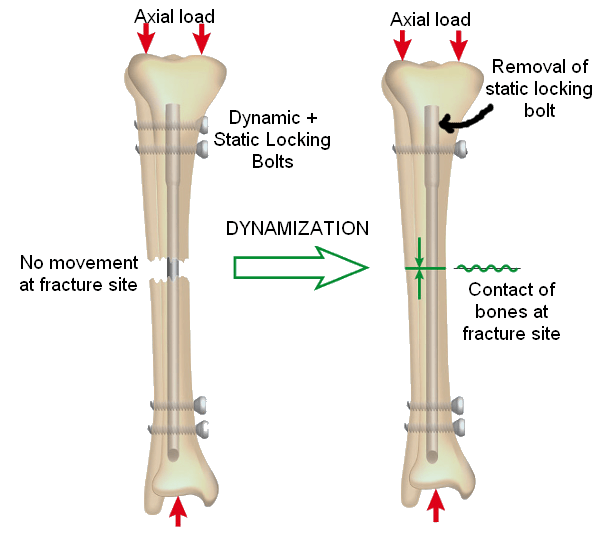
Nail dynamization

Technique of Nail Dynamization:

1. Removing the proximal static locking screw (In nails with dynamic slots): In modern nails, there are 2 proximal slots – oval one for dynamic locking and round one for static locking. Removing the static locking screw proximally will allow the proximal fragment to telescope under the limits allowed by dynamic (oval) slot while providing rotational stability which is usually adequate for bone contact.

2. Removing the screws from longer segment or farthest from fracture (In nails with only static slots): Screws are removed from longer segment to maintain adequate control of the shorter fragment.

Associated risk of dynamization: Premature dynamization may cause shortening, instability and non-union.

References:

  1. The elements of fracture fixation, 4th edition – Anand J Thakur
  2. Diagnostic imaging of musculoskeletal diseases – Akbar Bonakdarpour, William R. Reinus, Jasvir S. Khurana
  3. Current Practice of Fracture Treatment – P.C. Leung

dr. sulabh kumar shrestha
Dr. Sulabh Kumar Shrestha, MS Orthopedics

He is the section editor of Orthopedics in Epomedicine. He searches for and share simpler ways to make complicated medical topics simple. He also loves writing poetry, listening and playing music. He is currently pursuing Fellowship in Hip, Pelvi-acetabulum and Arthroplasty at B&B Hospital.

  • Facebook
  • Twitter
Surgical Skills Orthopedics

Post navigation

Previous post
Next post

Related Posts

Surgical Skills DCR

External Dacryocystorhinostomy (DCR)

Dec 18, 2013May 31, 2020

Definition External Dacryocystorhinostomy (DCR) is the surgery to connect the mucosal surface of lacrimal sac to the nasal mucosa by removing the intervening bone. It creates a permanent anastomosis between the lacrimal sac and medial meatus of nose. Prerequisite Common canaliculi must be patent Indications of External Dacryocystorhinostomy Nasolacrimal duct…

Read More
Surgical Skills

Orthopedic Screw Insertion Mnemonic

Dec 18, 2021Jan 20, 2024

Don’t Marry Too Soon DRILL Choose the correct drill bit Insert the drill bit correctly in the chuck Tighten the chuck sufficiently Start the drill home perpendicular to the surface Maintain adequate pressure Maintain the proper direction Irrigation with normal saline should be commenced simultaneously with drilling Keep the drill…

Read More
Surgical Skills

Krackow Suture Technique

Apr 9, 2022Dec 20, 2025

The Krackow technique is a continuous locking loop suture technique commonly used in tendon repair. The classic Krackow stitch involves 3 or more locking loops placed along each side of the ligament or tendon. Starting point: 1 cm from the tendon end Suture pitch: 5 mm (space the loops 5…

Read More

Leave a Reply Cancel reply

Your email address will not be published. Required fields are marked *

This site uses Akismet to reduce spam. Learn how your comment data is processed.

Shrestha SK. Intramedullary Nail Dynamization [Internet]. Epomedicine; 2025 Apr 29 [cited 2026 Jan 21]. Available from: https://epomedicine.com/surgical-skills/intramedullary-nail-dynamization/.

Pre-clinical (Basic Sciences)

Anatomy

Biochemistry

Community medicine (PSM)

Embryology

Microbiology

Pathology

Pharmacology

Physiology

Clinical Sciences

Anesthesia

Dermatology

Emergency medicine

Forensic

Internal medicine

Gynecology & Obstetrics

Oncology

Ophthalmology

Orthopedics

Otorhinolaryngology (ENT)

Pediatrics

Psychiatry

Radiology

Surgery

RSS Ask Epomedicine

  • What to study for Clinical examination in Orthopedics?
  • What is the mechanism of AVNRT?

Epomedicine weekly

  • About Epomedicine
  • Contact Us
  • Author Guidelines
  • Submit Article
  • Editorial Board
  • USMLE
  • MRCS
  • Thesis
©2026 Epomedicine . All rights reserved.