Skip to content
Epomedicine

Mnemonics, Simplified Concepts & Thoughts

Epomedicine

Mnemonics, Simplified Concepts & Thoughts

Eponychial Marsupialization for Chronic Paronychia

Epomedicine, Apr 27, 2025Apr 27, 2025

Chronic paronychia is an inflammatory recalcitrant disorder affecting the nail folds. It can be defined as an inflammation lasting for more than 6 weeks and involving one or more of the three nail folds (one proximal and two lateral).

Surgical management is only indicated in cases of chronic paronychia, which does not respond to medical management and proper use of general measures. Surgical treatment is required in such cases to remove the chronically inflamed tissue, which aids in effective penetration of topical as well as oral medications and regeneration of the cuticle.

Technique of Eponychial Marsupialization
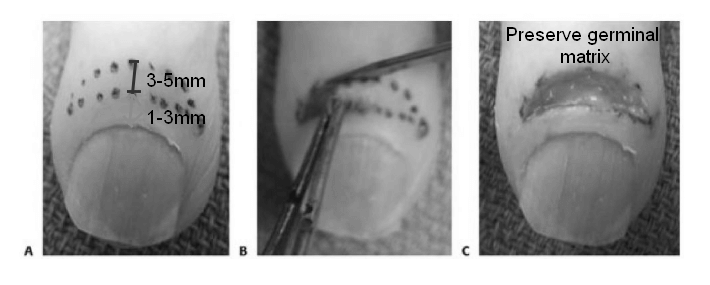
eponychial marsupialization

Anesthesia: Digital nerve block

Incision: Make a crescent shaped incision 1-3mm proximal to the eponychial fold, extending 3-5 mm proximally (at its largest point) and extending to edge of each nail fold

Excision: Excise the tissue, taking care not to damage the underlying germinal matrix

Nail plate removal: Should only be done when there is concurrent nail irregularities.

  • Eponychial marsupialization only drains the dorsal surface of the dorsal roof of germinal matrix
  • Nail removal more thoroughly debrides the entire nail fold by permitting drainage of the volar portion of the dorsal roof as well as the ventral floor

Dressing: Irrigate and dress the wound appropriately. Allow the wound to heal by secondary intention.

This procedure exteriorizes the infected and obstructed nail matrix and allows its drainage. Epithelialization of the excised defect occurs over the next 2-3 weeks.

  • Facebook
  • Twitter
Surgical Skills OrthopedicsPlastic surgerySurgical skills

Post navigation

Previous post
Next post

Related Posts

Surgical Skills

Surgical Sutures – Basics

Sep 17, 2020Mar 5, 2024

Monofilament Polyfilament Absorbable Caprosyn (Polyglytone 621)Monocryl (Polyglecaprone 25)Biosyn (Polyglecaprone CV-23)Maxon (Polytrimethylate carbon)PDS (Polydiaxonone) CatgutVicryl rapide (Polyglactin 910 rapide)Vicryl (Polyglactin 910)Dexon (Polyglycolic acid) Non-absorbable NylonEthilon (Monofilament polyamide)Prolene (Polypropylene) SilkDacronEthibond (Polyester)Braided nylon (Surgilon, Nurolon)Supramid Monofilament sutures: Polyfilament/Multifilament sutures: Natural sutures: Synthetic sutures: Absorbability: There are 2 principal methods, by which the sutures…

Read More
Surgical Skills Pterygium excsion bare sclera

Pterygium Excision

Jun 2, 2014May 31, 2020

Indications for surgery: 1. Reduced vision secondary to: Threatens visual axis: Pterygium advancing toward or already impinging visual axis Induced astigmatism: Due to flattening of meridian of pterygium by fibrosis in atrophic stage 2. Cosmesis 3. Significant discomfort not relieved by medical therapy 4. Diplopia: Resulting from limited ocular motility…

Read More
Surgical Skills

Intramedullary Nail Dynamization

Apr 29, 2025Apr 29, 2025

Dynamization of intramedullary nail is the process of converting a static interlocking nail (provides better fixation & rotational control) to a dynamic locking nail (allows axial loading of fracture to stimulate bone healing). Dynamization converts a bridging mode of fixation to the splinting mode. Timing of Dynamization: Dynamization should be…

Read More

Leave a Reply Cancel reply

Your email address will not be published. Required fields are marked *

This site uses Akismet to reduce spam. Learn how your comment data is processed.

Epomedicine. Eponychial Marsupialization for Chronic Paronychia [Internet]. Epomedicine; 2025 Apr 27 [cited 2025 Dec 6]. Available from: https://epomedicine.com/surgical-skills/eponychial-marsupialization-for-chronic-paronychia/.

Pre-clinical (Basic Sciences)

Anatomy

Biochemistry

Community medicine (PSM)

Embryology

Microbiology

Pathology

Pharmacology

Physiology

Clinical Sciences

Anesthesia

Dermatology

Emergency medicine

Forensic

Internal medicine

Gynecology & Obstetrics

Oncology

Ophthalmology

Orthopedics

Otorhinolaryngology (ENT)

Pediatrics

Psychiatry

Radiology

Surgery

RSS Ask Epomedicine

  • What to study for Clinical examination in Orthopedics?
  • What is the mechanism of AVNRT?

Epomedicine weekly

  • About Epomedicine
  • Contact Us
  • Author Guidelines
  • Submit Article
  • Editorial Board
  • USMLE
  • MRCS
  • Thesis
©2025 Epomedicine . All rights reserved.