Skip to content
Epomedicine

Mnemonics, Simplified Concepts & Thoughts

Epomedicine

Mnemonics, Simplified Concepts & Thoughts

Corner Stitch

Epomedicine, Oct 5, 2020Oct 5, 2020

Synonym: Half-buried horizontal mattress suture

Indications: V, Y or X-pattern laceration repair

Risk: Dermal stitch may be placed too close to the tip of the flap and compromise the tenuous blood supply

Suture: Non-absorbable

Principle: When repairing, this stitch must be placed first

Landmark sites (2 on each site of wound):

  1. Point 1 along left base of Y (6-8 mm from corner)
  2. Point 2 at left upper arm of Y (4 mm from corner)
  3. Point 3 at right upper arm of Y (4 mm from corner)
  4. Point 4 along right base of Y (6-8 mm from corner)
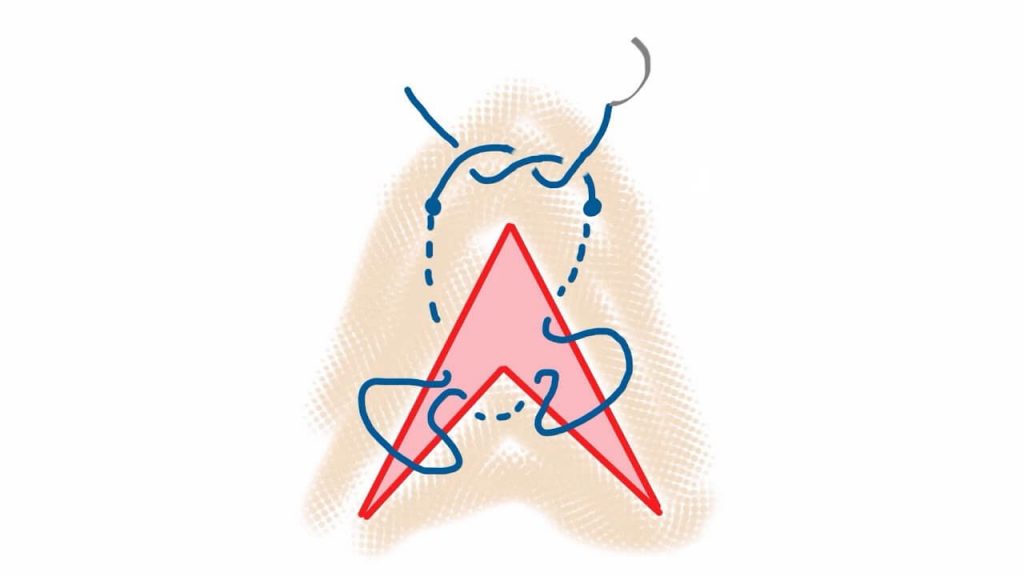
corner stitch

Technique:

  1. Enter Point 1 (Dermis to Epidermis)
  2. Enter Point 2 (Subcuticular)
  3. Enter Point 3 (Subcuticular)
  4. Enter Point 4 (Dermis to Epidermis)
  5. Square knot across the base of Y (knot is placed in front of the tip of the apex).

Further reading: Modifications of Corner-stitch
  • Facebook
  • Twitter
Surgical Skills Surgical skills

Post navigation

Previous post
Next post

Related Posts

Surgical Skills

Running subcuticular suturing

Feb 9, 2023Feb 10, 2023

1. Start with a buried knot at distal apex of the wound. 2. Take a bite deep to the epidermis that should curve parallel to the skin surface and exit in the same plane approximately 5-10mm along the wound, taking care to stay at the same level. 3. Continue step…

Read More
Surgical Skills

Krackow Suture Technique

Apr 9, 2022Dec 20, 2025

The Krackow technique is a continuous locking loop suture technique commonly used in tendon repair. The classic Krackow stitch involves 3 or more locking loops placed along each side of the ligament or tendon. Starting point: 1 cm from the tendon end Suture pitch: 5 mm (space the loops 5…

Read More
Surgical Skills

Swashbuckler (Modified Anterolateral) Approach to Distal Femur

Jul 9, 2024Jul 9, 2024

Advantages: Patient position: Supine with a roll under the knee to allow knee flexion Tourniquet: Not used unless required Incision: Superficial dissection: 1. Fascia is incised in line of incision & sharply dissected off the vastus lateralis muscle laterally to its inclusion with the iliotibial band, to expose the quadriceps…

Read More

Leave a Reply Cancel reply

Your email address will not be published. Required fields are marked *

This site uses Akismet to reduce spam. Learn how your comment data is processed.

Pre-clinical (Basic Sciences)

Anatomy

Biochemistry

Community medicine (PSM)

Embryology

Microbiology

Pathology

Pharmacology

Physiology

Clinical Sciences

Anesthesia

Dermatology

Emergency medicine

Forensic

Internal medicine

Gynecology & Obstetrics

Oncology

Ophthalmology

Orthopedics

Otorhinolaryngology (ENT)

Pediatrics

Psychiatry

Radiology

Surgery

RSS Ask Epomedicine

  • What to study for Clinical examination in Orthopedics?
  • What is the mechanism of AVNRT?

Epomedicine weekly

  • About Epomedicine
  • Contact Us
  • Author Guidelines
  • Submit Article
  • Editorial Board
  • USMLE
  • MRCS
  • Thesis
©2026 Epomedicine | WordPress Theme by SuperbThemes