Skip to content
Epomedicine

Mnemonics, Simplified Concepts & Thoughts

Epomedicine

Mnemonics, Simplified Concepts & Thoughts

Juncturae Tendinum

Epomedicine, Oct 5, 2020Oct 5, 2020

Synonyms: Connexus intertendinei, Intertendinous connections

Plural: Juncturae tendinae

Location: Intermetacarpal spaces in dorsum of hand between the extensor digitorum tendons

Morphologic types:

The usual pattern is that it gets thicker from radial to ulnar side.
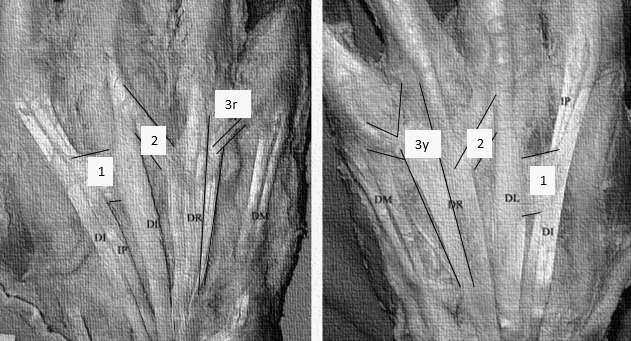
juncturae tendinum
  1. Type 1: Thin filamentous (square, rhomboidal or triangular) – present only in 2nd metacarpal space
  2. Type 2: Thicker rhomboidal and more distally located than type I – present only in 2nd and 3rd metacarpal spaces
  3. Type 3: Tendon slips (longest, narrowest and thickest) – occur in 3nd and 4th intermetacarpal spaces (most common in 4th intermetacarpal space)
    • 3y: splits into 2 equal halves and insert into adjacent tendons (present only in 3rd and 4th metacarpal spaces
    • 3r: more oblique (present only in 3rd and 4th metacarpal spaces)

Clinical relevance

1. EIP doesn’t have junctura tendinum (identification point)

2. Lacertation of middle finger communis tendon over metacarpal just proximal to junctura may result in only partial extension loss of middle finger

Reference:

  1. Surgical Anatomy of the Hand and Upper Extremity edited by James R. Doyle
  2. Campbell’s Operative Orthopedics – 13th Edition
  • Facebook
  • Twitter
PGMEE, MRCS, USMLE, MBBS, MD/MS Musculoskeletal systemOrthopedics

Post navigation

Previous post
Next post

Related Posts

PGMEE, MRCS, USMLE, MBBS, MD/MS

Hawkin’s Classification for Talus Fractures : Mnemonic

Jun 28, 2022

Mnemonic: NISA 10-50-90-100 Type I – Non-displaced Neck fracture (upto 10% risk of AVN) 1 blood vessel damaged (entering talar neck) Management: 8 weeks in cast and 4 weeks in CAM cast Type II – Type I + Inferior (subtalar) subluxation/dislocation (upto 50% risk of AVN) 2 blood vessels damaged…

Read More
PGMEE, MRCS, USMLE, MBBS, MD/MS

Cervical Vertebrae Anatomy

May 4, 2024May 4, 2024

Osteology Vertebra Body Spinous process Transverse process Typical (C3-6) Relatively small; oval; uncinate process superiorly Bifid Has foramen transversarium, Has anterior and posterior tubercle separated by groove for spinal nerve (large anterior tubercle in C6 called Carotid/Chassaignac tubercle) Atlas (C1) None; Ring (2 lateral masses connected by anterior & posterior…

Read More
PGMEE, MRCS, USMLE, MBBS, MD/MS

HIV Replication and Antiretroviral Drugs

Aug 15, 2023

HIV Replication and Antiretroviral Mechanism of Action Mnemonic: AFRITAB 1. Attachment (to CD4 cells) 2. Fusion (enters CD4 cells and dump it’s contents – RNA and reverse transcriptase) 3. Reverse transcription (1 strand RNA becomes 2 strand DNA) 4. Integration (HIV DNA integrates into human’s CD4 cell’s DNA) 5. Transcription…

Read More

Leave a Reply Cancel reply

Your email address will not be published. Required fields are marked *

This site uses Akismet to reduce spam. Learn how your comment data is processed.

Pre-clinical (Basic Sciences)

Anatomy

Biochemistry

Community medicine (PSM)

Embryology

Microbiology

Pathology

Pharmacology

Physiology

Clinical Sciences

Anesthesia

Dermatology

Emergency medicine

Forensic

Internal medicine

Gynecology & Obstetrics

Oncology

Ophthalmology

Orthopedics

Otorhinolaryngology (ENT)

Pediatrics

Psychiatry

Radiology

Surgery

RSS Ask Epomedicine

  • What to study for Clinical examination in Orthopedics?
  • What is the mechanism of AVNRT?

Epomedicine weekly

  • About Epomedicine
  • Contact Us
  • Author Guidelines
  • Submit Article
  • Editorial Board
  • USMLE
  • MRCS
  • Thesis
©2026 Epomedicine | WordPress Theme by SuperbThemes