Skip to content
Epomedicine

Mnemonics, Simplified Concepts & Thoughts

Epomedicine

Mnemonics, Simplified Concepts & Thoughts

Wound Healing : Stages

Epomedicine, Aug 5, 2020Aug 5, 2020
wound healing phases

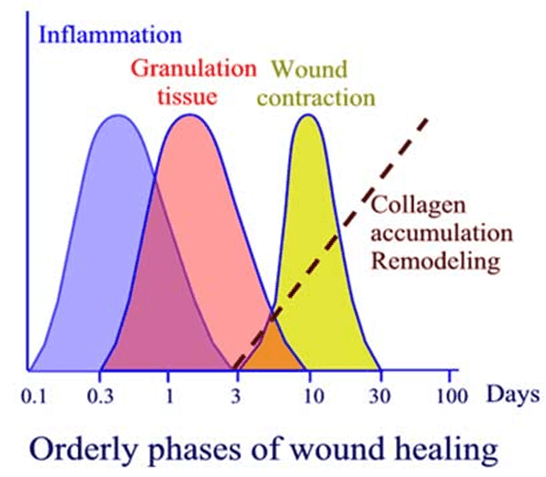
1. Haemostasis (immediate): In response to exposed collagen, platelets aggregate at the wound and degranulate, releasing inflammatory mediators. Clotting and complement cascades activated. Thrombus  formation and reactive vasospasm achieve haemostasis.

2. Inflammation (0-3 days): Vasodilatation and increased capillary permeability allow inflammatory cells to enter wound, and cause swelling. Neutrophils amplify inflammatory response by release of cytokines; reduce infection by bacterial killing; and debride damaged tissue. Macrophages follow and secrete cytokines, growth factors, and collagenases. They phagocytose bacteria and dead tissue and orchestrate fibroblast migration, proliferation, and collagen production.

3. Proliferation (3 days-3 weeks): Fibroblasts migrate into the wound and synthesize collagen. Specialized myofibroblasts containing actin cause wound contraction. Angiogenesis is stimulated by hypoxia and cytokines and granulation tissue forms

4. Remodelling (3 weeks-1 year): Re-orientation and maturation of collagen fibres increases wound strength.

Reference: Oxford Handbook of Clinical Surgery

Points to remember:
Maximum collagen production occurs at 20 days
Maximum wound strength at 3 to 6 months
  • Facebook
  • Twitter
PGMEE, MRCS, USMLE, MBBS, MD/MS General SurgeryPathology

Post navigation

Previous post
Next post

Related Posts

PGMEE, MRCS, USMLE, MBBS, MD/MS

Glucagonoma : 6 D’s

Jun 18, 2023Jun 18, 2023

Glucagonoma is an alpha-cell tumor of pancreas. Mnemonic: 6 D’s 1. Diabetes 2. Dermatitis (Necrolytic migratory erythema) 3. Declining weight 4. Diarrhea 5. Deep vein thrombosis 6. Dilated cardiomyopathy

Read More
PGMEE, MRCS, USMLE, MBBS, MD/MS internal capsule

Internal Capsule Simplified

Jul 30, 2016

Internal Capsule is a “boomerang” shaped (on horizontal section) and “funnel” shaped, i.e. tapering from superior to inferior (on sagittal section) white matter structure sandwiched between: Medially: Head of Caudate nucleus and Thalamus Laterally: Lenticular nucleus (Globus pallidus and Putamen) Parts of Internal Capsule 1. Anterior limb: Carries fibers to…

Read More
PGMEE, MRCS, USMLE, MBBS, MD/MS hypothalamus hunger satiety

Orexigenic and Anti-orexigenic peptides : Mnemonic

Jul 28, 2018

Orexigenic (Appetite stimulant) peptides Mnemonic: When you see MANGOEs, you feel like eating. MCH (Melanocyte Conentrating Hormone) AGRP (Agouti Related Peptide) NPY (Neuropeptide Y), Noradrenaline GnRH, GABA, Galanin, Ghrelin Orexins A and B Endorphins, Endocannabinoids Anti-orexigenic (Appetite supressant) peptides Mnemonic: NO BLACk PIGS Neurotensin Oxytocin, Oxyntomodulin Bombesin Leptin Alpha-MSH (POMC derivative), Amylin,…

Read More

Leave a Reply Cancel reply

Your email address will not be published. Required fields are marked *

This site uses Akismet to reduce spam. Learn how your comment data is processed.

Epomedicine. Wound Healing : Stages [Internet]. Epomedicine; 2020 Aug 5 [cited 2025 Dec 21]. Available from: https://epomedicine.com/medical-students/wound-healing-stages/.

Pre-clinical (Basic Sciences)

Anatomy

Biochemistry

Community medicine (PSM)

Embryology

Microbiology

Pathology

Pharmacology

Physiology

Clinical Sciences

Anesthesia

Dermatology

Emergency medicine

Forensic

Internal medicine

Gynecology & Obstetrics

Oncology

Ophthalmology

Orthopedics

Otorhinolaryngology (ENT)

Pediatrics

Psychiatry

Radiology

Surgery

RSS Ask Epomedicine

  • What to study for Clinical examination in Orthopedics?
  • What is the mechanism of AVNRT?

Epomedicine weekly

  • About Epomedicine
  • Contact Us
  • Author Guidelines
  • Submit Article
  • Editorial Board
  • USMLE
  • MRCS
  • Thesis
©2025 Epomedicine . All rights reserved.