Skip to content
Epomedicine

Mnemonics, Simplified Concepts & Thoughts

Epomedicine

Mnemonics, Simplified Concepts & Thoughts

visual cycle

Visual cycle – Simplified

Dr. Sulabh Kumar Shrestha, MS Orthopedics, May 31, 2019May 31, 2019

11-cis-retinal combines with opsin protein to form rhodopsin. Light stimulates conversion of rhodopsin bound 11-cis-retinal to all-trans-retinol (all-trans-retinol is transported from photoreceptor cells to retinal pigment epithelium), which subsequently dissociates from opsin (bleaching), leading to membrane depolarization and initiation of action potential in photoreceptors in the neural retina.
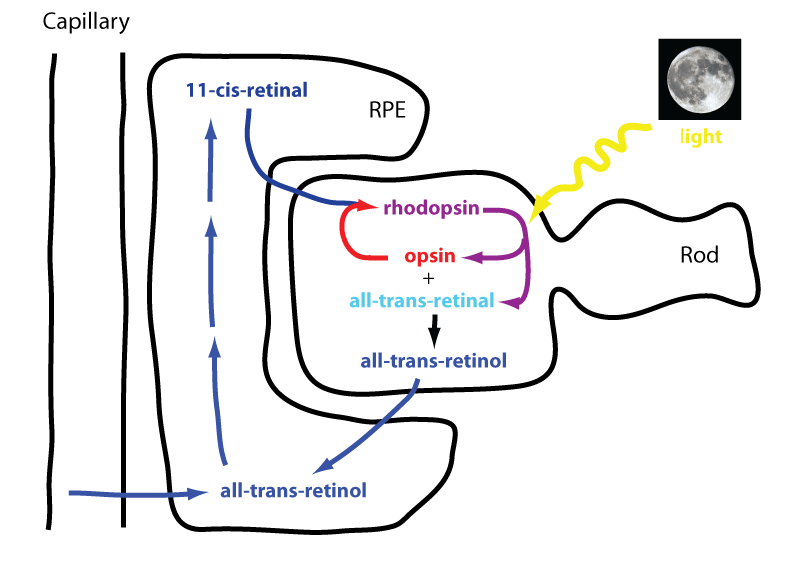
From: https://www.d.umn.edu/~jfitzake/Lectures/DMED/Vision/Retina/VisualCycle.html

Once in the RPE cell, the all-trans-retinal is either stored or converted back to the 11-cis-retinal form for transport back to the photoreceptors, completing the visual cycle. Recycling of rhodopsin is a key component of dark adaptation.

11-cis-retinal cannot be synthesized de novo by humans, but must be converted from vitamin A (deficiency leads to night blindness).

Study details of 10 layers of retina and process of phototransduction.

Mnemonics:

LighT phase: aLL Trans-retinal with opsin
dark phase: 11 cis-retinal with opsin
Dark: Depolarization of photoreceptor (Displays inhibitory neurotransmitters and hyperpolarizes bipolar cells)
ligHt: Hyperpolarization of photoreceptor (Hides inhibitory neurotransmitters and depolarizes bipolar cells)

Mnemonics adapted from Ophthalmonics by Dhaval Patel, MD.

dr. sulabh kumar shrestha
Dr. Sulabh Kumar Shrestha, MS Orthopedics

He is the section editor of Orthopedics in Epomedicine. He searches for and share simpler ways to make complicated medical topics simple. He also loves writing poetry, listening and playing music. He is currently pursuing Fellowship in Hip, Pelvi-acetabulum and Arthroplasty at B&B Hospital.
13 shares
  • Facebook13
  • Twitter
PGMEE, MRCS, USMLE, MBBS, MD/MS OphthalmologyPhysiology

Post navigation

Previous post
Next post

Related Posts

PGMEE, MRCS, USMLE, MBBS, MD/MS germ layer derivatives

Germ Layer Derivatives – Mnemonics

Jul 11, 2016Aug 13, 2023

Principle of Germ Layer Segmentation Ectoderm gives further rise to neuroectoderm and neural crest cells. Endoderm remains intact. Mesoderm gives further rise to paraxial mesoderm (somitomeres and 35 pairs of somites), intermediate mesoderm, and lateral mesoderm: General Rule for Germ Layer Derivatives Ectodermal derivatives: 1. Everything that makes you attractive: Skin, hair,…

Read More
PGMEE, MRCS, USMLE, MBBS, MD/MS cavernous sinus tributaries communications

Cavernous Sinus – Simplified

May 9, 2014Aug 22, 2023

Synonyms: Sinus cavernosus, Lateral sellar compartment Definition and Extent Size: 2 cm long and 1 cm wide Walls: Extent: Contents of Cavernous sinus These are closely related to the floor of sinus and are separated from the interior of sinus by endothelium. 4 nerves in the lateral wall: Note: Mandibular…

Read More
PGMEE, MRCS, USMLE, MBBS, MD/MS Visual field defect ethambutol

Ethambutol Induced Optic Neuropathy

Mar 27, 2017

Mechanism of Ethambutol induced optic neuropathy Ethambutol is metabolized to a chelating agent. The chelating agent formed then may impair the function of metal-containing mitochondiral enzymes, such as the copper containing cytochrome-c oxidase of complex IV and the iron containing NADH:Q oxidoreductase of complex I. These mitochondrial respiratory chain play…

Read More

Leave a Reply Cancel reply

Your email address will not be published. Required fields are marked *

This site uses Akismet to reduce spam. Learn how your comment data is processed.

Pre-clinical (Basic Sciences)

Anatomy

Biochemistry

Community medicine (PSM)

Embryology

Microbiology

Pathology

Pharmacology

Physiology

Clinical Sciences

Anesthesia

Dermatology

Emergency medicine

Forensic

Internal medicine

Gynecology & Obstetrics

Oncology

Ophthalmology

Orthopedics

Otorhinolaryngology (ENT)

Pediatrics

Psychiatry

Radiology

Surgery

RSS Ask Epomedicine

  • What to study for Clinical examination in Orthopedics?
  • What is the mechanism of AVNRT?

Epomedicine weekly

  • About Epomedicine
  • Contact Us
  • Author Guidelines
  • Submit Article
  • Editorial Board
  • USMLE
  • MRCS
  • Thesis
©2026 Epomedicine | WordPress Theme by SuperbThemes