Skip to content
Epomedicine

Mnemonics, Simplified Concepts & Thoughts

Epomedicine

Mnemonics, Simplified Concepts & Thoughts

Vesicoureteric reflux (VUR) Grading : Mnemonic

Epomedicine, Jun 26, 2024Jun 26, 2024

Mnemonic: Upset Kidneys Drink Their Pee

Grade 1: reflux up to Ureter (w/o dilation)

Grade 2: reflux up to Kidneys (w/o dilation)

Grade 3: Dilation (ureter/pelvis/calyces)

Grade 4: Tortuosity (and worse dilation)

Grade 5: Papillary impression loss

Source: Tweet from Ben Abelson
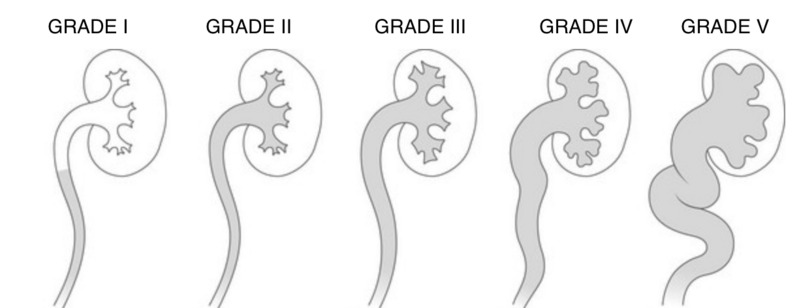
vur grading
Adityagupta95, CC0, via Wikimedia Commons
  • Facebook
  • Twitter
PGMEE, MRCS, USMLE, MBBS, MD/MS General SurgeryPediatricsRenal and Electroloyte

Post navigation

Previous post
Next post

Related Posts

PGMEE, MRCS, USMLE, MBBS, MD/MS Advanced glaucomatous changes diagram

Glaucomatous Optic Disc Changes Made Simple

May 3, 2014May 5, 2014

Optic disc changes in Glaucoma is one of the most frequently asked topics in Ophthalmology. However, students are often found to have difficulty in understanding and remembering them. Hence, I came up with an idea to illustrate them with schematic diagrams and mnemonics to simplify the topic. The diagrams are…

Read More
PGMEE, MRCS, USMLE, MBBS, MD/MS

Finger Extensor Apparatus – Simplified

Apr 26, 2020Oct 3, 2022

Synonyms: Extensor expansion, Extensor hood, Dorsal expansion, Dorsal hood, Dorsal aponeurosis Components: Extrinsic tendons Intrinsic tendons Soft-tissue stabilizing structures Extrinsic tendon Extensor Digitorum Communis (EDC; may be absent in little fingers) ± Extensor Indicis Proprius (EIP; usually ulnar to EDC) ± Extensor Digiti Minimi (EDM; ulnar to EDC) passes dorsally…

Read More
PGMEE, MRCS, USMLE, MBBS, MD/MS

Linea Aspera

Oct 26, 2022May 14, 2024

Linea aspera is a ridge of roughened surface on the posterior surface of the shaft of femur which serves as a site for attachment of muscles and intermuscular septum. The various structures attached to linea aspera can be remembered using few mnemonics: Mnemonic 1#: 1, 2, 3 It gives attachment…

Read More

Leave a Reply Cancel reply

Your email address will not be published. Required fields are marked *

This site uses Akismet to reduce spam. Learn how your comment data is processed.

Pre-clinical (Basic Sciences)

Anatomy

Biochemistry

Community medicine (PSM)

Embryology

Microbiology

Pathology

Pharmacology

Physiology

Clinical Sciences

Anesthesia

Dermatology

Emergency medicine

Forensic

Internal medicine

Gynecology & Obstetrics

Oncology

Ophthalmology

Orthopedics

Otorhinolaryngology (ENT)

Pediatrics

Psychiatry

Radiology

Surgery

RSS Ask Epomedicine

  • What to study for Clinical examination in Orthopedics?
  • What is the mechanism of AVNRT?

Epomedicine weekly

  • About Epomedicine
  • Contact Us
  • Author Guidelines
  • Submit Article
  • Editorial Board
  • USMLE
  • MRCS
  • Thesis
©2026 Epomedicine | WordPress Theme by SuperbThemes