Skip to content
Epomedicine

Mnemonics, Simplified Concepts & Thoughts

Epomedicine

Mnemonics, Simplified Concepts & Thoughts

Amylase and Lipase in Acute Pancreatitis

Epomedicine, Aug 28, 2019Aug 28, 2019
Amylase and Lipase
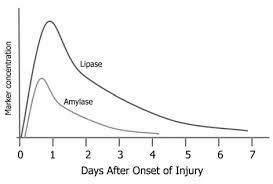
TestRisePeakReturn to baseline
Lipase4-6 hours488-14 days
Amylase2-4 hours24-485-7 days

Serum lipase elevation has a better diagnostic value as compared to serum amylase due to its superior specificity.  

Amylase has a low molecular weight and as a result can easily pass through the glomerulus into the urine.

Lipase and amylase levels have no role in determining the severity or prognosis of Acute Pancreatitis.

Greater the lipase: amylase ratio, the greater is the specificity of alcohol as the etiology of AP.

Potential advantages of serum lipase over serum amylase include a) slightly better specificity b) longer half life and hence greater sensitivity in patients who present late c) greater sensitivity for alcoholic pancreatitis.

In patients with hypertriglyceridemic Acute Pancreatitis, amylase is not significantly elevated. One of the possible explanations is that plasma triglyceride levels >500 mg/dL interfere with in vitro determination of the actual amylase level by preventing the calorimetric reading of the assay end point.

When compared to Acute Pancreatitis with elevated serum amylase, normoamylasemic pancreatitis was characterized by the following:

  1. Alcoholic etiology
  2. Greater number of previous attacks in alcoholic pancreatitis
  3. Longer duration of symptoms before admission

Non-pancreatic causes of raised amylase:

Mnemonic: AMyLASE

  1. Aortic aneurysm
  2. Macroamylasemia
  3. LOBE tumors (Lung, Ovary, Breast, Esophagus cancers)
  4. Acidosis (DKA), Acute renal failure
  5. Salivary gland disease
  6. Ectopic rupture, Esophageal perforation

Non-pancreatic causes of raised lipase:

Mnemonic: LIPASE

  1. Lipasemia (Macrolipasemia)
  2. Inflammatory bowel disease
  3. Peforated duodenum
  4. Acute cholecystitis
  5. Embolism (Fat), Extrahepatic biliary obstruction

References:

Jasdanwala S, Babyatsky M (2015) A critical evaluation of serum lipase and amylase as diagnostic tests for acute pancreatitis. Integr Mol Med 2: DOI: 10.15761/IMM.1000137

Clavien PA, Robert J, Meyer P, Borst F, Hauser H, Herrmann F, Dunand V, Rohner A. Acute pancreatitis and normoamylasemia. Not an uncommon combination. Ann Surg. 1989 Nov;210(5):614-20. doi: 10.1097/00000658-198911000-00008. PubMed PMID: 2479346; PubMed Central PMCID: PMC1357795.
2 shares
  • Facebook2
  • Twitter
PGMEE, MRCS, USMLE, MBBS, MD/MS BiochemistryGastrointestinal systemInternal medicinePediatrics

Post navigation

Previous post
Next post

Related Posts

PGMEE, MRCS, USMLE, MBBS, MD/MS

Neuroanatomy Notes

Sep 20, 2019Jul 25, 2021

This is a compilation of high yield topics on neuroanatomy with visual mnemonics and illustrations targeted for undergraduate medical students who find difficulty in conceptualizing the nervous system. Author: Dr. Sulabh Kumar Shrestha Key features: Covers clinically and academically important topics Schematic diagrams Visual mnemonics Useful for medical students, PG…

Read More
PGMEE, MRCS, USMLE, MBBS, MD/MS air bronchogram

Chest X-ray: Alveolar vs Interstitial Disease

Jun 19, 2015Jun 19, 2015

Interstitium is the scaffolding that supports the alveolar walls and surrounds both the alveoli and the terminal bronchioles. Neither alveoli nor interstitium is visible on a chest X-ray when normal. It is necessary to analyze whether the pattern of diffuse opacification in the lung field is alveolar or interstitial. Terms:…

Read More
PGMEE, MRCS, USMLE, MBBS, MD/MS voulantary horizontal conjugate gaze

Horizontal Conjugate Gaze Pathway

Jul 27, 2016May 19, 2019

Components of Pathway For both eyes to look at a side: Contralateral Frontal Eye Field (Brodmann area 8) Ipsilateral PPRF (Paramedial Pontine Reticular Formation) Ipsilateral CN VI Nucleus Contralateral Medial Longitudinal Fasciculus (MLF) Contralateral CN III Nucleus Horizontal Conjugate Gaze Pathway Lesions of Conjugate Gaze Pathway Abducens (CN VI) nerve:…

Read More

Leave a Reply Cancel reply

Your email address will not be published. Required fields are marked *

This site uses Akismet to reduce spam. Learn how your comment data is processed.

Pre-clinical (Basic Sciences)

Anatomy

Biochemistry

Community medicine (PSM)

Embryology

Microbiology

Pathology

Pharmacology

Physiology

Clinical Sciences

Anesthesia

Dermatology

Emergency medicine

Forensic

Internal medicine

Gynecology & Obstetrics

Oncology

Ophthalmology

Orthopedics

Otorhinolaryngology (ENT)

Pediatrics

Psychiatry

Radiology

Surgery

RSS Ask Epomedicine

  • What to study for Clinical examination in Orthopedics?
  • What is the mechanism of AVNRT?

Epomedicine weekly

  • About Epomedicine
  • Contact Us
  • Author Guidelines
  • Submit Article
  • Editorial Board
  • USMLE
  • MRCS
  • Thesis
©2026 Epomedicine | WordPress Theme by SuperbThemes