Skip to content
Epomedicine

Mnemonics, Simplified Concepts & Thoughts

Epomedicine

Mnemonics, Simplified Concepts & Thoughts

PPV NPV baye

Baye’s theorem derived PPV and NPV

Epomedicine, May 28, 2019Oct 26, 2022

Let’s unveil the mathematics behind the relation between:

  1. Prevalence (Pre-test probability)
  2. Predictive value (Post-test probability)
  3. Sensitivity
  4. Specificity
PPV NPV Baye theorem

SYMBOLS:

Total screened population = n
Prevalence = P
Sensitivity = Sn
Specificity = Sp
True positive = TP
True negative = TN
False positive = FP
False negative = FN
With disease = D+
Without disease = D-
Positive predictive value = PPV
Negative predictive value = NPV

Since, we calculate all these in percentage, lets assume n = 1
If n = 1,
Total diseased = D+ = P
Total without disease = D- = 1-P

WE WILL PLAY WITH THESE SYMBOLS:

Sn = TP rate = TP/D+
or, TP = Sn X D+ = SnXP

Sp = TN rate = TN/D-
or, TN = Sp X D – = SpX(1-P)

1-Sn = (D+ – TP)/D+ = FN/D+ = FN/P
or, FN = (1-Sn)XP

1-Sp = (D- – TN)/D- = FP/D- = FP/(1-P)
or, FP = (1-Sp)(1-P)

Mnemonic:

Just remember, prevalence (P) is there in all.
a. TP = + X + (truly positive)
b. TN = + X – (one positive and one negative)
c. FN = – X + (one positive and one negative)
d. FP = – X – (both negative by product is falsely positive)

FN has letter N, Sensitivity has letter N and there will be minus (-) on Sensitivity: FN = (1-Sn)XP — one negative, one positive

FP has letter P, Specificity and Prevalence both have letter P and there will be minus (-) on both: FP = (1-Sp) X (1-P) — both negative

Remember the other two, these are opposite. While FN relates to Sn, TN relates to Sp and while FP relates to Sp, TP relates to Sn.

TN = Sp X (1-P) — one positive one negative
TP = Sn X P — both positive


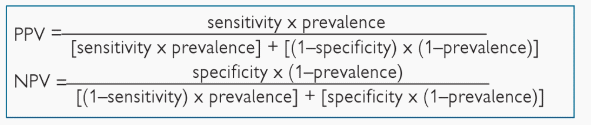
PPV = TP/(TP+FP)
= SnXP/[SnXP + (1-Sp)(1-P)]

NPV = TN/(TN+FN)
= SpX(1-P)/[SpX(1-P) + (1-Sn)XP]

You are often tested on exams with numerical questions. This is how, I try to figure out the Bayism in PPV and NPV when forgotten.
  • Facebook
  • Twitter
PGMEE, MRCS, USMLE, MBBS, MD/MS Community medicine

Post navigation

Previous post
Next post

Related Posts

PGMEE, MRCS, USMLE, MBBS, MD/MS

ASA Classification: Made Easy

May 26, 2023Aug 16, 2023

The purpose of the system is to assess and communicate a patient’s pre-anesthesia medical co-morbidities. The classification system alone does not predict the perioperative risks, but used with other factors (e.g., type of surgery, frailty, level of deconditioning), it can be helpful in predicting perioperative risks. ASA grade Definition Mortality…

Read More
PGMEE, MRCS, USMLE, MBBS, MD/MS

AKI RIFLE Criteria Mnemonic

Aug 6, 2024Aug 6, 2024

Stage GFR criteria Urine output criteria Mnemonic 1, 2, 3, 4 1, 2, 3 1. Risk Cr ↑ 1.5-2 XGFR ↓ 25-50% (>1/4) <0.5 ml/kg/hr X 6-12 (>1/4 day) 2. Injury Cr ↑ 2-3 XGFR ↓ >50-75% (>2/4) <0.5 ml/kg/hr X >12-24 hrs (>2/4 day) 3. Failure Cr ↑ >3…

Read More
PGMEE, MRCS, USMLE, MBBS, MD/MS

Achondroplasia Mnemonic

Jul 25, 2021Jul 25, 2021

A: Autosomal dominant C: “Champange glass” pelvis in X-rays H: Hypotonia O: Ossification affected (Enchondral > Appositional) N: Nasal bridge small D: Disproportionate Dwarfism R: Rhizomelic (proximal i.e. humerus and femur shortening) O: Out knees (varus deformity) P: Proliferative zone quantitative defect L: Little phalanx (brachydactyly) and metacarpals with Leister…

Read More

Comment

  1. Farhat says:
    Aug 22, 2021 at 3:08 pm

    I have three genes as a biomarker for CRC disease and need to combine their diagnostic values?

    Reply

Leave a Reply Cancel reply

Your email address will not be published. Required fields are marked *

This site uses Akismet to reduce spam. Learn how your comment data is processed.

Pre-clinical (Basic Sciences)

Anatomy

Biochemistry

Community medicine (PSM)

Embryology

Microbiology

Pathology

Pharmacology

Physiology

Clinical Sciences

Anesthesia

Dermatology

Emergency medicine

Forensic

Internal medicine

Gynecology & Obstetrics

Oncology

Ophthalmology

Orthopedics

Otorhinolaryngology (ENT)

Pediatrics

Psychiatry

Radiology

Surgery

RSS Ask Epomedicine

  • What to study for Clinical examination in Orthopedics?
  • What is the mechanism of AVNRT?

Epomedicine weekly

  • About Epomedicine
  • Contact Us
  • Author Guidelines
  • Submit Article
  • Editorial Board
  • USMLE
  • MRCS
  • Thesis
©2026 Epomedicine | WordPress Theme by SuperbThemes