Skip to content
Epomedicine

Mnemonics, Simplified Concepts & Thoughts

Epomedicine

Mnemonics, Simplified Concepts & Thoughts

lungs lymph nodes

TNM and Staging of Lung Cancer Simplified

Epomedicine, Aug 15, 2016

The current staging system is recommended for the classification of both non–small cell and small cell lung carcinomas and for carcinoid tumors of the lung .

TNM Staging of Lung Cancer

Primary Tumor (T)

The “T” staging of bronchogenic carcinoma is a bit complex compared to others. Five things must be checked before assigning a T classification. They can be remembered with a mnemonic: ABCDE.

  1. Atelectasis
  2. Bronchus involvement (bronchoscopy)
  3. Contiguous conquer (Adjacent site invasion)
  4. Diameter in cm
  5. Elevated nodules

Chest wall involvement as in breast cancer denotes advanced T stage.

Diameter (cm) Bronchoscopy (Main bronchus involvement) Atelectasis or Obstructive pneumonia Invasion Nodules
T1 A – ≤2 cm
B – 2 to ≤3 cm
T2 A – 3 to ≤5 cm ≥2 cm distal to carina Lobar Visceral pleura
B – 5 to ≤7 cm
T3 >7 cm <2 cm distal to carina Whole lung Chest wall (including pancoast or superior sulcus tumor), Diaphragm, Phrenic nerve, Mediastinal or parietal pleura Same lung lobe
T4 Any size Carina Heart, great vessels, trachea, esophagus, recurrent laryngeal nerve spine, Different ipsilateral lung lobe

lungs lymph nodes

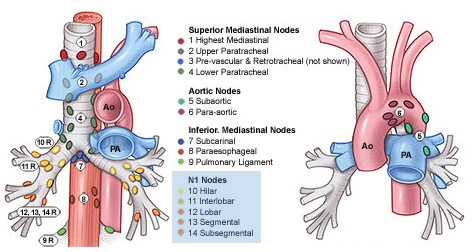
Regional Lymph Nodes (N)

  • N1: Ipsilateral – Peribronchial, hilar or intrapulmonary nodes
  • N2: Ipsilateral – Mediastinal or subcarinal nodes
  • N3:
    • Contralateral – Mediastinal or Hilar (N1 and N2 if ipsilateral)
    • Ipsilateral or Contralateral: Scalene or Supraclavicular nodes

Metastasis (M)

M1:

  • a – Separate tumor nodule in contralateral lung lobe (T4 if on ipsilateral lobe), Pleural nodules, Malignant pleural or pericardial effusion
  • b – Distant Metastasis

AJCC Staging of Lung Cancer
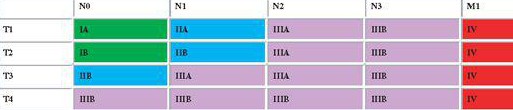
lung cancer staging matrix

The staging of lung cancer is similar to another thoracic tumor – breast cancer. In both of these sites, the primary drainage nodes (N1) is close to the involved site, hence, T1=N1.

  • M stage is a separate stage: M1 = Stage IV
  • N stage determines stage group I-III
    • N3 = Stage IIIB
    • N2 = Stage IIIA except with T4 (Stage III B)
  • T stage modifies substages:
    • T4 = Stage IIIB
    • T1 or T2 N0 = Stage IA or IB respectively
    • T1 or T2 N1 = Stage IIA or IIB respectively

Algorithm for Lung Cancer Management
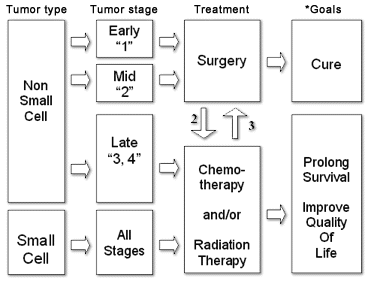
lung-cancer-treatment

39 shares
  • Facebook39
  • Twitter
PGMEE, MRCS, USMLE, MBBS, MD/MS Internal medicineOncologyRespiratory system

Post navigation

Previous post
Next post

Related Posts

PGMEE, MRCS, USMLE, MBBS, MD/MS pregnancy shaving

Heart Disease in pregnancy

Nov 20, 2022Nov 20, 2022

Mortality risk associated with pregnancy Group I – Mortality <1% Group II – Mortality 5-15% Group III – Mortality 25-50% Commonest in Pregnancy Valvular heart disease: Mitral stenosis Congenital heart disease: ASD Cyanotic congenital heart disease: Fallot’s tetralogy (TOF) Predictors of Cardiac Events during Pregnancy N – NYHA Class >II…

Read More
PGMEE, MRCS, USMLE, MBBS, MD/MS

Swan neck deformity vs Boutonniere deformity

Jun 5, 2022Jun 5, 2022

Alterations in the relationships between the balanced extrinsic and intrinsic musculature of the hand due to trauma or secondary to the effects of systemic disease may cause the development of functional deformities such as a boutonnière or swan-neck deformity. Swan-neck deformity Boutonniere deformity Deformity PIPJ Hyperextension PIPJ Flexion DIPJ Flexion…

Read More
PGMEE, MRCS, USMLE, MBBS, MD/MS gbs pathophysiology

Guillain Barre Syndrome (GBS) – Mnemonic

Apr 16, 2017Apr 16, 2017

ASBURY CRITERIA FOR GUILLAIN BARRE SYNDROME (GBS) Required Criteria Mnemonic: AIDP 1. Areflexia 2. Include in differential and rule out other causes 3. Duration < 4 weeks 4. Progressive weakness of 2 or more limbs due to neuropathy Supportive criteria Mnemonic: AIDPS 1. Afebrile 2. Involvement: Mild sensory involvement Facial…

Read More

Comment

  1. OncoNorm Plus says:
    Sep 29, 2020 at 10:00 am

    Great content and information. Knowing the staging of lung cancer and its TNM is very necessary if someone is having doubts about having lung cancer.

    Reply

Leave a Reply to OncoNorm Plus Cancel reply

Your email address will not be published. Required fields are marked *

This site uses Akismet to reduce spam. Learn how your comment data is processed.

Pre-clinical (Basic Sciences)

Anatomy

Biochemistry

Community medicine (PSM)

Embryology

Microbiology

Pathology

Pharmacology

Physiology

Clinical Sciences

Anesthesia

Dermatology

Emergency medicine

Forensic

Internal medicine

Gynecology & Obstetrics

Oncology

Ophthalmology

Orthopedics

Otorhinolaryngology (ENT)

Pediatrics

Psychiatry

Radiology

Surgery

RSS Ask Epomedicine

  • What to study for Clinical examination in Orthopedics?
  • What is the mechanism of AVNRT?

Epomedicine weekly

  • About Epomedicine
  • Contact Us
  • Author Guidelines
  • Submit Article
  • Editorial Board
  • USMLE
  • MRCS
  • Thesis
©2026 Epomedicine | WordPress Theme by SuperbThemes