Skip to content
Epomedicine

Mnemonics, Simplified Concepts & Thoughts

Epomedicine

Mnemonics, Simplified Concepts & Thoughts

tnm breast cancer

TNM and Staging of Breast Cancer Simplified

Epomedicine, Aug 14, 2016Aug 14, 2016

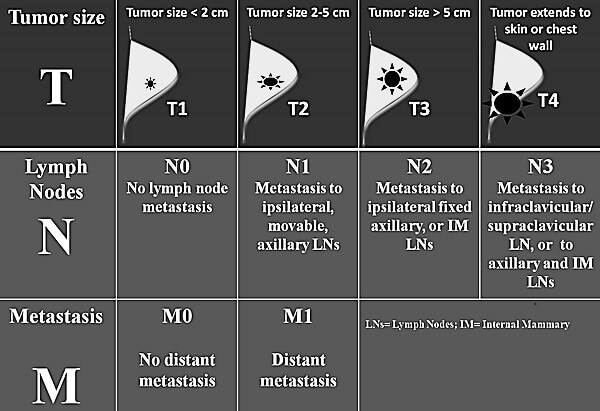
TNM Classification for Breast Cancer
tnm breast cancer

Primary Tumor (T)

  • T1: ≤2 cm (20 mm)
    • mi: ≤1 mm
    • a: 1-5 mm
    • b: 5-10 mm
    • c: 10-20 mm
  • T2: 2-5 cm
  • T3: >5 cm
  • T4: Direct extension to chest wall and/or skin
    • a: Chest wall (exclude only pectoralis muscle adherence/invasion)
    • b: Ipsilateral ulceration, satellite nodules or peau’d orange
    • c: Both a and b
    • d: Inflammatory carcinoma

Regional Lymph Node (N)

  • N1: Ipsilateral and mobile level I and II axillary nodes
  • N2:
    • a: Ipsilateral and matted level I and II axillary nodes
    • b: Ipsilateral internal mammary nodes only
  • N3:
    • a: Ipsilateral level III axillary nodes (infraclavicular node)
    • b: Ipsilateral internal mammary nodes + level I, II nodes
    • c: Ipsilateral supraclavicular nodes

Distant Metastasis (M)

  • cMo (i+): Clinically and radiologically normal but ≤ 0.2 mm tumor cells in blood, bone marrow or other nonregional nodal tissues
  • M1: >0.2 mm metastases

Trick or Mnemonic to remember AJCC Breast Cancer Staging
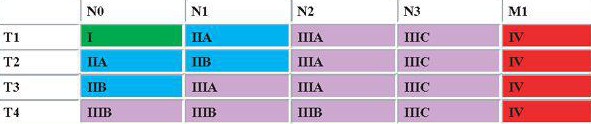
breast cancer staging matrix

M1 = Stage IV

T4 = Stage III – b or c

N3 = Stage III – c

N2 = Stage III – a or b

  • From above, we know that T4 is either Stage III – b or c (cannot be “a” and cannot be “c”)
    • T4N2 = Stage IIIb
  • Remaining T 1-3 is Stage IIIa
    • T 1,2,3 N2 = Stage IIIa

With remaining T 1-3 and N0-1, add them up:

  • Add upto make 1: Stage I (T1No)
  • Add upto make 2: Stage IIa (T1N1 or T2N0)
  • Add upto make 3: Stage IIb (T3N0 or T2N1)
  • Add upto make 4: Stage IIIa (T3N1)

Nottingham Prognostic Index (NPI) Score

NPI score is an indicator of breast cancer outcome based on:

1. Nodal score (N)

  • No positive nodes = 1
  • 1-3 positive nodes = 2
  • ≥4 positive nodes = 3

2. Modified Bloom and Richardson Grade (G): 1-3
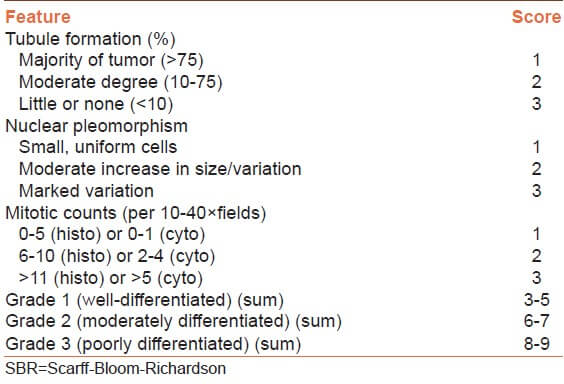
modified bloom and richardson grade

3. Tumor invasive size in cm (S)

NPI Score = (0.2 x Invasive Size) + Grade + Nodes

Interpretation:

NPI Score Prognostic Group
≤2.4 Excellent Prognostic Group (EPG)
2.4 – 3.4 Good Prognostic Group (GPG)
3.4 – 4.4 Moderate Prognostic Group 1 (MPG1)
4.4 – 5.4 Moderate Prognostic Group 2 (MPG2)
>5.4 Poor Prognostic Group (PPG)

Nottingham Prognostic Index Plus (NPI+) Score

NPI+ works by using a panel of biomarkers to assess the biological behaviour of an individual’s tumour by measuring protein expression levels. Combined with a novel bioinformatic and expert system, it can then can sub-classify patients into one of seven clinically distinct biological classes. Importantly, this approach has the potential to predict both clinical outcomes and relevant therapeutic options in breast cancer more accurately than existing methods.1http://nuhrise.org/2010/11/nottingham-prognostic-index-plus-npi-a-ground-breaking-tool-for-breast-cancer/

76 shares
  • Facebook49
  • Twitter
PGMEE, MRCS, USMLE, MBBS, MD/MS General SurgeryOncologyPathology

Post navigation

Previous post
Next post

Related Posts

PGMEE, MRCS, USMLE, MBBS, MD/MS fatty-acid-oxidation

Beta-oxidation of Fatty Acids : Simplified

Jul 31, 2018

Fatty Acid Activation (Cytoplasm) Before undergoing oxidation, fatty acid must be activated first by conversion into Acyl-CoA by the action of Fatty Acyl-CoA synthase (thiokinase). ATP is converted to AMP (not ADP) – 2 ATP equivalent used Uses Mg2+ as cofactor, Co-ASH and ATP Sites of Beta-oxidation A. Mitochondria: Short/Medium…

Read More
PGMEE, MRCS, USMLE, MBBS, MD/MS

Fibromyalgia : Mnemonic Approach

Mar 5, 2022Jun 20, 2025

Clinical Features Mnemonic: FIBRO 1. Fatigue: 80-90% 2. Fibrofog: Dyscognition or Cognitive impairment e.g. trouble concentrating, forgetfulness, and disorganized or slow thinking 3. Insomnia: 90% 4. Blues: Depression and anxiety 5. Rigidity: Prolonged early morning stiffness not relieved by exercise and absence of synovitis 6. Ow!: Pain (the predominant symptom)…

Read More
Clinical Skills and Approaches radial nerve course branches

Radial Nerve Anatomy : Course and Innervation

May 20, 2014Jun 1, 2024

Synonyms: Nervus radialis, Musculospiral nerve Recommended reading: Course 1. Origin: Terminal branch of Posterior cord of brachial plexus (Root value: C5, C6, C7, C8, T1) 2. Posterior axilla: It lies behind the axillary and upper part of the brachial arteries, passing anterior to tendons of subscapularis, lattisimus dorsi and teres…

Read More

Comments (4)

  1. OncoNorm Plus says:
    Sep 29, 2020 at 7:47 am

    A good and detailed blog on TNM, alongside stages of breast cancer. Very helpful and informative.

    Reply
  2. John ,unyime says:
    Dec 15, 2020 at 6:45 pm

    Simple to understand and easy to reproduce

    Reply
  3. akmal says:
    May 10, 2022 at 2:50 pm

    Thank you, very helpful for last minute revision.

    Reply
  4. K M LAKSHMIPATHY says:
    Aug 1, 2024 at 4:04 am

    Well illustrated TNM classification,
    easy to grasp and understand,
    Thank you for your effort in simplifying these important clinical areas.

    Reply

Leave a Reply to John ,unyime Cancel reply

Your email address will not be published. Required fields are marked *

This site uses Akismet to reduce spam. Learn how your comment data is processed.

Pre-clinical (Basic Sciences)

Anatomy

Biochemistry

Community medicine (PSM)

Embryology

Microbiology

Pathology

Pharmacology

Physiology

Clinical Sciences

Anesthesia

Dermatology

Emergency medicine

Forensic

Internal medicine

Gynecology & Obstetrics

Oncology

Ophthalmology

Orthopedics

Otorhinolaryngology (ENT)

Pediatrics

Psychiatry

Radiology

Surgery

RSS Ask Epomedicine

  • What to study for Clinical examination in Orthopedics?
  • What is the mechanism of AVNRT?

Epomedicine weekly

  • About Epomedicine
  • Contact Us
  • Author Guidelines
  • Submit Article
  • Editorial Board
  • USMLE
  • MRCS
  • Thesis
©2026 Epomedicine | WordPress Theme by SuperbThemes