Skip to content
Epomedicine

Mnemonics, Simplified Concepts & Thoughts

Epomedicine

Mnemonics, Simplified Concepts & Thoughts

kawasaki-disease

Kawasaki Disease – Diagnostic Criteria Mnemonic

Epomedicine, Oct 7, 2016Oct 7, 2016

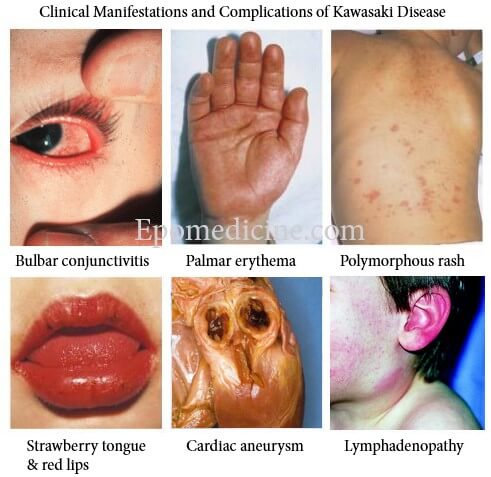
The diagnostic criteria of Kawasaki Disease can be remembered using a mnemonic – “FEBRILE“.
kawasaki-disease

Fever: >5 days plus ≥4 of the following

Enathem:

  • Lips: Erythema, fissuring or crusting
  • Oropharynx: Diffuse injection
  • Tongue: Strawberry tongue

Bulbar conjunctivitis: Bilateral, painless and non-exudative

Rash: Polymorphous rash

Internal organ involvement (not the part of criteria)

  • Cardiac artery aneurysm: commonest and most life-threatening complication
  • Urethritis with sterile pyuria
  • Aseptic meningitis
  • Hydrops of gallbladder
  • Sensorineural hearing loss
  • Uveitis
  • Hepatic dysfunction

Lymphadenopathy: >1.5 cm, non-suppurative

Extremity changes:

  • Erythema of palms or soles
  • Edema (non-pitting)
  • Desquamation (perigenital and perineal followed by periungual, starting at the tips of finger)

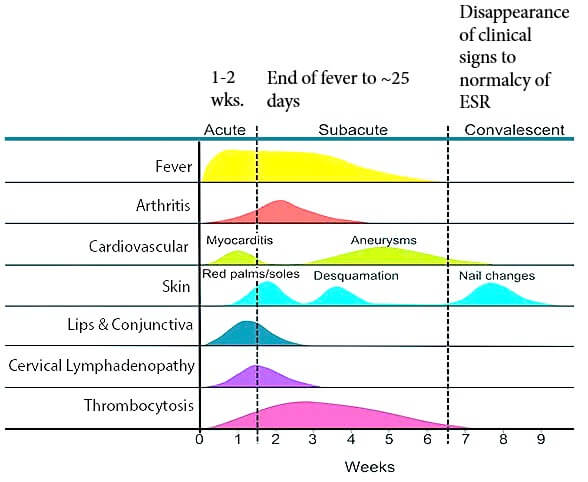
Clinical Phases of Kawasaki Disease
kawasaki-disease-clinical-phases


33 shares
  • Facebook33
  • Twitter
PGMEE, MRCS, USMLE, MBBS, MD/MS Cardiovascular systemPediatrics

Post navigation

Previous post
Next post

Related Posts

PGMEE, MRCS, USMLE, MBBS, MD/MS

Kocher Criteria for Septic Arthritis : Mnemonic

Apr 25, 2020Apr 25, 2020

Kocher criteria can help to differentiate between spetic arthritis and transient synovitis in a case of non-traumatic painful hip in a child. A restrospective study in 104 pediatric patients has depicted that meeting 3 out of 4 crtieria would miss 52% cases and is of limited usefulness in detecting septic…

Read More
PGMEE, MRCS, USMLE, MBBS, MD/MS

Motor March Phenomenon

Oct 21, 2022Oct 21, 2022

Motor march phenomenon is a sign of reinnervation like Hoffman-Tinel’s sign which has been discussed earlier. Observed in: Axonotmesis Repaired Neurotmesis Not observed in: Neuropraxia Motor march phenomenon: As the re-innervation of injured nerve proceeds, the muscles nearest to the site of injury recovers first followed by distal ones sequentially…

Read More
PGMEE, MRCS, USMLE, MBBS, MD/MS surface lungs

Respiratory Examination – Relevant Anatomy and Physiology

Apr 4, 2015

1. Division of Airway: Extrathoracic (Upper) airway: Nose to Upper trachea Intrathoracic (Lower) airway: Lower trachea to Alveoli and lungs Note: Vocal fold is also regarded as the demarcating line between upper and lower respiratory tract 2. Angle of Louis: Junction of body of sternum to manubrium (2nd costal cartilage…

Read More

Leave a Reply Cancel reply

Your email address will not be published. Required fields are marked *

This site uses Akismet to reduce spam. Learn how your comment data is processed.

Epomedicine. Kawasaki Disease – Diagnostic Criteria Mnemonic [Internet]. Epomedicine; 2016 Oct 7 [cited 2026 May 18]. Available from: https://epomedicine.com/medical-students/kawasaki-disease-diagnostic-criteria-mnemonic/.

Pre-clinical (Basic Sciences)

Anatomy

Biochemistry

Community medicine (PSM)

Embryology

Microbiology

Pathology

Pharmacology

Physiology

Clinical Sciences

Anesthesia

Dermatology

Emergency medicine

Forensic

Internal medicine

Gynecology & Obstetrics

Oncology

Ophthalmology

Orthopedics

Otorhinolaryngology (ENT)

Pediatrics

Psychiatry

Radiology

Surgery

RSS Ask Epomedicine

  • What to study for Clinical examination in Orthopedics?
  • What is the mechanism of AVNRT?

Epomedicine weekly

  • About Epomedicine
  • Contact Us
  • Author Guidelines
  • Submit Article
  • Editorial Board
  • USMLE
  • MRCS
  • Thesis
©2026 Epomedicine | WordPress Theme by SuperbThemes