Skip to content
Epomedicine

Mnemonics, Simplified Concepts & Thoughts

Epomedicine

Mnemonics, Simplified Concepts & Thoughts

Surface Anatomy of Pleura and Lung

Epomedicine, May 19, 2024

Surface Anatomy of Pleura

Mnemonic: 2, 4, 6, 8, 10, 12 rule

1. Starts about 2 cm above the midpoint of medial 1/3 of clavicle.

2. Meet in the midline at rib 2.

3. Left side reaches sternal line at rib 4 (to make room for heart).

4. Right side reaches sternal line at rib 6.

5. Both cross rib 8 in midclavicular line.

6. Both cross rib 10 in mid-axillary line.

7. Both cross mid-scapular line (posteriorly) in rib 12.
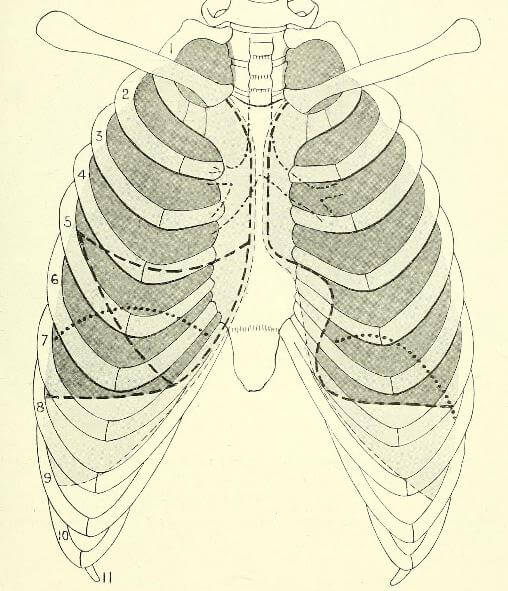
lung and pleura surface markings
“This image is taken from Page 17 of Surgery of the lung and pleura” by Medical Heritage Library, Inc. is licensed under CC BY-NC-SA 2.0.

Surface Anatomy of Lungs

1. Apex, Anterior border and Posterior border of lungs: Correspond to the lines of pleura but are slightly away from median plane

2. Inferior margin:

Below rib 6, the lungs extend to two rib spaces less than pleura (i.e. opposite to rib 6 mid-clavicular line, rib 8 mid-axillary line and rib 10 posteriorly). The parietal pleura extends a further two rib spaces inferiorly than the inferior lung edge to allow space for lung expansion.

LevelParietal pleuraLungs
Midclavicular line8th rib6th rib
Midaxillary line10th rib8th rib
Midscapular line12th rib10th rib

3. Oblique fissure: T3 to 6th costal cartilage

4. Transverse fissure (right lung only): Right 4th costal cartilage (sternal edge) to Oblique fissure
  • Facebook
  • Twitter
PGMEE, MRCS, USMLE, MBBS, MD/MS AnatomyRespiratory system

Post navigation

Previous post
Next post

Related Posts

PGMEE, MRCS, USMLE, MBBS, MD/MS

Gastrointestinal Stromal Tumor (GIST) : A Comprehensive Review

Jan 23, 2024Jan 23, 2024

Introduction: Other facts: Clinical features: Diagnosis: Role of biopsy/tissue diagnosis in GIST (current consensus): Treatment: High risk features: Choices of surgery: Aim of surgery: Prognostication:  Malignant potential Comments  Mortality  Benign  Size: up to 2 cmMitosis: up to 5/50 hpf No tumor related mortality Probably benign Size: 2-5 cmMitosis: same as…

Read More
PGMEE, MRCS, USMLE, MBBS, MD/MS

Pelvic Lymphatic Drainage

Jun 26, 2024Jun 26, 2024

1. Para-aortic (lumbar) nodes: Gonads (derive blood supply from kidneys) 2. Inferior mesenteric nodes: As of blood supply – to the structures derived from hindgut 3. Common iliac nodes: Receives external and internal iliac nodes; Drains into para-aortic nodes 4. Superficial inguinal nodes: Everything that can be touched with fingers…

Read More
PGMEE, MRCS, USMLE, MBBS, MD/MS

Calcium Metabolism

Jul 6, 2022Jul 6, 2022

Functions Mnemonic: Six ‘C’s Contraction of muscles (Coupling of excitation-contraction) Conduction in nerves Cardiac function Coagulation in blood (Co-factor) Communication (intracellular messengers) for hormones, autacoids and transmitters Cementing (mineralization) of bone – Compressive strength Distribution Average young adult = 1200 gm calcium 99% in bone as calcium hydroxyapatite 1% in…

Read More

Leave a Reply Cancel reply

Your email address will not be published. Required fields are marked *

This site uses Akismet to reduce spam. Learn how your comment data is processed.

Pre-clinical (Basic Sciences)

Anatomy

Biochemistry

Community medicine (PSM)

Embryology

Microbiology

Pathology

Pharmacology

Physiology

Clinical Sciences

Anesthesia

Dermatology

Emergency medicine

Forensic

Internal medicine

Gynecology & Obstetrics

Oncology

Ophthalmology

Orthopedics

Otorhinolaryngology (ENT)

Pediatrics

Psychiatry

Radiology

Surgery

RSS Ask Epomedicine

  • What to study for Clinical examination in Orthopedics?
  • What is the mechanism of AVNRT?

Epomedicine weekly

  • About Epomedicine
  • Contact Us
  • Author Guidelines
  • Submit Article
  • Editorial Board
  • USMLE
  • MRCS
  • Thesis
©2026 Epomedicine | WordPress Theme by SuperbThemes