Skip to content
Epomedicine

Mnemonics, Simplified Concepts & Thoughts

Epomedicine

Mnemonics, Simplified Concepts & Thoughts

Superior Orbital Fissure (SOF): Mnemonics

Epomedicine, Aug 5, 2023Aug 5, 2023

Superior Orbital Fissure (SOF) is a cleft between greater and lesser wing of sphenoid which connects orbit and middle cranial fossa. It is divided into 3 compartments by the tendinous ring (annulus of Zinn).
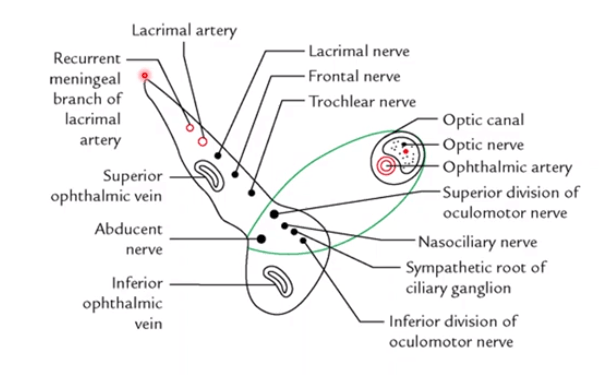
superior orbital fissure

Superior orbital fissure alone (Lateral compartment):

Mnemonic: LFTS

  1. Lacrimal nerve (CN V1)
  2. Frontal nerve (CN V1)
  3. Trochlear nerve (CN IV)
  4. Superior ophthalmic vein

Superior orbital fissure in tendinous ring (Intermediate compartment):

Mnemonic: SANI

  1. Superior division of Occulomotor nerve (CN III)
  2. Abducens nerve (CN VI)
  3. Nasociliary nerve (CN V1)
  4. Inferior division of Occulomotor nerve (CN III)

Optic canal also lies within the tendinous ring in the lesser wing of sphenoid and transmits:

  1. Optic nerve (CN II)
  2. Ophthalmic artery

Medial compartment of superior orbital fissure outside the tendinous ring transmits Inferior ophthalmic vein.

Inferior Orbital Fissure lies between the lateral wall (greater wing of sphenoid) and inferior wall of the orbit (maxilla) inferior to superior orbital fissure and transmits:

Mnemonic: ZIP

  1. Zygomatic nerve (CN V2)
  2. Infraorbital nerve (CN V2), artery and vein
  3. Pterygopalatine ganglion branches

Relevant syndromes

ConditionCranial nerves involvedCranial nerves not involvedVessels involved
Orbital apex syndromeII, III, IV, VI, V1 +/- V2Ophthalmic artery, Superior ophthalmic vein
Superior orbital fissure syndrome (Rochon-Duvigneaud syndrome)III, IV, VI +/- V2IISuperior ophthalmic vein
Cavernous sinus syndromeIII, IV, VIII, V2ICA (Cavernous portion)
  • Facebook
  • Twitter
PGMEE, MRCS, USMLE, MBBS, MD/MS AnatomyNervous systemOphthalmology

Post navigation

Previous post
Next post

Related Posts

PGMEE, MRCS, USMLE, MBBS, MD/MS

Personality Disorders – Mnemonic

May 17, 2019May 17, 2019

If you are having a hard time remembering the clusters and which disorder falls into which cluster, this mnemonic will be helpful. Three clusters: A, B and C; remember as WWW – Weird, Wild and Worried, respectively. Cluster A – Weird (Genetic association with Schizophrenia) Accusatory: Paranoid (Suspicious) Aloof: Schizoid…

Read More
PGMEE, MRCS, USMLE, MBBS, MD/MS hodgkin staging

Hodgkin’s Lymphoma – Staging and Prognostic Factors

Aug 13, 2016Aug 13, 2016

Costwold Modified Ann-Arbor Staging I: 1 Lymph Node (LN) region (I) or 1 Extralymphatic site (IE) II: On the same side of diaphragm – ≥2 LN region (II) or Localized Extralymphatic extension + ≥1 LN region (IIE) III: On both the sides of diaphragm – LN regions (III) ± Spleen involvement (IIIS) ± Localized…

Read More
PGMEE, MRCS, USMLE, MBBS, MD/MS cardiac impulse spread

Physiology of Conducting System of Heart

Jul 12, 2018Aug 10, 2023

Origin and Spread of Cardiac Impulse Mnemonic: SAIL MRS. SAVE APPS 1. SA node (generates impulse at highest rate, i.e. 70-80/min) 3 Internodal pathways: 2. AV node Bundle of His 3. Interventricular septum – Left 4. Midportion Right Septal activation Purkinje System 5. Septum (upper to lower) – purkinje system…

Read More

Leave a Reply Cancel reply

Your email address will not be published. Required fields are marked *

This site uses Akismet to reduce spam. Learn how your comment data is processed.

Pre-clinical (Basic Sciences)

Anatomy

Biochemistry

Community medicine (PSM)

Embryology

Microbiology

Pathology

Pharmacology

Physiology

Clinical Sciences

Anesthesia

Dermatology

Emergency medicine

Forensic

Internal medicine

Gynecology & Obstetrics

Oncology

Ophthalmology

Orthopedics

Otorhinolaryngology (ENT)

Pediatrics

Psychiatry

Radiology

Surgery

RSS Ask Epomedicine

  • What to study for Clinical examination in Orthopedics?
  • What is the mechanism of AVNRT?

Epomedicine weekly

  • About Epomedicine
  • Contact Us
  • Author Guidelines
  • Submit Article
  • Editorial Board
  • USMLE
  • MRCS
  • Thesis
©2026 Epomedicine | WordPress Theme by SuperbThemes