Skip to content
Epomedicine

Mnemonics, Simplified Concepts & Thoughts

Epomedicine

Mnemonics, Simplified Concepts & Thoughts

rosette types

Rosettes in Pathology

Epomedicine, Jan 26, 2017Jan 27, 2017

Rosette refers to a decoration or pattern resembling a rose.
rosette types

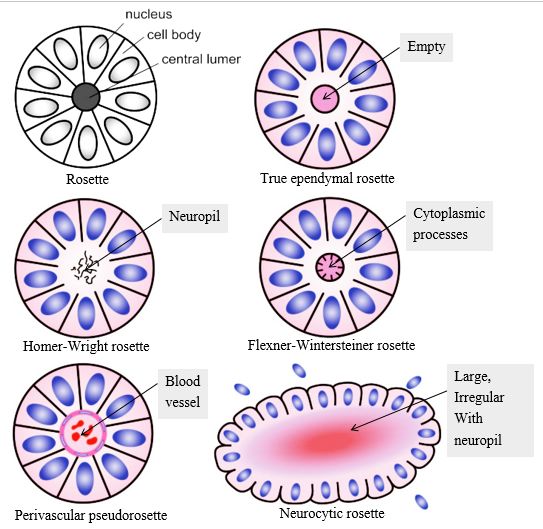
In pathology, rosette refers to aa halo or “spoke-wheel” arrangement of cells around a central structure especially in neoplasms of neuroblastic or neuroectoderma origin. The central structure can be:

a. Empty lumen: True ependymal rosette

  1. Well differentiated ependymomas (minority of cases)
  2. Ependymoblastoma (rare form of PNET)

b. Meshwork of fibers (Neuropil): Homer-Wright rosette

Remember: It is Neuropil and not neutrophil. Neuropil refers to primitive neuronal processes or neurites.

  1. Medulloblastoma
  2. Supratentorial PNETs
  3. Pineoblastoma
  4. Retinoblastoma

c. Cytoplasmic extensions of encircling tumor cells: Flexner-Wintersteiner rosette

  1. Retinoblastoma
  2. Pineoblastoma
  3. Medulloepithelioma

Fleurettes: This refers to tumor cell’s attempt for photoreceptor differentiation.

d. Blood vessel: Perivascular pseudorosette

This is pseudorosette because the central structure is not actually formed by the tumor itself, but instead represents an arrangement of cells around native, non-neoplastic element.

  1. Medulloblastoma
  2. PNETs
  3. Central neurocytoma
  4. Pilomyxoid astrocytoma

Glomeruloid bodies are like pseudovascular rosette. They are seen in:

  1. Glioblastoma multiforme
  2. Schiller-Duval bodies of Endodermal sinus – Yolk sac tumor.

e. Irregular large lumen with neuropil (similar to Homer-Wright rosette): Neurocytic rosette

  1. Central neurocytoma

Also, rosetting of erythrocytes in peripheral blood smear (PBS) is seen in Malaria (Plasmodium infection).
20 shares
  • Facebook20
  • Twitter
PGMEE, MRCS, USMLE, MBBS, MD/MS Nervous systemOncologyPathology

Post navigation

Previous post
Next post

Related Posts

PGMEE, MRCS, USMLE, MBBS, MD/MS

Basics of voiding cystourethrogram (VCUG)

Jan 12, 2024Jan 12, 2024

The above picture shows a VCUG scan which is a commonly performed test in urology for diagnosing various conditions related to urethra, bladder as well as assessing upper tracts. Diseases that can be diagnosed using VCUG includes: So, it is always better to have an idea about interpreting the scan as…

Read More
PGMEE, MRCS, USMLE, MBBS, MD/MS Submandibular gland

Applied Anatomy of Submandibular Salivary Gland

May 31, 2014Jun 19, 2023

Synonyms: Submaxillary gland (SMG), Mandibular gland Definition: Submandibular glands are one of the major salivary glands comprised of mixed serous and mucous acini and located below the lower border of the body of mandible. It is the second largest salivary gland and produces approximately 70% of the saliva. Location: Submandibular triangle…

Read More
PGMEE, MRCS, USMLE, MBBS, MD/MS lung cancer pathophysiology

Bronchogenic Carcinoma Etiopathogenesis

Jul 2, 2016Jul 2, 2016

INCIDENCE Male > Female Age group: 50-75 years Second highest cancer in both sexes after prostate (male) and breast (female) Smokers > Non-smokers ETIOLOGY OF LUNG CANCER A. Cigarette smoking: Smoking is the single most important risk factor for lung cancer, which can cause all types of lung cancer but…

Read More

Leave a Reply Cancel reply

Your email address will not be published. Required fields are marked *

This site uses Akismet to reduce spam. Learn how your comment data is processed.

Epomedicine. Rosettes in Pathology [Internet]. Epomedicine; 2017 Jan 26 [cited 2025 Dec 7]. Available from: https://epomedicine.com/medical-students/rosettes-in-pathology/.

Pre-clinical (Basic Sciences)

Anatomy

Biochemistry

Community medicine (PSM)

Embryology

Microbiology

Pathology

Pharmacology

Physiology

Clinical Sciences

Anesthesia

Dermatology

Emergency medicine

Forensic

Internal medicine

Gynecology & Obstetrics

Oncology

Ophthalmology

Orthopedics

Otorhinolaryngology (ENT)

Pediatrics

Psychiatry

Radiology

Surgery

RSS Ask Epomedicine

  • What to study for Clinical examination in Orthopedics?
  • What is the mechanism of AVNRT?

Epomedicine weekly

  • About Epomedicine
  • Contact Us
  • Author Guidelines
  • Submit Article
  • Editorial Board
  • USMLE
  • MRCS
  • Thesis
©2025 Epomedicine . All rights reserved.