Skip to content
Epomedicine

Mnemonics, Simplified Concepts & Thoughts

Epomedicine

Mnemonics, Simplified Concepts & Thoughts

Renal Tubular Acidosis (RTA) : Mnemonics

Epomedicine, Nov 18, 2020Nov 18, 2020

Renal Tubular Acidosis (RTA) cause non-anion gap metabolic acidosis.

Type 1: H+ excretion defect (A proton or 1st element of periodic table)

  • This occurs in distal tubule (hence, distal defect)
  • K+ is excreted instead of H+ causing Hypokalemia.
  • Distal tubule H+ is non-functioning – urine pH >5.5.
  • Chronic acidosis leads to decreased tubular calcium reabsorption leading to renal hypercalciuria.
  • Acidosis and hypokalemia stimulate citrate reabsorption in proximal tubule and decrease urine excretion.
  • Alkaline urine + Hypercalciuria + Hypocitraturia = Calcium phosphate stones and Nephrocalcinosis

Type 2: Bicarbonate reabsorption defect (Bi-carbonate or Two carbonates)

  • Majority of bicarbonate reabsorption occurs in proximal tubule (hence, proximal defect)
  • Since, it is a proximal defect – it has association with Fanconi’s syndrome
  • H+ secreting mechanism in distal tubule is intact – hence, urine pH is <5.5 even though HCO3- is lost in urine (compensatory mechanism).

Type 3: Mixed (1 + 2) [Forget type 3 for now as it is not even mentioned in several textbooks]

Type 4: Aldosterone deficiency or resistance (A looks like 4 – 4ldosterone) leading to decreased Ammonia/NH4+ production (A looks like 4 – 4mmonia or NH4+ has a 4 in it)

  • Aldosterone acts on distal tubule (hence, distal defect)
  • Since, distal tubule H+ pump functions normally – urine pH <5.5.
  • Due to impaired aldosterone action: Na+/K+-H+ exchange mechanism is impaired leading to defective excretion of K+ and H+ and defective reabsorption of Na+, i.e. hyperkalemia, acidosis and hyponatremia.
  • Hyperkalemia inhibits ammoniagenesis.

Another rhyme mnemonic

Stone/Immune, Bone and Aldosterone.

RTA type 1: associated with Calcium Phosphate Stone, Autoimmune disorders like Sjogren’s syndrome and Lupus

RTA type 2: associated with Osteomalacia and Multiple myeloma

RTA type 4: associated with Aldosterone defect
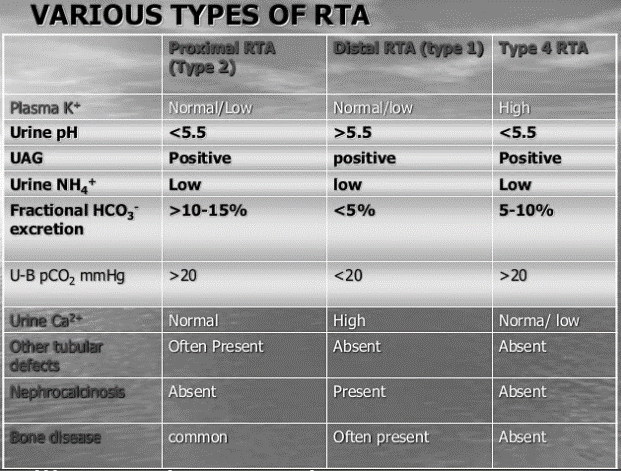
renal tubular acidosis types
  • Facebook
  • Twitter
PGMEE, MRCS, USMLE, MBBS, MD/MS Internal medicinePediatricsRenal and Electroloyte

Post navigation

Previous post
Next post

Related Posts

PGMEE, MRCS, USMLE, MBBS, MD/MS

Mnemonic Approach to Elbow Xray – FOOL

Oct 12, 2019Jun 14, 2022

Mnemonic: FOOLa. Fat padsb. Overt findings and outlinesc. Ossification centersd. Lines Fat pads The elbow joint has anterior and posterior fat pads which are extra-synovial but within the articular capsule. These are present as a radiolucent (black) line (compared to bone and surrounding soft tissues) in lateral X-rays. Normal finding:…

Read More
PGMEE, MRCS, USMLE, MBBS, MD/MS

Diacerin : Mnemonic

May 15, 2023May 15, 2023

Diacerin is a DMOAD (Diseases Modifying Osteoarthritis Drug) – D – Diarrhea (not recommended in >65 years – more vulnerable to diarrhea) I – IL-1 Inhibition A – Anthraquinone C – Chondroprotective effects E – Eczema R – Rashes I – Increase in hepatic enzymes (contraindicated in patients with history…

Read More
PGMEE, MRCS, USMLE, MBBS, MD/MS wilms tumor

Wilm’s Tumor (Nephroblastoma) : Quick review

Oct 27, 2017Jul 13, 2020

Wilm’s tumor is the most common primary renal tumor of childhood. Origin: Embryonic nephrogenic (mesodermal) cells Mechanism: Deletion of WT-1 gene on chromosome 11 Pathology: a. Macroscopic (Gross): large, solitary tan to grey color mass; pale on cut section with areas of hemorrhage; 10% are bilateral or multicentric; grossly difficult…

Read More

Comment

  1. RADHA KRISHNA PRASAD PENTA says:
    Dec 28, 2022 at 1:20 pm

    in Type 2, what happens to potassium not mentioned. Acidosis is always associated with hyperkalemia, except in RTA types 1 and 2

    Reply

Leave a Reply Cancel reply

Your email address will not be published. Required fields are marked *

This site uses Akismet to reduce spam. Learn how your comment data is processed.

Pre-clinical (Basic Sciences)

Anatomy

Biochemistry

Community medicine (PSM)

Embryology

Microbiology

Pathology

Pharmacology

Physiology

Clinical Sciences

Anesthesia

Dermatology

Emergency medicine

Forensic

Internal medicine

Gynecology & Obstetrics

Oncology

Ophthalmology

Orthopedics

Otorhinolaryngology (ENT)

Pediatrics

Psychiatry

Radiology

Surgery

RSS Ask Epomedicine

  • What to study for Clinical examination in Orthopedics?
  • What is the mechanism of AVNRT?

Epomedicine weekly

  • About Epomedicine
  • Contact Us
  • Author Guidelines
  • Submit Article
  • Editorial Board
  • USMLE
  • MRCS
  • Thesis
©2026 Epomedicine | WordPress Theme by SuperbThemes