Skip to content
Epomedicine

Mnemonics, Simplified Concepts & Thoughts

Epomedicine

Mnemonics, Simplified Concepts & Thoughts

Pressure Sores and Bed Sores

Epomedicine, Oct 22, 2022Oct 22, 2022

A pressure injury is localized damage to the skin and underlying soft tissue usually over a bony prominence or related to a medical or other device.

Normal capillary refill is 16-33 mmHg.

Ischemia occurs with prolonged pressure >33 mmHg:

  1. Ischial tuberosity: >100 mmHg during sitting
  2. Sacral region: 40-60 mmHg in supine
  3. Trochanteric region: 70-80 mmHg in lateral position

NPIAP Classification or Staging
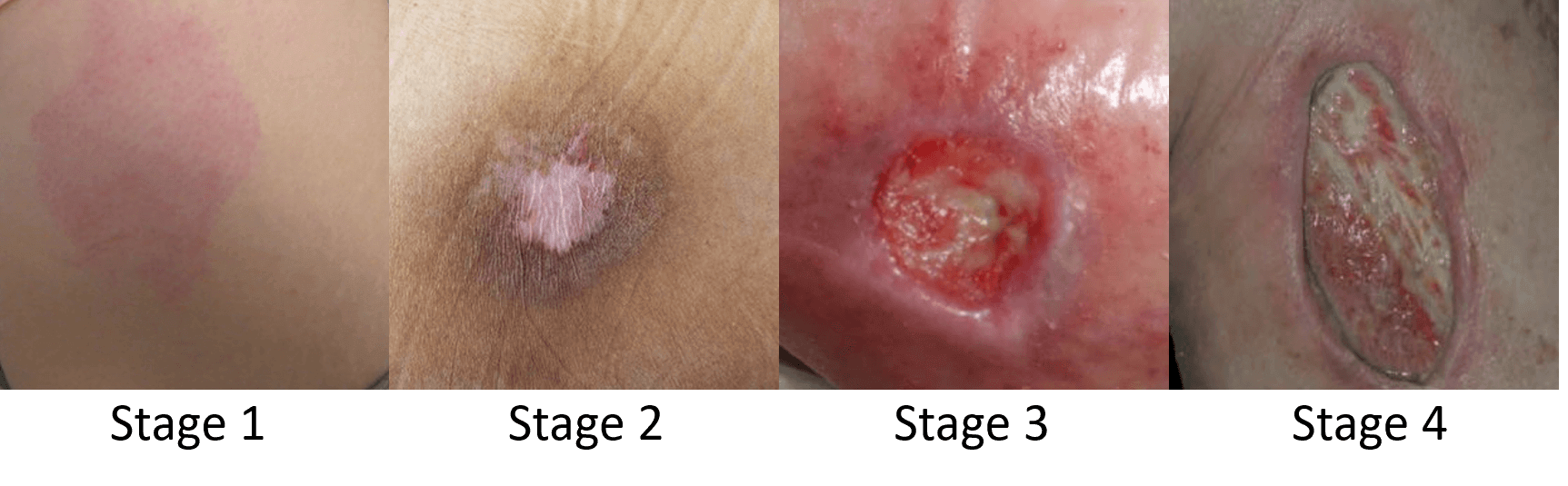
bed sore staging
GradeDescriptionManagement
INon-blanchable rednessProtective dressing
IIPartial thickness loss of skinMoist dressing; cleanse the wound
IIIFull thickness skin loss – fat visible
– No necrotic tissueMoist to absorbent dressing
Cleanse the wound
– Necrotic tissueDebridement (sharp if advancing cellulitis or autolytic/enzymatic/mechanical if non-urgent)
Then, moist to absorbent dressing; cleanse the wound
IVFull thickness skin loss – bone, tendon, muscle visible
– No necrotic tissueMoist to absorbent dressing
Cleanse the wound
– Necrotic tissueDebridement (sharp if advancing cellulitis or autolytic/enzymatic/mechanical if non-urgent)
Then, moist to absorbent dressing; cleanse the wound
Unclassified: Depth unknown (base covered by slough/eschar) and Suspected deep tissue injury (intact discolored skin)

Use topical antibiotics for local infection.

Patients who are at risk of pressure/bed sores

Mnemonic: Pressure Sores Are Not Much Fun

  1. Position change: restricted
  2. Sensation: impaired
  3. Activity: bedridden or chairbound
  4. Nutrition: poor
  5. Moisture: incontinence
  6. Friction shear: difficult transfers due to contractures/spasticity

Patients meeting 3 or more of the above requires intervention for bed sore prevention.

Reference: Maffeo, R. (1998). Clinical Notebook A quick mnemonic for predicting pressure sores in ED patients. Journal of Emergency Nursing, 24(5), 418–419. doi:10.1016/s0099-1767(98)70009-1

Pressure/Bed sore Prevention

Mnemonic: NO ULCERS

  1. Nutrition and fluid status
  2. Observation of skin
  3. Up and walking or assist with position changes
  4. Lift, don’t drag
  5. Clean skin and continence area
  6. Elevate heels
  7. Risk assessment
  8. Support surfaces
  • Facebook
  • Twitter
PGMEE, MRCS, USMLE, MBBS, MD/MS General conceptsNursing

Post navigation

Previous post
Next post

Related Posts

PGMEE, MRCS, USMLE, MBBS, MD/MS

Bronchopulmonary segments : Mnemonic

Jun 12, 2023May 19, 2024

Features of Bronchopulmonary segments: Right Lung Mnemonic: A PALM Seed Makes Another Little Palm (from top to bottom) 1. Superior lobe: 2. Middle lobe: 3. Inferior lobe: Left Lung Instead of lateral and medial segment as described in middle lobe of right lung, the left lung lingula has: Some books…

Read More
PGMEE, MRCS, USMLE, MBBS, MD/MS

Median, Ulnar and Radial Nerve – Course and Innervation

Aug 8, 2023Aug 8, 2023

Median nerve, Ulnar nerve and Radial nerve are the 3 major nerves of the upper limb originating from the brachial plexus. Some important neuroanatomic relationships in the forearm are: 1. Medial nerve: Crossed by brachial artery from lateral to medial just above the elbow to lie medial to brachial artery…

Read More
PGMEE, MRCS, USMLE, MBBS, MD/MS fetal circulation schematic

Fetal Circulation Made Easy

Aug 8, 2016Jun 2, 2020

Following are the important features of fetal circulation: 1. Placenta plays the role of lungs; lungs are not functional: Like pulmonary veins, left umbilical vein carries highly oxygenated blood from placenta to heart. Like pulmonary artery, right and left umbilical arteries braing deoxygenated blood to placenta. 2. Mixing potentially occurs…

Read More

Leave a Reply Cancel reply

Your email address will not be published. Required fields are marked *

This site uses Akismet to reduce spam. Learn how your comment data is processed.

Epomedicine. Pressure Sores and Bed Sores [Internet]. Epomedicine; 2022 Oct 22 [cited 2025 Dec 22]. Available from: https://epomedicine.com/medical-students/pressure-sores-and-bed-sores/.

Pre-clinical (Basic Sciences)

Anatomy

Biochemistry

Community medicine (PSM)

Embryology

Microbiology

Pathology

Pharmacology

Physiology

Clinical Sciences

Anesthesia

Dermatology

Emergency medicine

Forensic

Internal medicine

Gynecology & Obstetrics

Oncology

Ophthalmology

Orthopedics

Otorhinolaryngology (ENT)

Pediatrics

Psychiatry

Radiology

Surgery

RSS Ask Epomedicine

  • What to study for Clinical examination in Orthopedics?
  • What is the mechanism of AVNRT?

Epomedicine weekly

  • About Epomedicine
  • Contact Us
  • Author Guidelines
  • Submit Article
  • Editorial Board
  • USMLE
  • MRCS
  • Thesis
©2025 Epomedicine . All rights reserved.