Skip to content
Epomedicine

Mnemonics, Simplified Concepts & Thoughts

Epomedicine

Mnemonics, Simplified Concepts & Thoughts

Phases of Clinical Trial : Mnemonic

Epomedicine, Sep 7, 2023Sep 7, 2023

Clinical trials conduct ‘human experiments’. Three fundamental principles apply:

  • The trial must address a legitimate question
  • The patient must be informed and willing to participate
  • The patient may decline entry or withdraw at any stage

Blinding:

  1. Unblinded: All are aware of the treatment the participant receives
  2. Single blinding: Only the participant is unaware of the treatment they receive
  3. Double blinding: The participant and clinician (data collectors) are unaware of the treatment the participant receives
  4. Triple blinding: Participant, clinician and data analysts – all are unaware of the treatment the participant receives
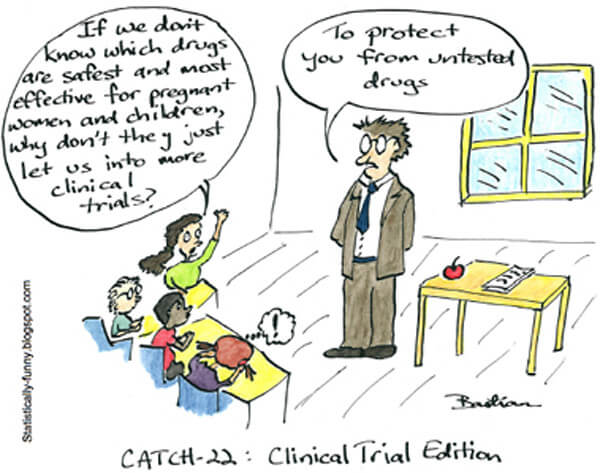
clinical trials
“Catch-22 Clinical Trial Edition” by DES Daughter is licensed under CC BY-NC-SA 2.0.

Phases:

Mnemonic: I SWIM

PhasePurposeNameSampleBlinding and control
0Initial (Pharmacokinetics and Pharmacodynamics)Microdosing studiesHealthy volunteers (smaller)No
ISafe? (Safe maximum dose and tolerability)Human pharmacology and safetyHealthy volunteers (larger)No
IIWorks? (Efficacy)Therapeutic exploratoryPatients (smaller)Single
IIIImprovement from current standard?Therapeutic safetyPatients (larger)Double
IVMarket suitability?Post-marketing surveillancePatients being treated by doctors
  • Facebook
  • Twitter
PGMEE, MRCS, USMLE, MBBS, MD/MS Community medicine

Post navigation

Previous post
Next post

Related Posts

PGMEE, MRCS, USMLE, MBBS, MD/MS Visual field defect ethambutol

Ethambutol Induced Optic Neuropathy

Mar 27, 2017

Mechanism of Ethambutol induced optic neuropathy Ethambutol is metabolized to a chelating agent. The chelating agent formed then may impair the function of metal-containing mitochondiral enzymes, such as the copper containing cytochrome-c oxidase of complex IV and the iron containing NADH:Q oxidoreductase of complex I. These mitochondrial respiratory chain play…

Read More
PGMEE, MRCS, USMLE, MBBS, MD/MS prostate arteries

Prostate Anatomy – Clinical correlate

Aug 15, 2016Aug 18, 2016

Anatomy of Prostate The embryology and detailed gross and microscopic anatomy of the prostate has already been discussed earlier. Read the anatomy of prostate. Benign Prostatic Hyperplasia (BPH) Occurs exclusively in transition zone (progressively enlarges with age). Median lobe of the gland enlarges upward and encroaches sphincter vesicae, located at…

Read More
PGMEE, MRCS, USMLE, MBBS, MD/MS brodmann areas

Brodmann Areas and Lesions

Jul 31, 2016Aug 1, 2016

Frontal Lobe Area 4 (Precentral gyrus): Primary motor cortex (gigantopyramidal – only area that contains giant pyramidal cells of Betz) Lesion: Contralateral spastic paralysis (UMNL) Area 6 (Superior frontal gyrus; agranular frontal): Premotor cortex and Supplementary motor cortex (Motor planning) Lesion: Apraxia (Unable to perform movements in correct sequence) Area…

Read More

Comment

  1. Kelvin says:
    Sep 10, 2023 at 6:45 pm

    This is awesome. Thank you 🙏🏾

    Reply

Leave a Reply to Kelvin Cancel reply

Your email address will not be published. Required fields are marked *

This site uses Akismet to reduce spam. Learn how your comment data is processed.

Pre-clinical (Basic Sciences)

Anatomy

Biochemistry

Community medicine (PSM)

Embryology

Microbiology

Pathology

Pharmacology

Physiology

Clinical Sciences

Anesthesia

Dermatology

Emergency medicine

Forensic

Internal medicine

Gynecology & Obstetrics

Oncology

Ophthalmology

Orthopedics

Otorhinolaryngology (ENT)

Pediatrics

Psychiatry

Radiology

Surgery

RSS Ask Epomedicine

  • What to study for Clinical examination in Orthopedics?
  • What is the mechanism of AVNRT?

Epomedicine weekly

  • About Epomedicine
  • Contact Us
  • Author Guidelines
  • Submit Article
  • Editorial Board
  • USMLE
  • MRCS
  • Thesis
©2026 Epomedicine | WordPress Theme by SuperbThemes