Skip to content
Epomedicine

Mnemonics, Simplified Concepts & Thoughts

Epomedicine

Mnemonics, Simplified Concepts & Thoughts

Diffusion-Perfusion-limited-Gas-Exchange

Perfusion and Diffusion Limited Gas Exchange

Epomedicine, Jul 7, 2018

Diffusion-Perfusion-limited-Gas-Exchange

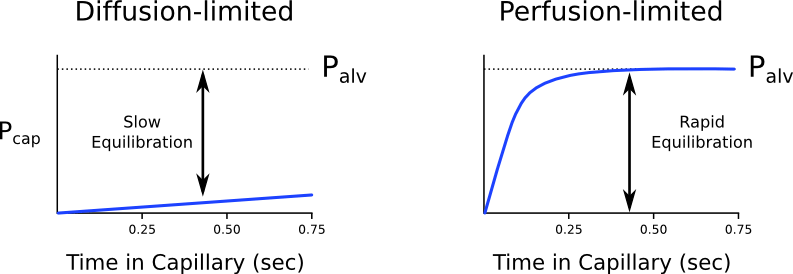
Under resting conditions, red blood cells move through the pulmonary capillary bed in approximately 0.75 seconds (transit time), although equilibration of oxygen and carbon dioxide takes place in about 0.25 seconds.

In a diffusion limited gas exchange situation, the alveolar gas is still equilibrating with the blood cell at the end of its transit time. In a perfusion limited gas exchange situation, the blood cell has reached equilibration with alveolar gas during its transit time. Carbon monoxide represents a diffusion-limited gas exchange, whereas oxygen, nitrous oxide and carbon dioxide are perfusion limited.

For example, nitrous oxide diffuses rapidly from the alveoli to capillary blood, so the only way to increase its uptake is to increase the amount of blood flowing through the alveolar capillaries. It is an example of perfusion limited gas. Changes in the diffusing capacity have no effect on the uptake of a perfusion-limited gas or its partial pressure in the blood and body. All anesthetic and “inert gases” that do not react chemically with blood are perfusion limited.

The uptake of a gas that does not reach achieve diffusion equilibrium could obviously increase if the diffusing capacity is increased. CO is an example of diffusion limited gas. Hemoglobin has a very high affinity for CO, so the effective solubility of CO in blood is large. Therefore, increases in the CO concentration in blood are not effective at increasing pCO. This keeps blood pCO lower than alveolar pCO, and results in a large disequilibrium and diffusion limitation. Under abnormal conditions, oxygen may be diffusion limited. A gas is diffusion limited gas when its effective solubility in blood is significantly greater than its solubility in the blood-gas barrier. This is because a gas has to dissolve in the barrier before it can diffuse across the barrier and dissolve in the blood.
  • Facebook
  • Twitter
PGMEE, MRCS, USMLE, MBBS, MD/MS AnesthesiaPhysiologyRespiratory system

Post navigation

Previous post
Next post

Related Posts

PGMEE, MRCS, USMLE, MBBS, MD/MS

Hypertensive Disorders in Pregnancy – Basics

Aug 30, 2014Aug 17, 2015

Hypertensive disorders in pregnancy is a term that encompass wide range of blood pressure related disorders during pregnancy like gestational hypertension, pre-eclampsia, eclampsia, etc. Blood pressure in Normal Pregnancy: During middle trimester, due to the reduction in Systemic Vascular Resistance (SVR) and Arterio-venous (AV) shunting within the uterus and intervillous…

Read More
PGMEE, MRCS, USMLE, MBBS, MD/MS

Well’s criteria for DVT with Mnemonic

Oct 9, 2020Jun 18, 2022

Mnemonic: ABCD(CD)E(CDE) – 4P A: Alternate diagnosis of DVT more likely (-2) B: Bedridden recently >3 days or Big (major) surgery within 3 months (+1) C: Cancer – treatment or palliation within 6 months (+1) D: Deep venous involvement: Mnemonic – CD Collateral (non-varicose) superficial veins present (+1) Deep venous…

Read More
PGMEE, MRCS, USMLE, MBBS, MD/MS psychiatry symbol

Definition of terms in Psychiatry

Nov 15, 2020Nov 15, 2020

1. Speech: Ideas, thoughts, feelings expressed through language 2. Emotion: Complex phenomenon involving reactions in 3 different components: Feeling experienced by subject (joy, sadness, anger) Behavioral (expressive component) Autonomic and endocrine component 3. Affect: Objective outward expression of the immediate cross-section emotion at a given time 4. Mood: Sustained pervasive…

Read More

Leave a Reply Cancel reply

Your email address will not be published. Required fields are marked *

This site uses Akismet to reduce spam. Learn how your comment data is processed.

Epomedicine. Perfusion and Diffusion Limited Gas Exchange [Internet]. Epomedicine; 2018 Jul 7 [cited 2026 Jan 17]. Available from: https://epomedicine.com/medical-students/perfusion-and-diffusion-limited-gas-exchange/.

Pre-clinical (Basic Sciences)

Anatomy

Biochemistry

Community medicine (PSM)

Embryology

Microbiology

Pathology

Pharmacology

Physiology

Clinical Sciences

Anesthesia

Dermatology

Emergency medicine

Forensic

Internal medicine

Gynecology & Obstetrics

Oncology

Ophthalmology

Orthopedics

Otorhinolaryngology (ENT)

Pediatrics

Psychiatry

Radiology

Surgery

RSS Ask Epomedicine

  • What to study for Clinical examination in Orthopedics?
  • What is the mechanism of AVNRT?

Epomedicine weekly

  • About Epomedicine
  • Contact Us
  • Author Guidelines
  • Submit Article
  • Editorial Board
  • USMLE
  • MRCS
  • Thesis
©2026 Epomedicine . All rights reserved.