Skip to content
Epomedicine

Mnemonics, Simplified Concepts & Thoughts

Epomedicine

Mnemonics, Simplified Concepts & Thoughts

Anterior Cranial Fossa : Mnemonic

Epomedicine, Apr 29, 2024Apr 29, 2024

Boundaries

  1. Anterior and Lateral: Frontal bone (inner surface)
  2. Posterior:
    • Medial: Sphenoid (limbus)
    • Lateral: Sphenoid (lesser wing)
  3. Floor: Frontal bone, Ethmoid bone, Sphenoid bone (lesser wing and anterior aspect of body)
Anterior cranial fossa
Polygon data were generated by Database Center for Life Science (DBCLS), CC BY-SA 2.1 JP, via Wikimedia Commons

Contents

Mnemonic: Remember 6 ‘C’

1. Frontal Crest: Site of attachment of falx cerebri

2. Foramen Cecum (Between frontal crest and crista galli): Site of communication between the draining veins of nasal cavity and the superior sagittal sinus

3. Crista galli: Site of attachment for falx cerebri

4. Cribiform plate: Supports Olfactory bulb and Olfactory tract runs through it

  • 2 foramina lateral to the olfactory bulb:
    • Anterior ethmoidal foramen: transmits anterior ethmoidal artery, nerve and vein
    • Posterior ethmoidal foramen: transmits posterior ethmoidal artery, nerve and vein

5. Anterior Clinoid process (formed by lesser wing of sphenoid): Important landmark for the optic nerve and supracavernous Internal Carotid Artery (ICA)

6. Chiasmatic sulcus: for optic chiasm

Clinical considerations

Fractures of the anterior cranial fossa:

  1. Bleeding: from anterior meningeal vessels when dura is torn
  2. Anosmia: injury to olfactory nerve fibers which run through the cribiform plate
  3. CSF rhinorrhea: tear in meningeal coverings leading to leakage of CSF into nasal cavity

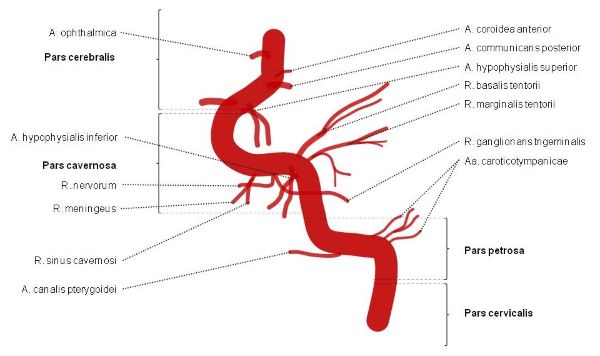
Ophthalmic artery:

  • Branch of supraclinoid portion of ICA
  • Origin is medial to anterior clinoid process and below the optic nerve
  • At the level of optic canal, the artery has passed to a position lateral to the nerve
  • This anatomical fact must be kept in mind during the opening of the falciform ligament to avoid an iatrogenic lesion of the artery
  • Facebook
  • Twitter
PGMEE, MRCS, USMLE, MBBS, MD/MS AnatomyNervous system

Post navigation

Previous post
Next post

Related Posts

PGMEE, MRCS, USMLE, MBBS, MD/MS

Short external rotator muscles : Hip

May 24, 2023May 24, 2023

Short external rotators of hip in general originate from sacrum and ischium and insert on and around greater trochanter of femur. Mnemonic: P GO GO Q From proximal, the short external rotators of hip are: Muscle Proximal attachment Distal attachment Innervation Piriformis Sacrum – anterior aspectSacrotuberous ligament Greater trochanter –…

Read More
PGMEE, MRCS, USMLE, MBBS, MD/MS

Fascia Lata and Tensor Fascia Lata

Jun 16, 2020Jun 16, 2020

Fascia lata and Tensor fascia lata althought different structures is often mistaken as the same by the students. Fascia Lata It is the fascial ‘stocking’ deep to the skin and superficial fascial and encloses the muscle of thigh. Proximally, its attachment can be traced around the pelvis and distally, it…

Read More
PGMEE, MRCS, USMLE, MBBS, MD/MS neutropenia

Neutropenic Fever and Empiric Therapy

Jul 4, 2016Jul 4, 2016

Synonym: Febrile Neutropenia Definition of Neutropenic Fever Fever: Single oral temperature ≥ 38.3 °c (101 °F) or ≥ 38 °c (100.4 °F) sustained over 1 hour Neutropenia: Absolute Neutrophil Count (ANC) <500 cells/cu.mm or ANC expected to fall <500/cu.mm in next 48 hours Profound neutropenia: ANC <100/cu.mm Prolonged neutropenia: Neutropenia for >7 days…

Read More

Leave a Reply Cancel reply

Your email address will not be published. Required fields are marked *

This site uses Akismet to reduce spam. Learn how your comment data is processed.

Epomedicine. Anterior Cranial Fossa : Mnemonic [Internet]. Epomedicine; 2024 Apr 29 [cited 2025 Dec 6]. Available from: https://epomedicine.com/medical-students/anterior-cranial-fossa-mnemonic/.

Pre-clinical (Basic Sciences)

Anatomy

Biochemistry

Community medicine (PSM)

Embryology

Microbiology

Pathology

Pharmacology

Physiology

Clinical Sciences

Anesthesia

Dermatology

Emergency medicine

Forensic

Internal medicine

Gynecology & Obstetrics

Oncology

Ophthalmology

Orthopedics

Otorhinolaryngology (ENT)

Pediatrics

Psychiatry

Radiology

Surgery

RSS Ask Epomedicine

  • What to study for Clinical examination in Orthopedics?
  • What is the mechanism of AVNRT?

Epomedicine weekly

  • About Epomedicine
  • Contact Us
  • Author Guidelines
  • Submit Article
  • Editorial Board
  • USMLE
  • MRCS
  • Thesis
©2025 Epomedicine . All rights reserved.