Skip to content
Epomedicine

Mnemonics, Simplified Concepts & Thoughts

Epomedicine

Mnemonics, Simplified Concepts & Thoughts

NSAIDs : Mnemonics

Epomedicine, Jul 28, 2022Jul 28, 2022

Classification

Mnemonic: Prescribed By SOFIA

  1. Propionic acid derivatives: Ibuprofen, Ketoprofen, Flurbiprofen, Naproxen
  2. Pyrrolo-pyrrole derivates: Ketoroloac
  3. Pyrazolone derivatives: Phenylbutazone, Oxybutazone
  4. Benzoxazocine derivatives: Nefopam
  5. Salicyaltes: Aspirin
  6. Selective COX-2 inhibitor: Celecoxib, Etoricoxib, Parecoxib
  7. Oxicam derivatives: Piroxicam, Tenoxicam
  8. Fenamic acid derivatives: Mefenamic acid (Anthranilic acid derivative)
  9. Indol derivatives: Indomethacin, Sulindac
  10. Aryl acetic acid derivatives: Diclofenac, Aceclofenac
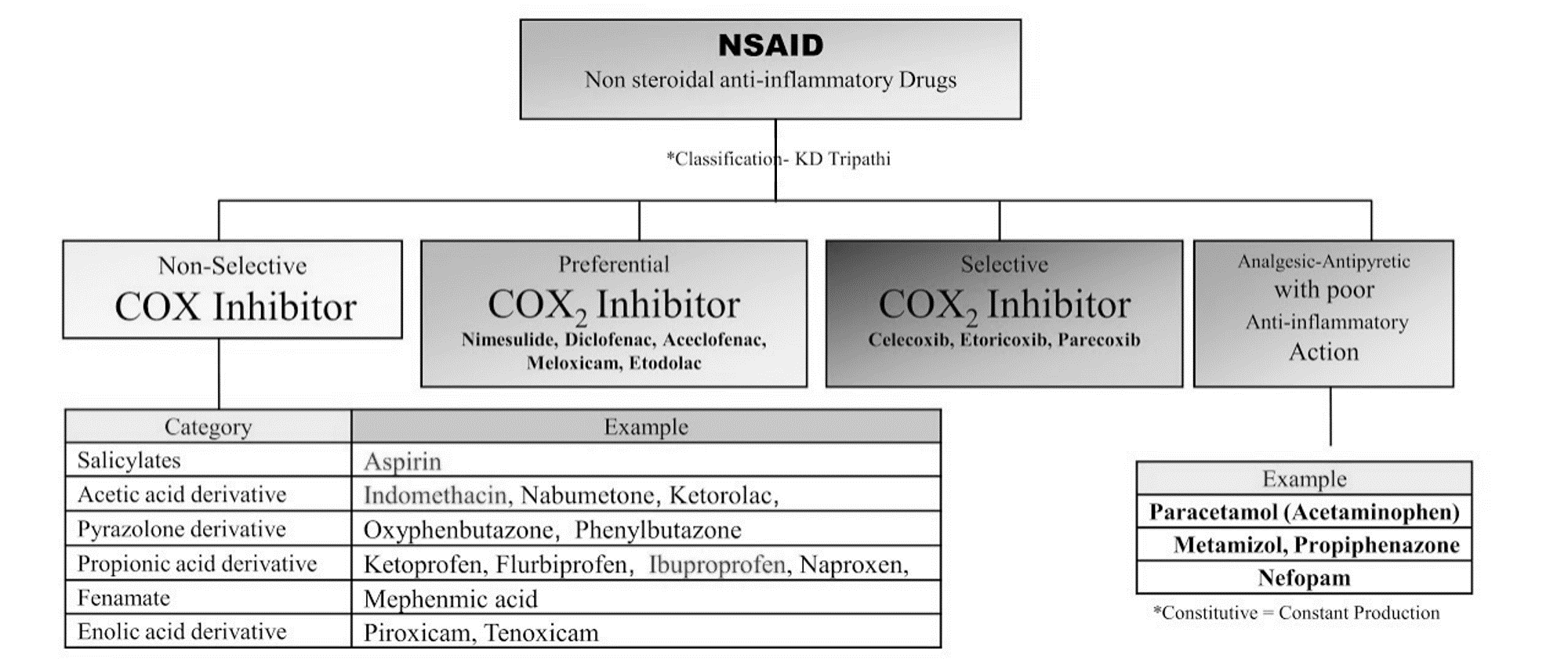
nsaid classification

Side effects and Contraindications

Mnemonic: BARS

  1. Bleeding
    • Inhibit platelet cycloxygenase (COX), thereby blocking the formation of thromboxane A2 (TXA2) and impairing TXA2 dependent platelet aggregation
  2. Asthma
    • Inhibition of COX pathway shifts the arachidonic acid metabolism to Lipoxygenase (LOX) pathway leading to increased leukotriene synthesis
  3. Allergy
    • Upto 2% prevalence
  4. Renal disease
    • Inhibition of PGE2/PGI2 leads to constriction of afferent arteriole and pre-renal AKI
    • Leads to sodium retention (peripheral edema, hypertension, heart failure)
  5. Stomach: Mucosal damage by –
    • COX-1 inhibition: Reduced blood flow
    • Topical irritation: Epithelial damage
    • COX-2 inhibition: Leukocyte adherence

Beneficial effects

Mnemonic: Five “A”s

  1. Analgesic
  2. Antipyretic
  3. Anti-inflammatory
  4. Anti-thrombotic
  5. Arteriosus closure (PDA closure)
8 shares
  • Facebook8
  • Twitter
PGMEE, MRCS, USMLE, MBBS, MD/MS Pharmacology

Post navigation

Previous post
Next post

Related Posts

PGMEE, MRCS, USMLE, MBBS, MD/MS gastric glands

Gastric Acid Secretion in Parietal cells: Mechanism

Jun 16, 2023Jun 16, 2023

Key player: H+/K+ ATPase or “proton pump” (in canalicular membrane of parietal cells) a. Hydrogen ions are generated within the parietal cell from dissociation of water. The hydroxyl ions formed in this process rapidly combine with carbon dioxide to form bicarbonate ion, a reaction catalyzed by carbonic anhydrase. b. Bicarbonate…

Read More
PGMEE, MRCS, USMLE, MBBS, MD/MS acetylcoa carboxylase

Fatty Acid Synthesis : Simplified

Jul 30, 2018

Enzymes: Fatty acid synthase (6 enzymes and 1 Acyl carrier protein molecule) Acetyl-CoA carboxylase (rate-limiting enzyme) Starting material: For palmitate synthesis: Acetyl-CoA For odd number carbon long chain fatty acid synthesis: Propionyl-CoA 2 Carbon donor: Malonyl-CoA (donates 2 C and 1 C is thrown out as CO2) Site: Cytosol Citrate…

Read More
PGMEE, MRCS, USMLE, MBBS, MD/MS

Le Fort Fractures : Mnemonics

Jun 21, 2023Aug 15, 2023

Le Fort fractures are the fractures that separate mid-face from the skull. Classification All of these subtypes involve a fracture of the pterygoid plate. LeFort type Fracture configuration Mnemonic Mnemonic I Horizontal Floating palate Speak no evil – fracture through maxilla just above roots of teeth (affects speaking) II Pyramidal…

Read More

Leave a Reply Cancel reply

Your email address will not be published. Required fields are marked *

This site uses Akismet to reduce spam. Learn how your comment data is processed.

Pre-clinical (Basic Sciences)

Anatomy

Biochemistry

Community medicine (PSM)

Embryology

Microbiology

Pathology

Pharmacology

Physiology

Clinical Sciences

Anesthesia

Dermatology

Emergency medicine

Forensic

Internal medicine

Gynecology & Obstetrics

Oncology

Ophthalmology

Orthopedics

Otorhinolaryngology (ENT)

Pediatrics

Psychiatry

Radiology

Surgery

RSS Ask Epomedicine

  • What to study for Clinical examination in Orthopedics?
  • What is the mechanism of AVNRT?

Epomedicine weekly

  • About Epomedicine
  • Contact Us
  • Author Guidelines
  • Submit Article
  • Editorial Board
  • USMLE
  • MRCS
  • Thesis
©2026 Epomedicine | WordPress Theme by SuperbThemes