Skip to content
Epomedicine

Mnemonics, Simplified Concepts & Thoughts

Epomedicine

Mnemonics, Simplified Concepts & Thoughts

Nerve fibers – Classification

Epomedicine, Sep 7, 2020Sep 7, 2020

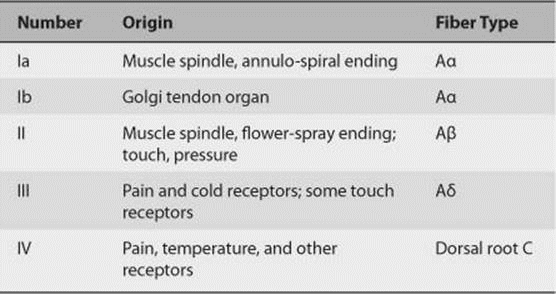
Nerve fibers can be classified as A, B and C and A type fibers can be further classified into alpha, beta, gamma and delta. The size and myelination (thus conduction) progressively decreases in the descending order.
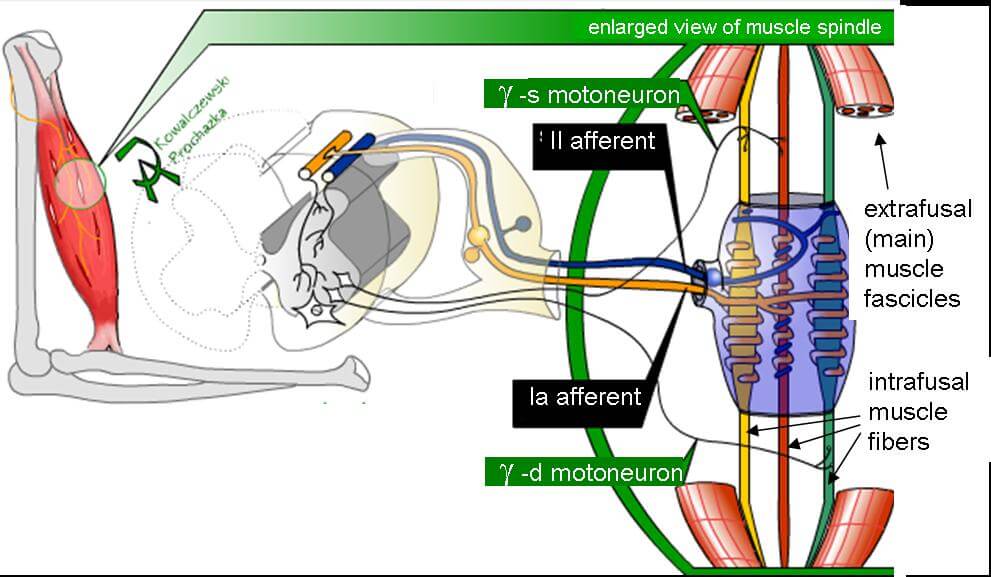
muscle spindle model
Neuromechanics / Public domain

A alpha:

  1. Efferent (Somatic motor) – To extrafusal fibers (muscle spindle)
  2. Afferent (Proprioception):
    1. Ia – Muscle spindle (Annulospiral endings)
    2. Ib – Golgi tendon organ

spindLE = LEngth of muscle
TENdon = TENsion of muslcle

A beta:

  • Mechanoafferents of skin (Fine touch, Pressure, Vibration)
  • Type II afferent fibers (secondary fibers from muscle spindle)

A gamma:

Efferents – To intrafusal fibers (muscle spindel)

A delta:

Fast (sharp) pain and Temperature (cold)

B: Preganglionic sympathetic (Autonomic nervous system)

C:

  1. Dorsal root: Slow pain, Temperature (hot)
  2. Sympathetic: Postganglionic
nerve fibers type

Motor fibers:

TypeErlanger-Gasser
Classification
DiameterMyelinConduction velocityAssociated muscle fibers
αAα13–20 μmYes80–120 m/sExtrafusal muscle fibers
γAγ5–8 μmYes4–24 m/sIntrafusal muscle fibers

Afferent fibers:

TypeErlanger-Gasser
Classification
DiameterMyelinConduction velocityAssociated sensory receptors
IaAα13–20 μmYes80–120 m/sMuscle spindle
IbAα13–20 μmYes80–120 m/sGolgi tendon organ
IIAβ6–12 μmYes33–75 m/sSecondary receptors of muscle spindle
All cutaneous mechanoreceptors
IIIAδ1–5 μmThin3–30 m/sFree nerve endings of touch and pressure
Nociceptors of neospinothalamic tract
Cold thermoreceptors
IVC0.2–1.5 μmNo0.5–2.0 m/sNociceptors of paleospinothalamic tract
Warmth receptors

Susceptibilities of the nerve fibers to LA, pressure and hypoxia:

  • A fibers are most susceptible to pressure
  • B fibers are most susceptible to hypoxia
  • C fibers are most susceptible to local anaesthetics
  • C fibers are least susceptible to hypoxia and pressure
  • A fibers are least susceptible to local anaesthetics

If you have any mnemonics or ideas for remembering these, share with the world by writing in the comments.
5 shares
  • Facebook5
  • Twitter
PGMEE, MRCS, USMLE, MBBS, MD/MS AnesthesiaNervous systemPhysiology

Post navigation

Previous post
Next post

Related Posts

PGMEE, MRCS, USMLE, MBBS, MD/MS

Apt Test in Newborn: Maternal vs Neonatal Blood

Nov 19, 2022Nov 19, 2022

We had few cases of suspected GI bleeding, admitted or referred to our NICU. One was case of Hematochezia and other was case of fresh blood in vomitus. Both babies were born to mother with Antepartum hemorrhage. The general condition of the babies were fine, and the vitals. There was…

Read More
PGMEE, MRCS, USMLE, MBBS, MD/MS

How to crack Postgraduate MD/MS Entrance Examination?

May 24, 2024May 26, 2024

(Article for Nepalese/ Indian and South Asian students) Postgraduate entrance exam for MD/MS is one of the toughest examinations in Nepal. The cut throat competition, the dilemma between studying or earning, and the pressure to perform against the toppers and best minds in the country make it one of the…

Read More
PGMEE, MRCS, USMLE, MBBS, MD/MS gastric glands

Gastric Acid Secretion in Parietal cells: Mechanism

Jun 16, 2023Jun 16, 2023

Key player: H+/K+ ATPase or “proton pump” (in canalicular membrane of parietal cells) a. Hydrogen ions are generated within the parietal cell from dissociation of water. The hydroxyl ions formed in this process rapidly combine with carbon dioxide to form bicarbonate ion, a reaction catalyzed by carbonic anhydrase. b. Bicarbonate…

Read More

Comments (4)

  1. MERAJ ur rahman says:
    Sep 24, 2020 at 10:40 am

    IT’S help me a lot easy way to learn more in short time .great work

    Reply
  2. Shaina Pinto says:
    Feb 19, 2022 at 6:45 pm

    susceptibility to various agents : HPA axis ( hypoxia , pressure anaesthesia )
    most susceptible to least susceptible
    B A C k
    A B B
    C
    k

    Reply
  3. Karunakar says:
    Aug 25, 2022 at 4:51 pm

    May I know y they are susceptible for particular condition??

    Reply
  4. Alina says:
    May 31, 2023 at 6:37 pm

    i want to know the reason why they are susceptible to those conditions

    Reply

Leave a Reply Cancel reply

Your email address will not be published. Required fields are marked *

This site uses Akismet to reduce spam. Learn how your comment data is processed.

Pre-clinical (Basic Sciences)

Anatomy

Biochemistry

Community medicine (PSM)

Embryology

Microbiology

Pathology

Pharmacology

Physiology

Clinical Sciences

Anesthesia

Dermatology

Emergency medicine

Forensic

Internal medicine

Gynecology & Obstetrics

Oncology

Ophthalmology

Orthopedics

Otorhinolaryngology (ENT)

Pediatrics

Psychiatry

Radiology

Surgery

RSS Ask Epomedicine

  • What to study for Clinical examination in Orthopedics?
  • What is the mechanism of AVNRT?

Epomedicine weekly

  • About Epomedicine
  • Contact Us
  • Author Guidelines
  • Submit Article
  • Editorial Board
  • USMLE
  • MRCS
  • Thesis
©2026 Epomedicine | WordPress Theme by SuperbThemes