Skip to content
Epomedicine

Mnemonics, Simplified Concepts & Thoughts

Epomedicine

Mnemonics, Simplified Concepts & Thoughts

Nerve fibers – Classification

Epomedicine, Sep 7, 2020Sep 7, 2020

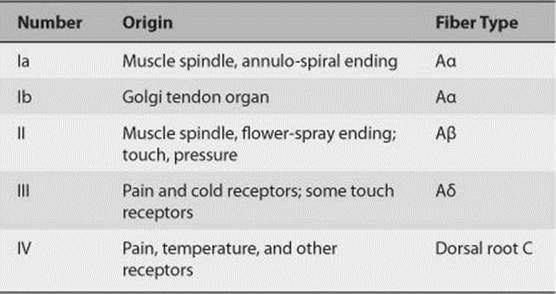
Nerve fibers can be classified as A, B and C and A type fibers can be further classified into alpha, beta, gamma and delta. The size and myelination (thus conduction) progressively decreases in the descending order.
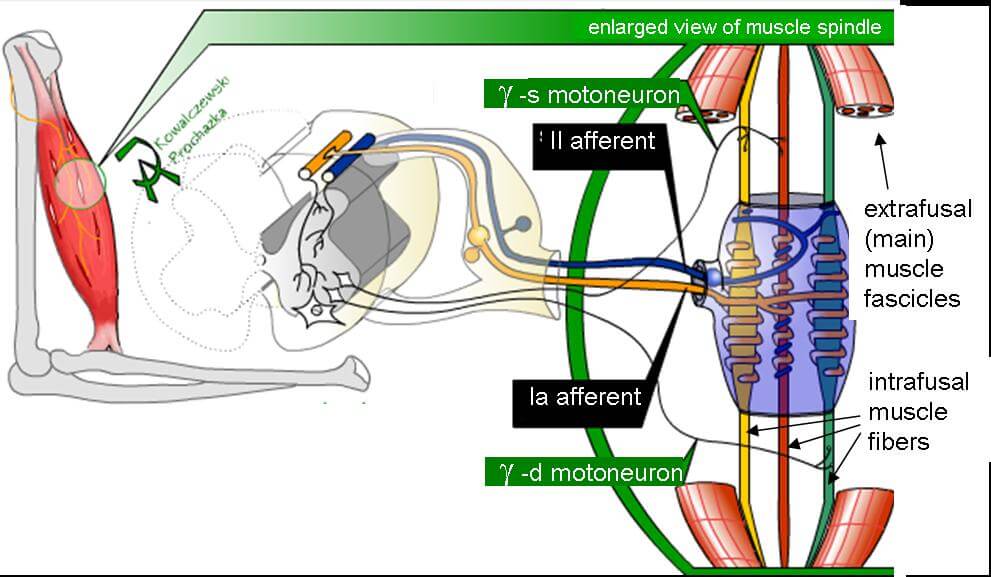
muscle spindle model
Neuromechanics / Public domain

A alpha:

  1. Efferent (Somatic motor) – To extrafusal fibers (muscle spindle)
  2. Afferent (Proprioception):
    1. Ia – Muscle spindle (Annulospiral endings)
    2. Ib – Golgi tendon organ

spindLE = LEngth of muscle
TENdon = TENsion of muslcle

A beta:

  • Mechanoafferents of skin (Fine touch, Pressure, Vibration)
  • Type II afferent fibers (secondary fibers from muscle spindle)

A gamma:

Efferents – To intrafusal fibers (muscle spindel)

A delta:

Fast (sharp) pain and Temperature (cold)

B: Preganglionic sympathetic (Autonomic nervous system)

C:

  1. Dorsal root: Slow pain, Temperature (hot)
  2. Sympathetic: Postganglionic
nerve fibers type

Motor fibers:

TypeErlanger-Gasser
Classification
DiameterMyelinConduction velocityAssociated muscle fibers
αAα13–20 μmYes80–120 m/sExtrafusal muscle fibers
γAγ5–8 μmYes4–24 m/sIntrafusal muscle fibers

Afferent fibers:

TypeErlanger-Gasser
Classification
DiameterMyelinConduction velocityAssociated sensory receptors
IaAα13–20 μmYes80–120 m/sMuscle spindle
IbAα13–20 μmYes80–120 m/sGolgi tendon organ
IIAβ6–12 μmYes33–75 m/sSecondary receptors of muscle spindle
All cutaneous mechanoreceptors
IIIAδ1–5 μmThin3–30 m/sFree nerve endings of touch and pressure
Nociceptors of neospinothalamic tract
Cold thermoreceptors
IVC0.2–1.5 μmNo0.5–2.0 m/sNociceptors of paleospinothalamic tract
Warmth receptors

Susceptibilities of the nerve fibers to LA, pressure and hypoxia:

  • A fibers are most susceptible to pressure
  • B fibers are most susceptible to hypoxia
  • C fibers are most susceptible to local anaesthetics
  • C fibers are least susceptible to hypoxia and pressure
  • A fibers are least susceptible to local anaesthetics

If you have any mnemonics or ideas for remembering these, share with the world by writing in the comments.
5 shares
  • Facebook5
  • Twitter
PGMEE, MRCS, USMLE, MBBS, MD/MS AnesthesiaNervous systemPhysiology

Post navigation

Previous post
Next post

Related Posts

PGMEE, MRCS, USMLE, MBBS, MD/MS erythropoietin mechanism

Erythropoietin (EPO) Physiology

Sep 2, 2017

Structure of erythropoietin (EPO) Glycoprotein hormone 165 amino acids Molecular mass – 30 kDa Site of production/synthesis of erythropoietin (EPO) Kidneys (75-90%): Peritubular interstitial cells Liver (15%; chief source in fetus and neonates): Centrilobular hepatocytes After birth, erythropoietin is not detectable until 8-12 weeks after birth leading to physiological anaemia…

Read More
PGMEE, MRCS, USMLE, MBBS, MD/MS tyrosinemia

Tyrosinemia Enzymes : Mnemonic

Aug 12, 2018Aug 12, 2018

Mnemonic: FAHeem TATtooes because of Histrionic Personality Disorder (HPD) Tyrosine is necessary for biosynthesis of catecholamines, thyroid hormones and melanin pigment. 1. Tyrosinemia type I (Tyrosinosis/Hepatorenal tyrosinemia): Enzyme defect: FAH (Fumaryl-acetoacetate hydroxylase) Last enzyme in the cycle Cabbage like odor Hepatocellular carcinoma Renal tubular acidosis Peripheral neuropathy 2. Tyrosinemia type II…

Read More
PGMEE, MRCS, USMLE, MBBS, MD/MS

Vesicoureteric reflux (VUR) Grading : Mnemonic

Jun 26, 2024Jun 26, 2024

Mnemonic: Upset Kidneys Drink Their Pee Grade 1: reflux up to Ureter (w/o dilation) Grade 2: reflux up to Kidneys (w/o dilation) Grade 3: Dilation (ureter/pelvis/calyces) Grade 4: Tortuosity (and worse dilation) Grade 5: Papillary impression loss Source: Tweet from Ben Abelson

Read More

Comments (4)

  1. MERAJ ur rahman says:
    Sep 24, 2020 at 10:40 am

    IT’S help me a lot easy way to learn more in short time .great work

    Reply
  2. Shaina Pinto says:
    Feb 19, 2022 at 6:45 pm

    susceptibility to various agents : HPA axis ( hypoxia , pressure anaesthesia )
    most susceptible to least susceptible
    B A C k
    A B B
    C
    k

    Reply
  3. Karunakar says:
    Aug 25, 2022 at 4:51 pm

    May I know y they are susceptible for particular condition??

    Reply
  4. Alina says:
    May 31, 2023 at 6:37 pm

    i want to know the reason why they are susceptible to those conditions

    Reply

Leave a Reply to MERAJ ur rahman Cancel reply

Your email address will not be published. Required fields are marked *

This site uses Akismet to reduce spam. Learn how your comment data is processed.

Pre-clinical (Basic Sciences)

Anatomy

Biochemistry

Community medicine (PSM)

Embryology

Microbiology

Pathology

Pharmacology

Physiology

Clinical Sciences

Anesthesia

Dermatology

Emergency medicine

Forensic

Internal medicine

Gynecology & Obstetrics

Oncology

Ophthalmology

Orthopedics

Otorhinolaryngology (ENT)

Pediatrics

Psychiatry

Radiology

Surgery

RSS Ask Epomedicine

  • What to study for Clinical examination in Orthopedics?
  • What is the mechanism of AVNRT?

Epomedicine weekly

  • About Epomedicine
  • Contact Us
  • Author Guidelines
  • Submit Article
  • Editorial Board
  • USMLE
  • MRCS
  • Thesis
©2026 Epomedicine | WordPress Theme by SuperbThemes