Skip to content
Epomedicine

Mnemonics, Simplified Concepts & Thoughts

Epomedicine

Mnemonics, Simplified Concepts & Thoughts

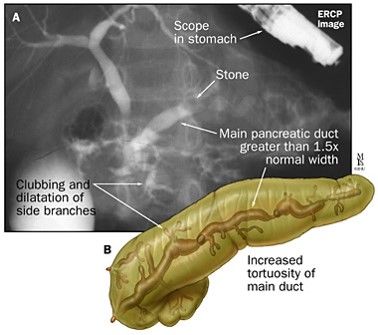
ERCP in pancreatitis

Mnemonic based management of Acute Pancreatitis

Epomedicine, Jul 27, 2021Jul 27, 2021

Acute pancreatitis along with case based discussion has been already covered earlier here:

Acute Pancreatitis – Case Discussion

To remember the initial management of acute pancreatitis, one can remember the mnemonics given below:

iPA-NCREAS (Ye et.al.)

Investigations:

  1. Imaging (CT, MRI or Ultrasonography)
  2. Prognostic screen to identify severe pancreatitis
  3. Amylase and lipase levels

Initial treatment:

  1. Nutritional support
  2. Cholecystectomy if suspected/proven gallstone pancreatitis
  3. Resuscitation of fluids
  4. ERCP within 72 hours of pain onset if gallstone pancreatitis
  5. Antibiotics
  6. Supplemental oxygen

Another acronym mnemonic based approach has been discussed by Khaliq et.al.

PANCREAS

  1. Perfusion:
    • Fluid resuscitation to maintain urine output 0.5-1 ml/kg/hr
    • Oxygenation in order to maintain SpO2 >95% in severe pancreatitis
  2. Analgesia: including opioids
  3. Nutrition: Enteral feeding within 48 hours (+/- nasojejunal feeding)
  4. Clinical: Prognostic scoring e.g. BISAP, RANSON, APACHE-II
  5. Radiology:
    • USG: to detect gallstones, choledocholithiasis and local complications
    • CECT: after 48-72 hours of pain onset to determine degree and extent of necrosis
    • Percutaneous catheter drainage guided by USG or CECT is helpful in management of necrosis and as bridging therapy until surgical management
  6. ERCP: with 72 hours if cholangitis or severe acute pancreatitis with persistent obstruction
  7. Antibiotics: Empirical antibiotics if infection is suspected
  8. Surgery: for –
    • MODS with necrosis unresponsive to conservative management and percutaneous drainage
    • Pseudo-aneurysm of surrounding vessels with bleeding
    • Infected necrosis
    • Pancreatic abscess
    • Bowel perforation
Amylase and Lipase in Acute Pancreatitis
  • Facebook
  • Twitter
PGMEE, MRCS, USMLE, MBBS, MD/MS Gastrointestinal systemGeneral SurgeryInternal medicine

Post navigation

Previous post
Next post

Related Posts

PGMEE, MRCS, USMLE, MBBS, MD/MS ECG interval

Basics of ECG- Interpretation of waves and intervals

Nov 9, 2013Jun 12, 2016

A normal ECG is electrical representation of a normal heart beat or sinus rhythm. The cardiac action potential causing deporalization and repolarization of various cardiac tissues gives a pattern of rhythic change is Electrocardiograph which can be used to diagnose different diseases of the CVS.   Normal Rate The beats…

Read More
PGMEE, MRCS, USMLE, MBBS, MD/MS

Ligaments of Pelvis

Oct 3, 2020Oct 3, 2020

Inherent stability of the pelvis is provided by ligaments. The 3 groups of ligaments are: 1. Sacrum to Pelvis: Sacroiliac ligamentous complex: is divided into posterior (short and long) and anterior ligaments. Posterior ligaments provide most of the stability. Sacrotuberous ligament: runs from the posterolateral aspect of the sacrum and the…

Read More
PGMEE, MRCS, USMLE, MBBS, MD/MS

Inferior Venacava (IVC) Tributaries and Abdominal Aorta Branches : Mnemonic

May 11, 2024May 11, 2024

Inferior Venacava (IVC) Tributaries Mnemonic: I Like To Rise So Incredibly High 1. common Iliac veins (L5) – Origin or Formation 2. Lumbar veins (L1-L5) 3. Testicular/gonadal veins – right (L2) 4. Renal veins (L1) 5. Suprarenal veins – right (L1) 6. Inferior phrenic veins (T8) 7. Hepatic veins (T8)…

Read More

Leave a Reply Cancel reply

Your email address will not be published. Required fields are marked *

This site uses Akismet to reduce spam. Learn how your comment data is processed.

Epomedicine. Mnemonic based management of Acute Pancreatitis [Internet]. Epomedicine; 2021 Jul 27 [cited 2026 Jan 17]. Available from: https://epomedicine.com/medical-students/mnemonic-management-acute-pancreatitis/.

Pre-clinical (Basic Sciences)

Anatomy

Biochemistry

Community medicine (PSM)

Embryology

Microbiology

Pathology

Pharmacology

Physiology

Clinical Sciences

Anesthesia

Dermatology

Emergency medicine

Forensic

Internal medicine

Gynecology & Obstetrics

Oncology

Ophthalmology

Orthopedics

Otorhinolaryngology (ENT)

Pediatrics

Psychiatry

Radiology

Surgery

RSS Ask Epomedicine

  • What to study for Clinical examination in Orthopedics?
  • What is the mechanism of AVNRT?

Epomedicine weekly

  • About Epomedicine
  • Contact Us
  • Author Guidelines
  • Submit Article
  • Editorial Board
  • USMLE
  • MRCS
  • Thesis
©2026 Epomedicine . All rights reserved.