Skip to content
Epomedicine

Mnemonics, Simplified Concepts & Thoughts

Epomedicine

Mnemonics, Simplified Concepts & Thoughts

Mediastinum : Simplified

Epomedicine, Aug 7, 2023Sep 7, 2023

It is the region in thoracic cavity between the pulmonary cavities (covered by mediastinal pleura and excludes the lungs).

Extent: Thoracic outlet (1st rib) to Diaphragm (T12)

Superior mediastinum:

Upper extentThoracic outlet
Contents (superficial to deep)1. Glands (Thymus and Lymph nodes)
2. 3 Veins (Brachiocephalic Lt. and Rt. and SVC)
3. 4 Arteries (Arch of aorta and it’s 3 branches)
4. 3 Nerves (Vagus, Phrenic and Left recurrent laryngeal)
5. 2 Tubes (Trachea and Esophagus)
7. 1 duct (Thoracic duct)
Lower extentLine through angle of Louis (manubriosternal joint to T4/5)
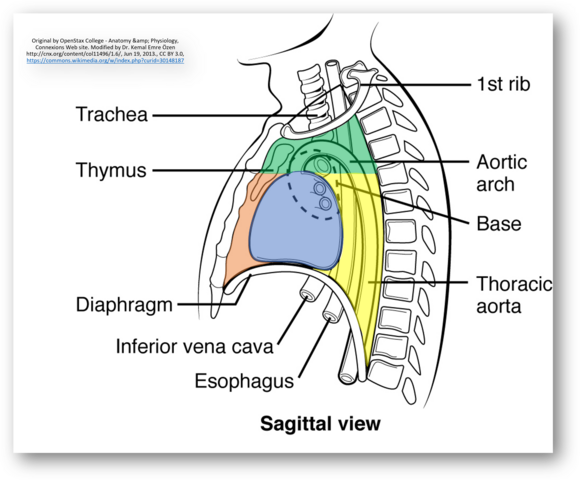
mediastinum
Illustration from Anatomy & Physiology, Connexions Web site. http://cnx.org/content/col11496/1.6/, Jun 19, 2013., CC BY-SA 3.0, via Wikimedia Commons
Green (Superior mediastinum); Orange (Anterior mediastinum); Blue (Middle mediastinum); Yellow (Posterior mediastinum)

Inferior mediastinum:

Anterior mediastinumMiddle mediastinumPosterior mediastinum
Upper extentT4/5T4/5T4/5
Contents1. Thymic remnants
2. Lymph nodes
3. Fat
1. Phrenic nerve
2. Pericardium
3. Heart
4. Ascending aorta
5. Pulmonary trunk
6. SVC
7. Lymph nodes
Remember esophageal and aortic openings of diaphragm: 3 gooses And A Duck.
1. Esophagoose
2. Right vagoose
3. Left vagoose
4. Aorta (descending)
5. Azygous vein
6. throacic Duct
7. Sympathetic and Splanchnic nerves
Lower extentnT9T9T12

Mediastinal masses

Anterior mediastinum: Mnemonic – 4 Ts

  1. Thymic neoplasm
  2. Teratoma
  3. Thyroid
  4. Terrible lymphoma

Middle mediastinum:

  1. Bronchogenic and pericardial cysts
  2. Esophageal tumors
  3. Vascular masses
  4. Lymphoma and lymph nodes

Posterior mediastinum: Mnemonic – MNOP

  1. Meningocele
  2. Neurogenic tumors
  3. Osseous tumors (Chordoma, Chondrosarcoma, Ewings)
  4. Paraspinal abscess
  • Facebook
  • Twitter
PGMEE, MRCS, USMLE, MBBS, MD/MS AnatomyCardiovascular systemRespiratory system

Post navigation

Previous post
Next post

Related Posts

PGMEE, MRCS, USMLE, MBBS, MD/MS

Staging of Gynecological Cancers : Simplified

Apr 5, 2026

FIGO-staging is a classification system used to describe size and extent of gynaecological cancers, using the FIGO nomenclature (International Federation of Gynecology and Obstetrics). Carcinoma cervix Endometrial cancer Carcinoma ovary Basis of staging Clinical (examination + radiographs) Surgical (pathologic assessment) Surgical (pathologic assessment) FIGO stages 2018 2023 2014 I Confined…

Read More
PGMEE, MRCS, USMLE, MBBS, MD/MS

Extremity Amputations – Review

Apr 29, 2023Apr 29, 2023

Indications Mnemonic: three Ds 1. Dead (or dying): Peripheral vascular disease (most common indication for amputation), Severe trauma (leading indication for amputation in younger patients), Burns, Frostbite 2. Dangerous (or deadly): Malignant tumors, Potentially lethal sepsis, Crush injury 3. Damned nuisance: Gross deformity, Recurrent sepsis, Sever loss of function Increase…

Read More
PGMEE, MRCS, USMLE, MBBS, MD/MS lung embryology

Lung Development – Embryology Made Easy

Aug 10, 2016Aug 10, 2016

Remember the mnemonic – “Every Premature Child Takes Air“. The development of lungs comprises of 5 distinct stages: Embryonic (3-8 weeks, i.e. embryonic period) Pseudoglandular (5-16 weeks) Canalicular (16-26 weeks) Terminal saccular (26-36 weeks) Alveolar (36 weeks to 40 weeks and continues to childhood) The first and last stages, i.e….

Read More

Leave a Reply Cancel reply

Your email address will not be published. Required fields are marked *

This site uses Akismet to reduce spam. Learn how your comment data is processed.

Epomedicine. Mediastinum : Simplified [Internet]. Epomedicine; 2023 Aug 7 [cited 2026 May 11]. Available from: https://epomedicine.com/medical-students/mediastinum-simplified/.

Pre-clinical (Basic Sciences)

Anatomy

Biochemistry

Community medicine (PSM)

Embryology

Microbiology

Pathology

Pharmacology

Physiology

Clinical Sciences

Anesthesia

Dermatology

Emergency medicine

Forensic

Internal medicine

Gynecology & Obstetrics

Oncology

Ophthalmology

Orthopedics

Otorhinolaryngology (ENT)

Pediatrics

Psychiatry

Radiology

Surgery

RSS Ask Epomedicine

  • What to study for Clinical examination in Orthopedics?
  • What is the mechanism of AVNRT?

Epomedicine weekly

  • About Epomedicine
  • Contact Us
  • Author Guidelines
  • Submit Article
  • Editorial Board
  • USMLE
  • MRCS
  • Thesis
©2026 Epomedicine | WordPress Theme by SuperbThemes