Skip to content
Epomedicine

Mnemonics, Simplified Concepts & Thoughts

Epomedicine

Mnemonics, Simplified Concepts & Thoughts

Mediastinum : Simplified

Epomedicine, Aug 7, 2023Sep 7, 2023

It is the region in thoracic cavity between the pulmonary cavities (covered by mediastinal pleura and excludes the lungs).

Extent: Thoracic outlet (1st rib) to Diaphragm (T12)

Superior mediastinum:

Upper extentThoracic outlet
Contents (superficial to deep)1. Glands (Thymus and Lymph nodes)
2. 3 Veins (Brachiocephalic Lt. and Rt. and SVC)
3. 4 Arteries (Arch of aorta and it’s 3 branches)
4. 3 Nerves (Vagus, Phrenic and Left recurrent laryngeal)
5. 2 Tubes (Trachea and Esophagus)
7. 1 duct (Thoracic duct)
Lower extentLine through angle of Louis (manubriosternal joint to T4/5)
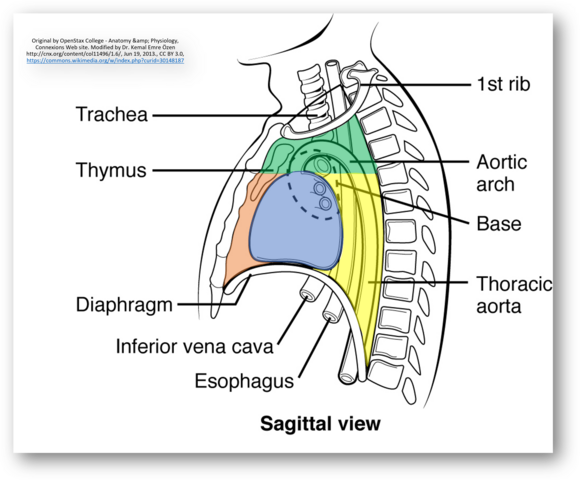
mediastinum
Illustration from Anatomy & Physiology, Connexions Web site. http://cnx.org/content/col11496/1.6/, Jun 19, 2013., CC BY-SA 3.0, via Wikimedia Commons
Green (Superior mediastinum); Orange (Anterior mediastinum); Blue (Middle mediastinum); Yellow (Posterior mediastinum)

Inferior mediastinum:

Anterior mediastinumMiddle mediastinumPosterior mediastinum
Upper extentT4/5T4/5T4/5
Contents1. Thymic remnants
2. Lymph nodes
3. Fat
1. Phrenic nerve
2. Pericardium
3. Heart
4. Ascending aorta
5. Pulmonary trunk
6. SVC
7. Lymph nodes
Remember esophageal and aortic openings of diaphragm: 3 gooses And A Duck.
1. Esophagoose
2. Right vagoose
3. Left vagoose
4. Aorta (descending)
5. Azygous vein
6. throacic Duct
7. Sympathetic and Splanchnic nerves
Lower extentnT9T9T12

Mediastinal masses

Anterior mediastinum: Mnemonic – 4 Ts

  1. Thymic neoplasm
  2. Teratoma
  3. Thyroid
  4. Terrible lymphoma

Middle mediastinum:

  1. Bronchogenic and pericardial cysts
  2. Esophageal tumors
  3. Vascular masses
  4. Lymphoma and lymph nodes

Posterior mediastinum: Mnemonic – MNOP

  1. Meningocele
  2. Neurogenic tumors
  3. Osseous tumors (Chordoma, Chondrosarcoma, Ewings)
  4. Paraspinal abscess
  • Facebook
  • Twitter
PGMEE, MRCS, USMLE, MBBS, MD/MS AnatomyCardiovascular systemRespiratory system

Post navigation

Previous post
Next post

Related Posts

PGMEE, MRCS, USMLE, MBBS, MD/MS

Carcinoid Tumors : Mnemonic

Jun 30, 2023Jun 30, 2023

Origin: Neuroendocrine cells Location: Lungs, Bronchi, Trachea, Gastrointestinal tract Synthesize: Biogenic amines (mainly serotonin which is metabolied to 5-HIAA) 5 Manifestations Mnemonic: 5-HIAAS 1. Heart disease (2/3 patients) 2. Intestinal manifestations 3. Airway obstruction 4. Asthma 5. Skin manifestations Alternative mnemonic: CARCinoid Rule of 1/3 Surgery for appendiceal carcinoid tumor…

Read More
PGMEE, MRCS, USMLE, MBBS, MD/MS wilms tumor

Wilm’s Tumor (Nephroblastoma) : Quick review

Oct 27, 2017Jul 13, 2020

Wilm’s tumor is the most common primary renal tumor of childhood. Origin: Embryonic nephrogenic (mesodermal) cells Mechanism: Deletion of WT-1 gene on chromosome 11 Pathology: a. Macroscopic (Gross): large, solitary tan to grey color mass; pale on cut section with areas of hemorrhage; 10% are bilateral or multicentric; grossly difficult…

Read More
PGMEE, MRCS, USMLE, MBBS, MD/MS

Colorectal carcinoma – Duke Staging and Management

Jul 7, 2024Jul 7, 2024

TNM stage Duke’s stage Description 5 yr survival Surgery Chemotherapy Radiotherapy 0 – Tis, N0, M0 Limited to mucosa >95% Local excision/polypectomy → Surveillance No No Mnemonic I – T1-2, N0, M0 A A-Ok limited to bowel wall only 90% Wide surgical resection + Anastomosis No No II – T3-4,…

Read More

Leave a Reply Cancel reply

Your email address will not be published. Required fields are marked *

This site uses Akismet to reduce spam. Learn how your comment data is processed.

Pre-clinical (Basic Sciences)

Anatomy

Biochemistry

Community medicine (PSM)

Embryology

Microbiology

Pathology

Pharmacology

Physiology

Clinical Sciences

Anesthesia

Dermatology

Emergency medicine

Forensic

Internal medicine

Gynecology & Obstetrics

Oncology

Ophthalmology

Orthopedics

Otorhinolaryngology (ENT)

Pediatrics

Psychiatry

Radiology

Surgery

RSS Ask Epomedicine

  • What to study for Clinical examination in Orthopedics?
  • What is the mechanism of AVNRT?

Epomedicine weekly

  • About Epomedicine
  • Contact Us
  • Author Guidelines
  • Submit Article
  • Editorial Board
  • USMLE
  • MRCS
  • Thesis
©2026 Epomedicine | WordPress Theme by SuperbThemes