Skip to content
Epomedicine

Mnemonics, Simplified Concepts & Thoughts

Epomedicine

Mnemonics, Simplified Concepts & Thoughts

mechanoreceptors

Mechanoreceptors : Mnemonic

Epomedicine, Jul 27, 2018Jun 15, 2022

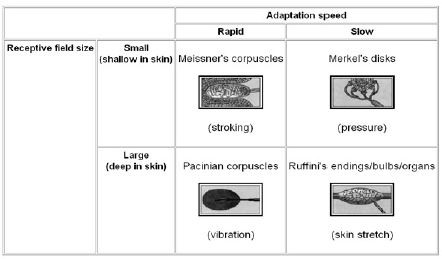
Adaptation of Mechanoreceptors

Mnemonic: Life is fast for MPs (Member of Parliament) and slow for MRs. In alphabetical order, meIssner’s come becore meRkel. Hence, Meissner’s corpuscle are the quicker among two.

1. Fast adapting receptors: MP

  • Meissner’s corpuscle
  • Pacinian corpuscle

2. Slowly adapting receptors: MR

  • Merkel disc
  • Ruffini corpuscle/ending

mechanoreceptors

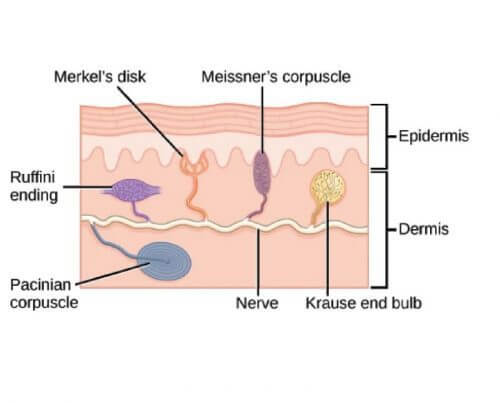
Location of Mechanoreceptors

Mnemonic: Both starting with “M” are superficial and have small receptive field. Other 2 are deeply located.

  1. Superficial (Epidermis): Meissner’s corpuscle and Merkel’s disc
  2. Deep (Dermis): Ruffini’s ending and Pacinian corpuscle

Mnemonic: MeiSSner has SS which stands for hairleSS or Smooth Surface.

  1. Found in hairless (glaborous skin) only: Meissner corpuscle
  2. Found in both hairless and hairy skin: Others
mechanoreceptors

Functions of Mechanoreceptors

Mnemonic:

The superficial receptors detect touch and the deep receptors detect pressure.

  1. Meissner is smooth to pronounce – found on smooth skin and detects smooth (fine) touch.
  2. Merkel is harder to pronounce – found also on hairy skin and detects crude touch.
  3. ViP STaR or PV = nRT
    • Vibtation: Pacinian corpuscle
    • Stretch and Temperature (warm): Ruffini endings
  4. Krause bulb = Kelvin = Kold (Cold)
  1. Meissner corpuscle: Light/fine touch and Moving 2 point discrimination
  2. Merkel disc: Crude touch and Static 2 point discrimination
  3. Ruffini endings: Stretch (prolonged pressure) and warmth
  4. Pacinian corpuscle: Vibration
  5. Krause bulb: Cold

They are also classified as: Fast Adapting (FA) or Slow Adapting (SA) followed by 1 (superficial) or 2 (deep)

  • FA1 – Meissner corpuscle
  • FA2 – Pacinian corpuscle
  • SA1 – Merkel disc
  • SA2 – Ruffini endings
31 shares
  • Facebook29
  • Twitter
PGMEE, MRCS, USMLE, MBBS, MD/MS DermatologyPhysiology

Post navigation

Previous post
Next post

Related Posts

PGMEE, MRCS, USMLE, MBBS, MD/MS type 1 and 2 error

Errors and P-value

May 30, 2019Sep 27, 2021

Statistical hypotheses Null hypothesis (H0): No difference or relation exists; e.g. Treatment A is not better than Treatment B Alternative or research hypothesis (H1): Some difference or relation exists, e.g. Treatment A is better than Treatment B Statistical errors Type I error (alpha): False positive (Falsely rejecting Null-hypothesis; i.e. null…

Read More
PGMEE, MRCS, USMLE, MBBS, MD/MS

Pirani Score and Dimeglio Classification for Clubfoot Assessment

Apr 13, 2022Aug 3, 2022

Pirani socre Pirani score for assessment of clubfoot (CTEV) consists of 6 parameters (3 each in midfoot and hindfoot) which is scored as 0, 0.5 or 1 with a maximum possible score of 6. The parameters can be remembered using the mnemonic: PER TOM Posterior crease Empty heel Rigid equinus…

Read More
PGMEE, MRCS, USMLE, MBBS, MD/MS rib notching

Rib Notching

Feb 13, 2017

Normal Rib Notching A small notch near the costo-vertebral joint is normal, so pathologic rib notching is more likely if the notching is more lateral. Types of Pathological Rib Notching 1. Superior rib notching 2. Inferior rib notching (more common) Inferior Rib Notching (Roesler’s sign) Mechanism: Enlargement of one or…

Read More

Comments (3)

  1. sunil nakum says:
    Jul 31, 2018 at 10:47 am

    I would say more than amazing! Its fantastic.

    Reply
  2. Ritesh K.M. says:
    Jun 7, 2019 at 2:00 am

    Awesome mnemonic 👍👍 helped me a lot to remember them 👌👌

    Reply
  3. suruk says:
    Apr 21, 2020 at 5:40 am

    lovely, From Thailand 😀

    Reply

Leave a Reply to suruk Cancel reply

Your email address will not be published. Required fields are marked *

This site uses Akismet to reduce spam. Learn how your comment data is processed.

Pre-clinical (Basic Sciences)

Anatomy

Biochemistry

Community medicine (PSM)

Embryology

Microbiology

Pathology

Pharmacology

Physiology

Clinical Sciences

Anesthesia

Dermatology

Emergency medicine

Forensic

Internal medicine

Gynecology & Obstetrics

Oncology

Ophthalmology

Orthopedics

Otorhinolaryngology (ENT)

Pediatrics

Psychiatry

Radiology

Surgery

RSS Ask Epomedicine

  • What to study for Clinical examination in Orthopedics?
  • What is the mechanism of AVNRT?

Epomedicine weekly

  • About Epomedicine
  • Contact Us
  • Author Guidelines
  • Submit Article
  • Editorial Board
  • USMLE
  • MRCS
  • Thesis
©2026 Epomedicine | WordPress Theme by SuperbThemes