Skip to content
Epomedicine

Mnemonics, Simplified Concepts & Thoughts

Epomedicine

Mnemonics, Simplified Concepts & Thoughts

mechanoreceptors

Mechanoreceptors : Mnemonic

Epomedicine, Jul 27, 2018Jun 15, 2022

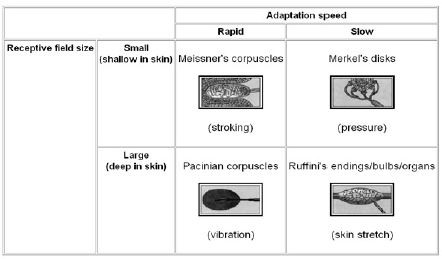
Adaptation of Mechanoreceptors

Mnemonic: Life is fast for MPs (Member of Parliament) and slow for MRs. In alphabetical order, meIssner’s come becore meRkel. Hence, Meissner’s corpuscle are the quicker among two.

1. Fast adapting receptors: MP

  • Meissner’s corpuscle
  • Pacinian corpuscle

2. Slowly adapting receptors: MR

  • Merkel disc
  • Ruffini corpuscle/ending

mechanoreceptors

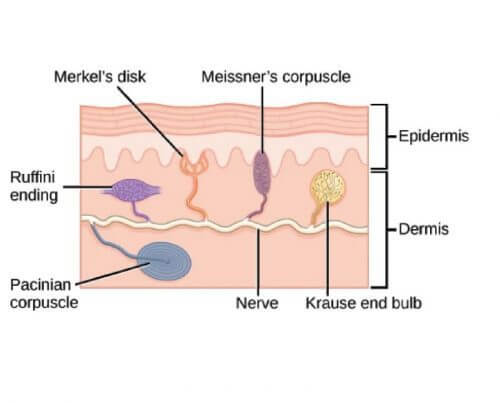
Location of Mechanoreceptors

Mnemonic: Both starting with “M” are superficial and have small receptive field. Other 2 are deeply located.

  1. Superficial (Epidermis): Meissner’s corpuscle and Merkel’s disc
  2. Deep (Dermis): Ruffini’s ending and Pacinian corpuscle

Mnemonic: MeiSSner has SS which stands for hairleSS or Smooth Surface.

  1. Found in hairless (glaborous skin) only: Meissner corpuscle
  2. Found in both hairless and hairy skin: Others
mechanoreceptors

Functions of Mechanoreceptors

Mnemonic:

The superficial receptors detect touch and the deep receptors detect pressure.

  1. Meissner is smooth to pronounce – found on smooth skin and detects smooth (fine) touch.
  2. Merkel is harder to pronounce – found also on hairy skin and detects crude touch.
  3. ViP STaR or PV = nRT
    • Vibtation: Pacinian corpuscle
    • Stretch and Temperature (warm): Ruffini endings
  4. Krause bulb = Kelvin = Kold (Cold)
  1. Meissner corpuscle: Light/fine touch and Moving 2 point discrimination
  2. Merkel disc: Crude touch and Static 2 point discrimination
  3. Ruffini endings: Stretch (prolonged pressure) and warmth
  4. Pacinian corpuscle: Vibration
  5. Krause bulb: Cold

They are also classified as: Fast Adapting (FA) or Slow Adapting (SA) followed by 1 (superficial) or 2 (deep)

  • FA1 – Meissner corpuscle
  • FA2 – Pacinian corpuscle
  • SA1 – Merkel disc
  • SA2 – Ruffini endings
31 shares
  • Facebook29
  • Twitter
PGMEE, MRCS, USMLE, MBBS, MD/MS DermatologyPhysiology

Post navigation

Previous post
Next post

Related Posts

PGMEE, MRCS, USMLE, MBBS, MD/MS

Kanavel Sign for Pyogenic Flexor Tenosynovitis

Sep 30, 2020Sep 30, 2020

1. Exquisite tenderness over the course of the sheath, limited to the sheath Present in 64% cases Late sign of proximal extension of pyogenic tenosynovitis Most important sign as described by Kanavel 2. Flexion of the finger (‘hook’ sign) Present in 69% cases 3. Exquisite pain on extending the finger,…

Read More
PGMEE, MRCS, USMLE, MBBS, MD/MS myeloid differentiation aml

Concept of Acute Myeloid Leukemia (AML) FAB Classification

Aug 23, 2016Mar 10, 2018

There is no need of mnemonics to remember the FAB classification of Acute Myeloid Leukemia (AML); just remember the process myeloid differentiation. A simple schematic diagram with few intermediate processes and stimulating factors eliminated will meet our purpose here. The cells belonging to the myeloid lineage are: Granulocytes: Neutrophils, Eosinophils…

Read More
PGMEE, MRCS, USMLE, MBBS, MD/MS

Median nerve Anatomy : Course and Innervation

Jun 7, 2018Jun 1, 2024

Origin C5-T1 (lateral and medial cords of Brachial plexus) Course Motor innervation Muscles supplied: 2 lateral lumbricals, 3 thenars, 3Ps (2 pronator and 1 palmaris) and 4 flexors. Sensory innervation Clinical correlation 1. Martin-Gruber motor connection: occur in 17% of individuals between median and ulnar nerves resulting in variable innervations…

Read More

Comments (3)

  1. sunil nakum says:
    Jul 31, 2018 at 10:47 am

    I would say more than amazing! Its fantastic.

    Reply
  2. Ritesh K.M. says:
    Jun 7, 2019 at 2:00 am

    Awesome mnemonic 👍👍 helped me a lot to remember them 👌👌

    Reply
  3. suruk says:
    Apr 21, 2020 at 5:40 am

    lovely, From Thailand 😀

    Reply

Leave a Reply to Ritesh K.M. Cancel reply

Your email address will not be published. Required fields are marked *

This site uses Akismet to reduce spam. Learn how your comment data is processed.

Epomedicine. Mechanoreceptors : Mnemonic [Internet]. Epomedicine; 2018 Jul 27 [cited 2025 Dec 20]. Available from: https://epomedicine.com/medical-students/mechanoreceptors-mnemonic/.

Pre-clinical (Basic Sciences)

Anatomy

Biochemistry

Community medicine (PSM)

Embryology

Microbiology

Pathology

Pharmacology

Physiology

Clinical Sciences

Anesthesia

Dermatology

Emergency medicine

Forensic

Internal medicine

Gynecology & Obstetrics

Oncology

Ophthalmology

Orthopedics

Otorhinolaryngology (ENT)

Pediatrics

Psychiatry

Radiology

Surgery

RSS Ask Epomedicine

  • What to study for Clinical examination in Orthopedics?
  • What is the mechanism of AVNRT?

Epomedicine weekly

  • About Epomedicine
  • Contact Us
  • Author Guidelines
  • Submit Article
  • Editorial Board
  • USMLE
  • MRCS
  • Thesis
©2025 Epomedicine . All rights reserved.