Skip to content
Epomedicine

Mnemonics, Simplified Concepts & Thoughts

Epomedicine

Mnemonics, Simplified Concepts & Thoughts

Management of Anti-tubercular therapy (ATT) induced Hepatitis

Epomedicine, May 21, 2022May 21, 2022

Definition of ATT induced hepatitis

  1. ALT > 3 X Normal + Symptoms OR
  2. ALT > 5 X Normal without Symptoms

Management of ATT induced hepatitis

1. Hold all TB drugs for 7-10 days. Wait before restarting ATT until:

  • Symptoms: Resolve
  • ALT <2.5 X Normal

For severe TB, patients should be started on SEQ (Streptomycin, Ethambutol and Quinolone) until first line drugs can be re-introduced.
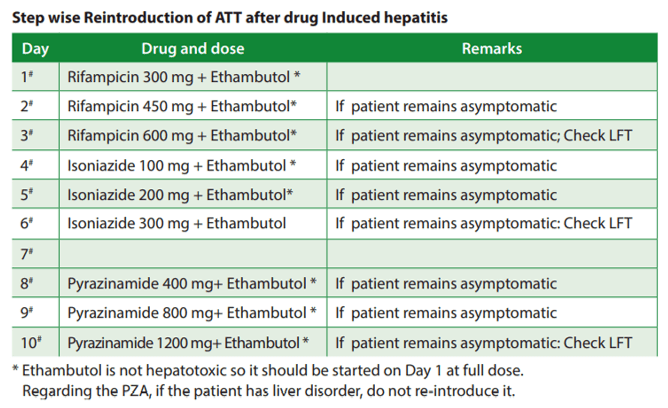
ATT hepatitis drug re-introduction

2. Re-introduce first line ATT in a stepwise manner:

  • Start full dose Ethambutol (it is non-hepatotoxic) from Day 1
  • Day 1-3: E + H (1/3rd-full dose)
    • Start Isoniazid and increase the dose in subsequent days, i.e. 1/3rd, 2/3rd then full dose
    • Perform LFT at Day 3
  • Day 4-6: E + H + R (1/3rd-full dose)
    • Start Rifampicin and increase the dose in subsequent days, i.e. 1/3rd, 2/3rd then full dose
    • Perform LFT at Day 6
  • Day 7-9 (only if patient has no liver disorder): E + H + R + Z (1/3rd-full dose)
    • Start Pyrazinamide and increase the dose in subsequent days, i.e. 1/3rd, 2/3rd then full dose
    • Perform LFT at Day 9
  • If patient is symptomatic or LFT is deranged at any stage, offending drug must be stopped.

3. Duration of treatment depends on the number of drugs given.

Reference: National-Tuberculosis-Management-Guidelines-2019_Nepal.pdf (nepalntp.gov.np)
  • Facebook
  • Twitter
PGMEE, MRCS, USMLE, MBBS, MD/MS Infectious diseaseInternal medicinePediatricsPharmacology

Post navigation

Previous post
Next post

Related Posts

PGMEE, MRCS, USMLE, MBBS, MD/MS

Neuroanatomy Notes

Sep 20, 2019Jul 25, 2021

This is a compilation of high yield topics on neuroanatomy with visual mnemonics and illustrations targeted for undergraduate medical students who find difficulty in conceptualizing the nervous system. Author: Dr. Sulabh Kumar Shrestha Key features: Covers clinically and academically important topics Schematic diagrams Visual mnemonics Useful for medical students, PG…

Read More
PGMEE, MRCS, USMLE, MBBS, MD/MS

JVP Mnemonics

Aug 4, 2019Aug 4, 2019

Jugular venous pulse (JVP) waveforms a – Atrial contraction (RA) c – Closure and Curving of tricuspid valve into RA x – atrial relaXation v – Venous filling of right atrium (RA) y – atrial emptYing Distinguishing JVP from Internal carotid pulsation Mnemonic: POLICE Palpation: Non-palpable Occlussion: Readily occludable Location:…

Read More
PGMEE, MRCS, USMLE, MBBS, MD/MS

Appendix, Appendicitis and Appendicectomy

Feb 8, 2020May 23, 2020

Inflammation of the Appendix is one of the most common causes of Pain Abdomen presenting in the Emergency Room. Since its first description in the texts, there has been a lot of improvement in the quality of management due to the availability of resources and technology. Appendix, in the initial…

Read More

Comment

  1. Dr Bijay KC says:
    Mar 11, 2024 at 9:24 am

    The table for “reintroduction of TB drugs in sequence of Rifampicin–>Isoniazid—> Pyrazinamide” doesn’t well correlate to what is written in explanation. Must be a typo only but it makes the matter most confusing!

    Reply

Leave a Reply Cancel reply

Your email address will not be published. Required fields are marked *

This site uses Akismet to reduce spam. Learn how your comment data is processed.

Epomedicine. Management of Anti-tubercular therapy (ATT) induced Hepatitis [Internet]. Epomedicine; 2022 May 21 [cited 2026 Aug 7]. Available from: https://epomedicine.com/medical-students/management-of-anti-tubercular-therapy-att-induced-hepatitis/.

Pre-clinical (Basic Sciences)

Anatomy

Biochemistry

Community medicine (PSM)

Embryology

Microbiology

Pathology

Pharmacology

Physiology

Clinical Sciences

Anesthesia

Dermatology

Emergency medicine

Forensic

Internal medicine

Gynecology & Obstetrics

Oncology

Ophthalmology

Orthopedics

Otorhinolaryngology (ENT)

Pediatrics

Psychiatry

Radiology

Surgery

RSS Ask Epomedicine

  • What to study for Clinical examination in Orthopedics?
  • What is the mechanism of AVNRT?

Epomedicine weekly

  • About Epomedicine
  • Contact Us
  • Author Guidelines
  • Submit Article
  • Editorial Board
  • USMLE
  • MRCS
  • Thesis
©2026 Epomedicine | WordPress Theme by SuperbThemes