Skip to content
Epomedicine

Mnemonics, Simplified Concepts & Thoughts

Epomedicine

Mnemonics, Simplified Concepts & Thoughts

Management of Anti-tubercular therapy (ATT) induced Hepatitis

Epomedicine, May 21, 2022May 21, 2022

Definition of ATT induced hepatitis

  1. ALT > 3 X Normal + Symptoms OR
  2. ALT > 5 X Normal without Symptoms

Management of ATT induced hepatitis

1. Hold all TB drugs for 7-10 days. Wait before restarting ATT until:

  • Symptoms: Resolve
  • ALT <2.5 X Normal

For severe TB, patients should be started on SEQ (Streptomycin, Ethambutol and Quinolone) until first line drugs can be re-introduced.
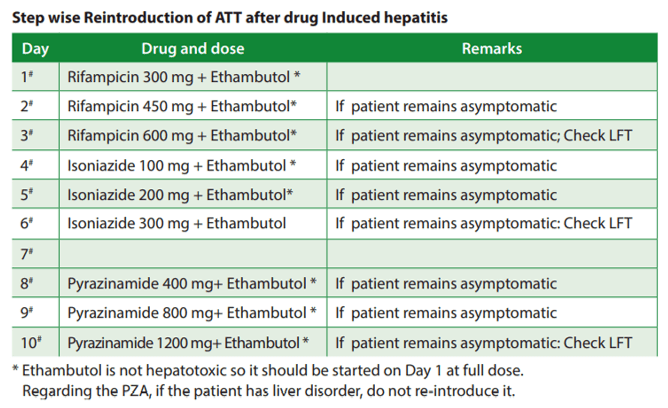
ATT hepatitis drug re-introduction

2. Re-introduce first line ATT in a stepwise manner:

  • Start full dose Ethambutol (it is non-hepatotoxic) from Day 1
  • Day 1-3: E + H (1/3rd-full dose)
    • Start Isoniazid and increase the dose in subsequent days, i.e. 1/3rd, 2/3rd then full dose
    • Perform LFT at Day 3
  • Day 4-6: E + H + R (1/3rd-full dose)
    • Start Rifampicin and increase the dose in subsequent days, i.e. 1/3rd, 2/3rd then full dose
    • Perform LFT at Day 6
  • Day 7-9 (only if patient has no liver disorder): E + H + R + Z (1/3rd-full dose)
    • Start Pyrazinamide and increase the dose in subsequent days, i.e. 1/3rd, 2/3rd then full dose
    • Perform LFT at Day 9
  • If patient is symptomatic or LFT is deranged at any stage, offending drug must be stopped.

3. Duration of treatment depends on the number of drugs given.

Reference: National-Tuberculosis-Management-Guidelines-2019_Nepal.pdf (nepalntp.gov.np)

  • Facebook
  • Twitter
PGMEE, MRCS, USMLE, MBBS, MD/MS Infectious diseaseInternal medicinePediatricsPharmacology

Post navigation

Previous post
Next post

Related Posts

PGMEE, MRCS, USMLE, MBBS, MD/MS

PQLI vs HDI : Mnemonic

Aug 24, 2024Aug 24, 2024

PQLI and HDI are similar, the main difference between the two being the inclusion of income in HDI & exclusion of same from PQLI. HDI represents both physical and financial attributes of development and PQLI has only physical aspects of life. PQLI HDI Full form Physical Quality of Life Index…

Read More
PGMEE, MRCS, USMLE, MBBS, MD/MS salter harris classification

Salter Harris Classification for Physeal Fracture: Mnemonic

Oct 29, 2017Jun 20, 2024

In children, the growth plate (physis) is a zone of cartilate situated between the epiphysis and the metaphysis of long bones. Cartilage is weaker than bone and thus is a common site of fracture. The Salter-Harris classification consists of 5 different types of growth plate fractures based on the location…

Read More
PGMEE, MRCS, USMLE, MBBS, MD/MS

Osteopetrosis : Mnemonic

Jul 20, 2022Jul 20, 2022

Synonyms: Marble bone disease Albers-Schonberg disease (Autosomal dominant form) Mnemonic: OSTEOPETROSIS Osteoclast dysfunction (Carbonic anhydrase II gene mutation or chloride channel dysfunction) Symmetric skeletal sclerosis Thickened cortex with loss of medullary canal diameter (bone in bone appearance) Extramedullary hematopoiesis (aplastic anemia and hepatosplenomegaly) Overgrowth of skull foramina (cranial nerve palsies)…

Read More

Comment

  1. Dr Bijay KC says:
    Mar 11, 2024 at 9:24 am

    The table for “reintroduction of TB drugs in sequence of Rifampicin–>Isoniazid—> Pyrazinamide” doesn’t well correlate to what is written in explanation. Must be a typo only but it makes the matter most confusing!

    Reply

Leave a Reply to Dr Bijay KC Cancel reply

Your email address will not be published. Required fields are marked *

This site uses Akismet to reduce spam. Learn how your comment data is processed.

Pre-clinical (Basic Sciences)

Anatomy

Biochemistry

Community medicine (PSM)

Embryology

Microbiology

Pathology

Pharmacology

Physiology

Clinical Sciences

Anesthesia

Dermatology

Emergency medicine

Forensic

Internal medicine

Gynecology & Obstetrics

Oncology

Ophthalmology

Orthopedics

Otorhinolaryngology (ENT)

Pediatrics

Psychiatry

Radiology

Surgery

RSS Ask Epomedicine

  • What to study for Clinical examination in Orthopedics?
  • What is the mechanism of AVNRT?

Epomedicine weekly

  • About Epomedicine
  • Contact Us
  • Author Guidelines
  • Submit Article
  • Editorial Board
  • USMLE
  • MRCS
  • Thesis
©2026 Epomedicine | WordPress Theme by SuperbThemes