Skip to content
Epomedicine

Mnemonics, Simplified Concepts & Thoughts

Epomedicine

Mnemonics, Simplified Concepts & Thoughts

Management of Anti-tubercular therapy (ATT) induced Hepatitis

Epomedicine, May 21, 2022May 21, 2022

Definition of ATT induced hepatitis

  1. ALT > 3 X Normal + Symptoms OR
  2. ALT > 5 X Normal without Symptoms

Management of ATT induced hepatitis

1. Hold all TB drugs for 7-10 days. Wait before restarting ATT until:

  • Symptoms: Resolve
  • ALT <2.5 X Normal

For severe TB, patients should be started on SEQ (Streptomycin, Ethambutol and Quinolone) until first line drugs can be re-introduced.
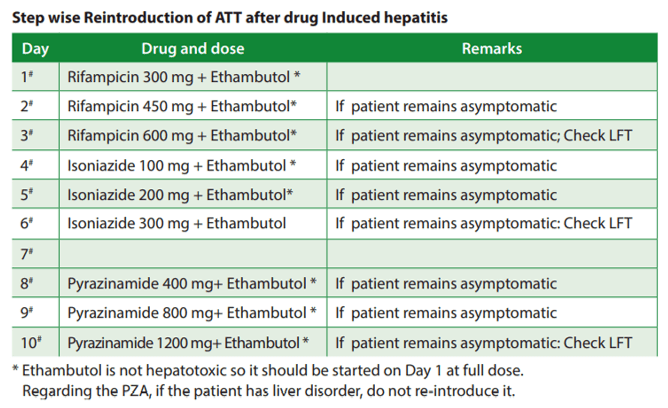
ATT hepatitis drug re-introduction

2. Re-introduce first line ATT in a stepwise manner:

  • Start full dose Ethambutol (it is non-hepatotoxic) from Day 1
  • Day 1-3: E + H (1/3rd-full dose)
    • Start Isoniazid and increase the dose in subsequent days, i.e. 1/3rd, 2/3rd then full dose
    • Perform LFT at Day 3
  • Day 4-6: E + H + R (1/3rd-full dose)
    • Start Rifampicin and increase the dose in subsequent days, i.e. 1/3rd, 2/3rd then full dose
    • Perform LFT at Day 6
  • Day 7-9 (only if patient has no liver disorder): E + H + R + Z (1/3rd-full dose)
    • Start Pyrazinamide and increase the dose in subsequent days, i.e. 1/3rd, 2/3rd then full dose
    • Perform LFT at Day 9
  • If patient is symptomatic or LFT is deranged at any stage, offending drug must be stopped.

3. Duration of treatment depends on the number of drugs given.

Reference: National-Tuberculosis-Management-Guidelines-2019_Nepal.pdf (nepalntp.gov.np)
  • Facebook
  • Twitter
PGMEE, MRCS, USMLE, MBBS, MD/MS Infectious diseaseInternal medicinePediatricsPharmacology

Post navigation

Previous post
Next post

Related Posts

PGMEE, MRCS, USMLE, MBBS, MD/MS

Elbow ligaments : Simplified Anatomy

Apr 7, 2020Apr 7, 2020

Lateral collateral ligament complex Restraint to varus and posterolateral rotatory instability. Anatomy is more variable. LCL arises from lateral humeral condyle at a point through which the axis of rotation passes – it maintains a uniform tension throughout the arc of motion. Annular ligament is a “U” shaped ligament that…

Read More
PGMEE, MRCS, USMLE, MBBS, MD/MS visual cycle

Visual cycle – Simplified

May 31, 2019May 31, 2019

11-cis-retinal combines with opsin protein to form rhodopsin. Light stimulates conversion of rhodopsin bound 11-cis-retinal to all-trans-retinol (all-trans-retinol is transported from photoreceptor cells to retinal pigment epithelium), which subsequently dissociates from opsin (bleaching), leading to membrane depolarization and initiation of action potential in photoreceptors in the neural retina. Once in…

Read More
PGMEE, MRCS, USMLE, MBBS, MD/MS congenital neck swellings

Differential diagnoses of Neck Swellings

May 4, 2014Aug 20, 2023

Triangles of Neck The following anatomic points define the anterior compartment/triangle of the neck: Contents: larynx, trachea, esophagus, thyroid and parathyroid glands, carotid sheath, and suprahyoid and infrahyoid strap muscles. Submandibular triangle: region contained in the anterior neck bordered by the inferior margin of the mandible and the digastric, stylohyoid, and mylohyoid muscles. This region contains…

Read More

Comment

  1. Dr Bijay KC says:
    Mar 11, 2024 at 9:24 am

    The table for “reintroduction of TB drugs in sequence of Rifampicin–>Isoniazid—> Pyrazinamide” doesn’t well correlate to what is written in explanation. Must be a typo only but it makes the matter most confusing!

    Reply

Leave a Reply Cancel reply

Your email address will not be published. Required fields are marked *

This site uses Akismet to reduce spam. Learn how your comment data is processed.

Epomedicine. Management of Anti-tubercular therapy (ATT) induced Hepatitis [Internet]. Epomedicine; 2022 May 21 [cited 2026 Jan 9]. Available from: https://epomedicine.com/medical-students/management-of-anti-tubercular-therapy-att-induced-hepatitis/.

Pre-clinical (Basic Sciences)

Anatomy

Biochemistry

Community medicine (PSM)

Embryology

Microbiology

Pathology

Pharmacology

Physiology

Clinical Sciences

Anesthesia

Dermatology

Emergency medicine

Forensic

Internal medicine

Gynecology & Obstetrics

Oncology

Ophthalmology

Orthopedics

Otorhinolaryngology (ENT)

Pediatrics

Psychiatry

Radiology

Surgery

RSS Ask Epomedicine

  • What to study for Clinical examination in Orthopedics?
  • What is the mechanism of AVNRT?

Epomedicine weekly

  • About Epomedicine
  • Contact Us
  • Author Guidelines
  • Submit Article
  • Editorial Board
  • USMLE
  • MRCS
  • Thesis
©2026 Epomedicine . All rights reserved.