Skip to content
Epomedicine

Mnemonics, Simplified Concepts & Thoughts

Epomedicine

Mnemonics, Simplified Concepts & Thoughts

Maddrey Score (Discriminant Function) and Lillie Model : Alcohoic Hepatitis

Epomedicine, Aug 7, 2019

The severity of alcoholic hepatitis can be assessed using a number of simple quantitative indices (Maddrey score, Meld score, Combined clinical and laboratory index). Of these, the Maddrey Discriminant Function (MDF) is the simplest.
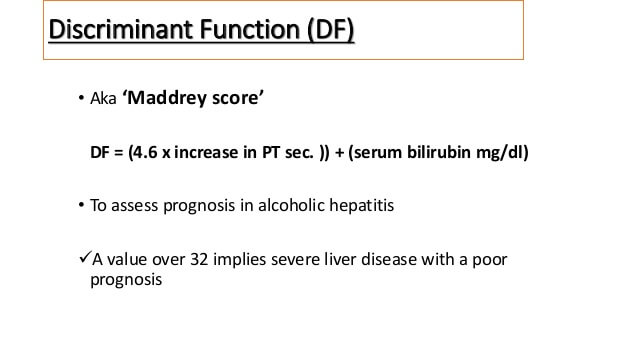
maddrey discriminant function

Maddrey score = 4.6 X (prolongation of prothrombin time above control in seconds) + Total bilirubin in mg/dl

To calculate Maddrey discriminant function using SI units – micromol/l (i.e. not US) divide bilirubin value by 17.

Interpretation:

Maddrey score >32 characterizes severe alcoholic hepatitis associated with a short-term mortality (within 30 days) of 30-50%, and has been used to determine the need for corticosteroid therapy.

Example: Patient prothrombin time 16 s, bilirubin 150 micromole/L, lab control prothrombin time 12 s

Maddrey score = 4.6 (16-12) + 150/7 = 26 (Maddrey score <32 is associated with a low likelihood of mortality during the current admission)

Lillie model

In patients with severe alcoholic hepatitis who have been treated with glucocorticoids, a prognostic scoring system (the Lillie model) has been proposed for predicting mortality. The model combines 6 variables:

  1. Age
  2. Renal insufficiency (Creatinine >1.3 pr creatinine clearance <40)
  3. Albumin
  4. PT
  5. Bilirubin
  6. Evolution of bilirubin at Day 7

The authors concluded that the term “nonresponder” can now be extended to patients with a Lille score above 0.45, which corresponds to 40% of cases.

References:

  1. A Practical Approach to the Spectrum of Alcoholic Liver Disease, An Issue of Clinics in Liver Disease – By David Bernstein
  2. Gastroenterology and Hepatology: A Clinical Handbook edited by Nicholas Joseph Talley, Isidor Segal, Martin D. Weltman
  3. Louvet A, Naveau S, Abdelnour M, Ramond MJ, Diaz E, Fartoux L, Dharancy S, Texier F, Hollebecque A, Serfaty L, Boleslawski E, Deltenre P, Canva V, Pruvot FR, Mathurin P. The Lille model: a new tool for therapeutic strategy in patients with severe alcoholic hepatitis treated with steroids. Hepatology. 2007 Jun;45(6):1348-54. PubMed PMID: 17518367.
1 shares
  • Facebook
  • Twitter
PGMEE, MRCS, USMLE, MBBS, MD/MS Gastrointestinal systemInternal medicine

Post navigation

Previous post
Next post

Related Posts

PGMEE, MRCS, USMLE, MBBS, MD/MS thalamus structure

Thalamic Connections Mnemonic

Jul 16, 2016Aug 4, 2023

Structure of Thalamus A vertical “Y” shaped white mater – internal medullary lamina divides thalamus into: In anatomical position: Pulvinar = Posterior end or posterior pole of thalamus Thalamic Connections Picture mnemonic Remember the schematic diagram drawn below showing important parts of thalamus in an anticlockwise fashion: Now, we assign…

Read More
PGMEE, MRCS, USMLE, MBBS, MD/MS

Novel Coronavirus Disease (CoViD-19) – “An Old Family with a New Disease”

Feb 27, 2020May 23, 2020

Coronaviridae, one of the families of viruses which are known to cause diseases in mammals and birds ranging from the common cold to Severe Acute Respiratory Syndrome. A new species which belongs to this family emerged recently causing an outbreak of a respiratory disease in the eastern part of Asia….

Read More
PGMEE, MRCS, USMLE, MBBS, MD/MS cellulitis

Cellulitis Assessment : Mnemonic

Sep 27, 2020Sep 27, 2020

Cellulitis is a rapidly spreading acute inflammation with infection of skin and subcutaneous tissue that spreads widely through tissue spaces. It is commonly caused by either Streptococcus pyogenes or Staphylococcus aureus. Erysipelas is a superficial form of cellulitis involving lymphatics; it has a peau d’orange appearance and a sharp border. It characteristically appears on the face. Since,…

Read More

Leave a Reply Cancel reply

Your email address will not be published. Required fields are marked *

This site uses Akismet to reduce spam. Learn how your comment data is processed.

Pre-clinical (Basic Sciences)

Anatomy

Biochemistry

Community medicine (PSM)

Embryology

Microbiology

Pathology

Pharmacology

Physiology

Clinical Sciences

Anesthesia

Dermatology

Emergency medicine

Forensic

Internal medicine

Gynecology & Obstetrics

Oncology

Ophthalmology

Orthopedics

Otorhinolaryngology (ENT)

Pediatrics

Psychiatry

Radiology

Surgery

RSS Ask Epomedicine

  • What to study for Clinical examination in Orthopedics?
  • What is the mechanism of AVNRT?

Epomedicine weekly

  • About Epomedicine
  • Contact Us
  • Author Guidelines
  • Submit Article
  • Editorial Board
  • USMLE
  • MRCS
  • Thesis
©2026 Epomedicine | WordPress Theme by SuperbThemes