Skip to content
Epomedicine

Mnemonics, Simplified Concepts & Thoughts

Epomedicine

Mnemonics, Simplified Concepts & Thoughts

internal carotid artery

Internal Carotid Artery – Segments and Branches

Epomedicine, Feb 13, 2017

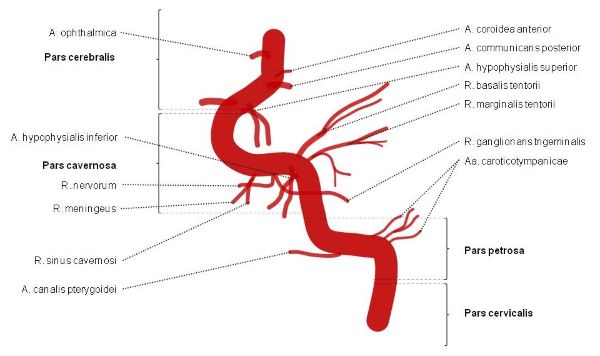
7 segments of Internal Carotid Artery

We have already discussed a mnemonic to remember the course of Internal Carotid Artery with the help of 2 horizontal “S” under the topic of Circle of Willis.

  • C1 – Cervical segment
  • C2 – Petrous (horizontal) segment
  • C3 – Lacerum segment
  • C4 – Cavernous segment
  • C5 – Clinoid segment
  • C6 – Ophthalmic (supraclinoid) segment
  • C7 – Communicating (terminal) segment

Mnemonic: Except for the C7, odd numbered segments do not have branches.
internal carotid artery

Branches of Internal Carotid Artery

Segment C2

These supply the nose and ear.

  1. Vidian artery
  2. Caroticotympanic artery

Segment C4

These supply the trigeminal ganglion, pituitary and meninges.

  1. Inferolateral trunk: supplies trigeminal ganglion
  2. Meningohypophyseal trunk: supplies meninges and pituitary (through inferior hypophyseal artery)

Segment C6

These supply the pituitary, eye, orbit and nose.

  1. Superior hypophyseal artery
  2. Ophthalmic artery

Segment C7

These supply brain as a part of circle of willis.

  1. Posterior communicating artery
  2. Anterior choroidal artery
  3. Terminal branches: Middle cerebral artery and Anterior cerebral artery

Mnemonic:

  1. 1st supplies the parts of head – nose and ear.
  2. Then supplies the covering of brain and pituitary.
  3. Then supplies the eyes.
  4. At last supplies the brain.

Mnemonic for branches: A VIP’S COMMA

  • A: Anterior choroidal artery (C7)
  • V: Vidian artery (C2)
  • I: Inferolateral trunk (C4)
  • P: Posterior communicating artery (C7)
  • S: Superior hypophyseal artery (C6)
  • C: Caroticotympanic artery (C2)
  • O: Ophthalmic artery (C6)
  • M: Meningohypophyseal trunk (C4)
  • M: Middle cerebral artery (C7)
  • A: Anterior cerebral artery (C7)

Brain structures supplied by Internal Carotid Artery

1. Cerebral hemispheres

2. Eye, optic nerve, optic chiasma and optic tract

3. Midbrain through anterior choroidal artery

4. Thalamus and internal capsule through posterior communicating artery

5. Pituitary gland and hypothalamus

6. Meninges of the skull base
39 shares
  • Facebook36
  • Twitter
PGMEE, MRCS, USMLE, MBBS, MD/MS AnatomyCardiovascular systemNervous system

Post navigation

Previous post
Next post

Related Posts

PGMEE, MRCS, USMLE, MBBS, MD/MS hypertension-terms

Terminologies of Hypertension

Oct 15, 2016Oct 15, 2016

There are various terminologies used to describe hypertension which may overlap and are a source of confusion to the medical students and health professionals. Essential or Primary or Idiopathic hypertension Hypertension in which secondary causes have been excluded. Identifiable etiologic factors of essential hypertension: Obesity Insulin resistance High alcohol intake…

Read More
PGMEE, MRCS, USMLE, MBBS, MD/MS Advance glaucomatous field defect

Understanding visual field defects in Glaucoma (Perimetry)

May 21, 2014May 21, 2014

Introduction Field of vision or Visual field is defined as the area that is perceived while fixating one central target. According to traquair’s analogy, visual field is “an island of vision surrounded by a sea of darkness”. It is a 3D hill – peak being fovea and at ground level,…

Read More
PGMEE, MRCS, USMLE, MBBS, MD/MS

Radiological Lines for assessing Basilar Invagination : Mnemonic

Nov 24, 2024Feb 21, 2025

Mnemonic: Imagine a letter “Z“. a. McRae’s line has “R” and is at Roof. b. Chamberlain’s line starts with “C” and is at Center. c. McGregor’s line has “G” and is at Ground. a. McRae’s line (foramen magnum line): drawn from anterior margin of foramen (basion) to posterior margin of…

Read More

Leave a Reply Cancel reply

Your email address will not be published. Required fields are marked *

This site uses Akismet to reduce spam. Learn how your comment data is processed.

Pre-clinical (Basic Sciences)

Anatomy

Biochemistry

Community medicine (PSM)

Embryology

Microbiology

Pathology

Pharmacology

Physiology

Clinical Sciences

Anesthesia

Dermatology

Emergency medicine

Forensic

Internal medicine

Gynecology & Obstetrics

Oncology

Ophthalmology

Orthopedics

Otorhinolaryngology (ENT)

Pediatrics

Psychiatry

Radiology

Surgery

RSS Ask Epomedicine

  • What to study for Clinical examination in Orthopedics?
  • What is the mechanism of AVNRT?

Epomedicine weekly

  • About Epomedicine
  • Contact Us
  • Author Guidelines
  • Submit Article
  • Editorial Board
  • USMLE
  • MRCS
  • Thesis
©2026 Epomedicine | WordPress Theme by SuperbThemes