Skip to content
Epomedicine

Mnemonics, Simplified Concepts & Thoughts

Epomedicine

Mnemonics, Simplified Concepts & Thoughts

hyperkalemia ecg

ECG changes in Hyperkalemia

Epomedicine, Nov 9, 2013May 26, 2019

Synonym: Hyperpotassemia

Definition: Serum potassium (K+) > 5 mEq/l

Electrophysiologic basis of ECG changes:

In patients with mild hyperkalemia, potassium conductance (IKr) through potassium channels is increased, which tend to shorten the AP duration and on the ECG causing tall tented T waves.

With severe hyperkalemia, effect on RMP becomes prominent. Increased extracellular K+ reduces the Resting Membrane Potential (RMP), i.e. makes it less negative, which leads to partial inactivation of cardiac Na+ channels resulting in slower upstroke velocity of AP. This results in impaired conduction velocity and slowing of AV conduction and intra-ventricular conduction.

a. Atria are more sensitive: Intially, PR prolongation and flattening of P waves

b. Later ventricles involved: QRS widened

c. With extreme hyperkalemia: Total inactivation of Na+ channels and heart stops (cardioplegia)
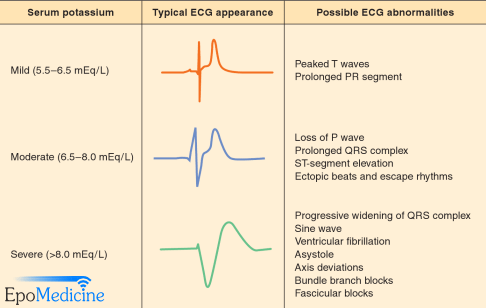
ECG features:
 
Changes in the T wave provide the earliest clues to hyperkalemia.
 
Hyperkalemia
 
  1. At K = 5.0 to 6.0 mEq/L, rapid repolarization causes peaked T waves (best seen in leads V2 to V4).
  2. At K = 6.0 to 6.5 mEq/L, decrease in conduction causes prolonged PR and QT intervals.
  3. At K = 6.5 to 7.0 mEq/L, P waves are diminished and ST segment may be depressed.
  4. At K = 7.0 to 8.0 mEq/L, P waves disappear, QRS widens, and irregular idioventricular rhythm appears.
  5. At K = 8.0 to 10.0 mEq/L, QRS merges with T wave to produce classic sine wave (QRS-T fusion – a sinusoidal waveform).
  6. At K = 10.0 to 12.0 mEq/L, ventricular fibrillation and diastolic arrest occur.
 
Note: Hyperkalemia causes tall, peaked (tented) T waves. ECG signs may be absent if the onset of hyperkalemia is slow – as seen in chronic renal failure – even though the serum potassium is in the range of 7 – 7.5meq/L.

106 shares
  • Facebook74
  • Twitter
Emergency Medicine Cardiovascular systemECG

Post navigation

Previous post
Next post

Related Posts

Emergency Medicine

Handtevy Method : Emergency Drug Dose by Age

Sep 11, 2021Sep 11, 2021

To obtain the correct weight for each age, assign each finger a chronological odd number starting with 1, representing the age in years. Now, using the same fingers, count in the multiples of 5, starting with 10 to obtain the corresponding ideal body weight in kilograms. For the even ages,…

Read More
Emergency Medicine san francisco syncope rule

San Francisco Syncope Rule (FED 30 90)

Oct 28, 2017Oct 28, 2017

San Francisco Syncope Rule (SFSR) defines high risk criteria for patients with syncope. FED 30 90 Failure (Congestive heart failure) ECG abnormalities Dyspnea (shortness of breath) Hematocrit <30% Systolic blood pressure <90 mmHg (at any time) Presence of any of the above criteria is regarded as positive. Mnemonic: CHESS Congestive…

Read More
Emergency Medicine upper gi bleeding scores

Upper GI Bleed (UGI Bleed) Scoring : Mnemonics

Nov 22, 2017Jul 28, 2023

Blatchford Score Blatchford score is recommended by NICE for 1st assessment. Admission risk marker Score component value Blood Urea (mg/dL) 18.2-22.4 2 22.4-28 3 28-70 4 >70 6 Haemoglobin (g/L) for men 12.0-12.9 1 10.0-11.9 3 10.0 6 Haemoglobin (g/L) for women 10.0-11.9 1 10.0 6 Systolic blood pressure (mm…

Read More

Leave a Reply Cancel reply

Your email address will not be published. Required fields are marked *

This site uses Akismet to reduce spam. Learn how your comment data is processed.

Pre-clinical (Basic Sciences)

Anatomy

Biochemistry

Community medicine (PSM)

Embryology

Microbiology

Pathology

Pharmacology

Physiology

Clinical Sciences

Anesthesia

Dermatology

Emergency medicine

Forensic

Internal medicine

Gynecology & Obstetrics

Oncology

Ophthalmology

Orthopedics

Otorhinolaryngology (ENT)

Pediatrics

Psychiatry

Radiology

Surgery

RSS Ask Epomedicine

  • What to study for Clinical examination in Orthopedics?
  • What is the mechanism of AVNRT?

Epomedicine weekly

  • About Epomedicine
  • Contact Us
  • Author Guidelines
  • Submit Article
  • Editorial Board
  • USMLE
  • MRCS
  • Thesis
©2026 Epomedicine | WordPress Theme by SuperbThemes