Skip to content
Epomedicine

Mnemonics, Simplified Concepts & Thoughts

Epomedicine

Mnemonics, Simplified Concepts & Thoughts

hodgkin staging

Hodgkin’s Lymphoma – Staging and Prognostic Factors

Epomedicine, Aug 13, 2016Aug 13, 2016

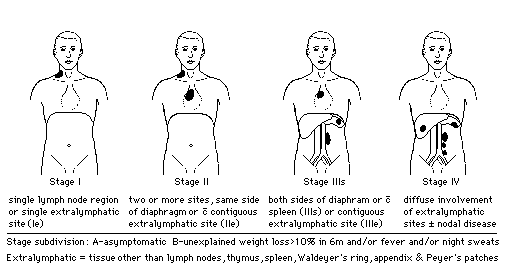
Costwold Modified Ann-Arbor Staging

I: 1 Lymph Node (LN) region (I) or 1 Extralymphatic site (IE)

II: On the same side of diaphragm – ≥2 LN region (II) or Localized Extralymphatic extension + ≥1 LN region (IIE)

III: On both the sides of diaphragm – LN regions (III) ± Spleen involvement (IIIS) ± Localized Extralymphatic extension (IIIE) or both (IIISE)

IV: Noncontiguous involvement of ≥1 Extralymphatic site with or without LN involvement
hodgkin staging

Annonations

A: Asymptomatic or Absence of B symptoms

B: B symptoms – ≥1 in last 6 months:

  1. Weight loss > 10%
  2. Unexplained persistent or recurrent fever
  3. Drenching night sweats

X: Bulky disease (≥6 cm in diameter or mass > 1/3 of mediastinal diameter)

E: Extension to a single Extralymphatic organ adjacent to a known involved site.

International Prognostic Score (IPS)

Mnemonic: HALSWAM

  1. Hemoglobin: <10.5 gm/dl
  2. Age: ≥ 45 years
  3. Lymphocytopenia: Lymphocyte count < 8% of WBC or <600/cu.mm
  4. Stage: IV
  5. WBC: >15,000/cu.mm
  6. Albumin: <4 gm/dl
  7. Male gender

Interpretation:

  • None: 84% FFP (Free From Progression) at 5 yrs

Presence of each factor depresses the curve plateau by ~8%.

  • 1: 77%
  • 2: 67%
  • 3: 60%
  • 4: 51%
  • 5+: 42%
13 shares
  • Facebook12
  • Twitter
PGMEE, MRCS, USMLE, MBBS, MD/MS HematologyInternal medicineOncologyPathology

Post navigation

Previous post
Next post

Related Posts

PGMEE, MRCS, USMLE, MBBS, MD/MS antidepressant side effects

Antidepressants Made Easy

Jan 4, 2017

Tricyclic Antidepressants (TCA) Mnemonic: -pramine, -triptyline, -pin Secondary amines: predominantly norepinephrine reuptake inhibitors Nor-triptyline Desi-pramine Tertiary amines: Ami-triptyline Imi-pramine Clomi-pramine Doxe-pin Irreversible MAO Inhibitors Mnemonic: TIPS Non-selective MAO inhibitors: Tranylcypromine Isocarboxazid Phenelzine Selective MAO-B inhibitor: Selegiline (transdermal patch) Reversible Inhibitor of MAO-A (RIMA) Moclobemide Tolaxatone Tetracyclic Antidepressants Nonselective inhibitor of…

Read More
PGMEE, MRCS, USMLE, MBBS, MD/MS

Ketamine : Mnemonic

Feb 11, 2023Feb 11, 2023

K: Kids (Induction agent of choice in children) E: Emergence reaction (floating sensations, vivid dreams and hallucination; reduced using benzodiazepines), Enantiomers (S-Ketamine and R-Ketamine) T: Thalamo-cortical dissociation with limbic system causing dissociative anesthesia A: Analgesic, Amnesic, Antidepressant, All routes (IV, IM, PO, Intranasal, Epidural, Intrathecal) M: Meals – can be…

Read More
PGMEE, MRCS, USMLE, MBBS, MD/MS thalamus structure

Thalamic Connections Mnemonic

Jul 16, 2016Aug 4, 2023

Structure of Thalamus A vertical “Y” shaped white mater – internal medullary lamina divides thalamus into: In anatomical position: Pulvinar = Posterior end or posterior pole of thalamus Thalamic Connections Picture mnemonic Remember the schematic diagram drawn below showing important parts of thalamus in an anticlockwise fashion: Now, we assign…

Read More

Leave a Reply Cancel reply

Your email address will not be published. Required fields are marked *

This site uses Akismet to reduce spam. Learn how your comment data is processed.

Epomedicine. Hodgkin’s Lymphoma – Staging and Prognostic Factors [Internet]. Epomedicine; 2016 Aug 13 [cited 2026 Oct 18]. Available from: https://epomedicine.com/medical-students/hodgkins-lymphoma-staging-prognostic-factors/.

Pre-clinical (Basic Sciences)

Anatomy

Biochemistry

Community medicine (PSM)

Embryology

Microbiology

Pathology

Pharmacology

Physiology

Clinical Sciences

Anesthesia

Dermatology

Emergency medicine

Forensic

Internal medicine

Gynecology & Obstetrics

Oncology

Ophthalmology

Orthopedics

Otorhinolaryngology (ENT)

Pediatrics

Psychiatry

Radiology

Surgery

RSS feed: Ask Epomedicine Ask Epomedicine

  • What to study for Clinical examination in Orthopedics?
  • What is the mechanism of AVNRT?

Epomedicine weekly

  • About Epomedicine
  • Contact Us
  • Author Guidelines
  • Submit Article
  • Editorial Board
  • USMLE
  • MRCS
  • Thesis
©2026 Epomedicine | WordPress Theme by SuperbThemes