Skip to content
Epomedicine

Mnemonics, Simplified Concepts & Thoughts

Epomedicine

Mnemonics, Simplified Concepts & Thoughts

hip deformity

Hip and Shoulder Deformities

Epomedicine, Jun 7, 2019Jun 7, 2019

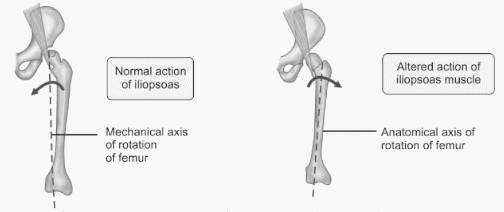
HIP

Flexion, Abduction, External rotation (FABER) + apparent lengthening: Synovitis

Flexion, Abduction, External rotation (FABER) + true lengthening: Anterior dislocation of hip (Obturator)

Extension+ Abduction + External rotation (EABER): Anterior dislocation of hip (Superior or Pubic)

Flexion, Adduction, Internal rotation (FADIR) + true shortening: Arthritis, Posterior dislocation of hip

Flexion, Adduction, External rotation (FADER) + Shortening: Femoral neck fracture, Primary osteoarthritis, Inter-trochanteric fracture (marked deformity), Slipped femoral epiphysis

Any type possible (Joker lesion): Fracture acetabulum
hip deformity

SHOULDER

Flexion, Abduction, External Rotation (FABER): Anterior dislocation of shoulder

Flexion, Adduction, Internation Rotation (FADIR): Posterior dislocation of shoulder

Hyperabduction (Salute position): Inferior dislocation of shoulder

Mnemonic:

Alphabetically, “B” comes before “D” and “E” comes before “I”. Anterior comes before posterior.

FABER: 1st stage of TB hip (synovitis), Anterior dislocation of hip, Anterior dislocation of shoulder

FADIR: Later stages of TB hip (arthritis stages), Posterior dislocation of hip, Posterior dislocation of shoulder
  • Facebook
  • Twitter
PGMEE, MRCS, USMLE, MBBS, MD/MS Musculoskeletal systemOrthopedics

Post navigation

Previous post
Next post

Related Posts

PGMEE, MRCS, USMLE, MBBS, MD/MS

Scaphoid Fractures : Rule of 70s

May 2, 2021Aug 12, 2021

70% of blood supply of scaphoid is by dorsal branch of radial artery 70% of scaphoid bones have arterial foramina through out their length 70% of carpal fractures are scaphoid fractures 70% of scaphoid fractures occur through the waist 70% of scaphoid fractures are detected on initial radiographs 70% proximal…

Read More
PGMEE, MRCS, USMLE, MBBS, MD/MS

Antiarrhythmics Classification (Vaughan Williams)

May 27, 2024May 27, 2024

Understand the conducting system of heart, cardiac action potential and pacemaker action potential. Mnemonic to remember Vaughan Williams classification for anti-arrhythmic – Some Block Potassium Channel DAAM! Mnemonic Class Mechanism of action Comments Example Use Some IA Sodium channel blocker (moderate)Intermediate action Moderate ↓ phase 0 slope↑ EFR & AP…

Read More
PGMEE, MRCS, USMLE, MBBS, MD/MS

Laryngeal Muscles : Mnemonics

Apr 29, 2024Apr 29, 2024

Extrinsic muscles Nerve supply: Ansa cervicalis (CN XII + C1, C2, C3) Infrahyoid muscles (Depressors of larynx): Mnemonic: TOSS Suprahyoid muscles (Elevators of larynx): Mnemonic: MDGS Intrinsic muscles Muscles Origin Insertion Function Thyroepiglotticus Thyroaryetenoid muscle Epiglottis (lateral surface) Opens laryngeal inlet Aryepiglotticus Oblique arytenoid muscle Epiglottis Closes laryngeal inlet Posterior…

Read More

Leave a Reply Cancel reply

Your email address will not be published. Required fields are marked *

This site uses Akismet to reduce spam. Learn how your comment data is processed.

Epomedicine. Hip and Shoulder Deformities [Internet]. Epomedicine; 2019 Jun 7 [cited 2025 Dec 27]. Available from: https://epomedicine.com/medical-students/hip-shoulder-deformities/.

Pre-clinical (Basic Sciences)

Anatomy

Biochemistry

Community medicine (PSM)

Embryology

Microbiology

Pathology

Pharmacology

Physiology

Clinical Sciences

Anesthesia

Dermatology

Emergency medicine

Forensic

Internal medicine

Gynecology & Obstetrics

Oncology

Ophthalmology

Orthopedics

Otorhinolaryngology (ENT)

Pediatrics

Psychiatry

Radiology

Surgery

RSS Ask Epomedicine

  • What to study for Clinical examination in Orthopedics?
  • What is the mechanism of AVNRT?

Epomedicine weekly

  • About Epomedicine
  • Contact Us
  • Author Guidelines
  • Submit Article
  • Editorial Board
  • USMLE
  • MRCS
  • Thesis
©2025 Epomedicine . All rights reserved.