Skip to content
Epomedicine

Mnemonics, Simplified Concepts & Thoughts

Epomedicine

Mnemonics, Simplified Concepts & Thoughts

Heart Sounds - Murmurs Cover Picture

Heart Sounds – Murmurs

Dr. Vinay Kumar Parepalli, MS General Surgery, Feb 12, 2020Aug 17, 2020

Murmur is a low, indistinct sound. In terms of medicine, it is the sound produced due to turbulent flow within the heart and great vessels. They are described and named in relation to the normal heart sounds, location, and quality.

Please go through these articles before reading further:
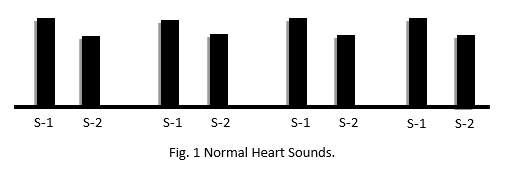
Heart Sounds – Clinically Explained

Heart Sounds – Abnormal

normal heart sounds

Mechanism of Murmur

Conditions where murmur may be heard:

  • Pathological Heart Valve – Rheumatic Heart Disease, Degenerative Valves.
  • Abnormal Communications of the Heart – Defects of Septum, PDA.

A heart murmur may always not be indicative of a structural abnormality. In situations causing hyper-dynamic circulation turbulence is created across the valves causing an INNOCENT MURMUR.

Murmurs
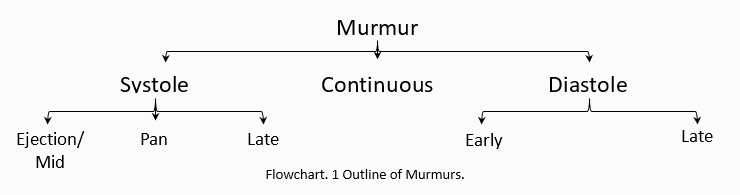
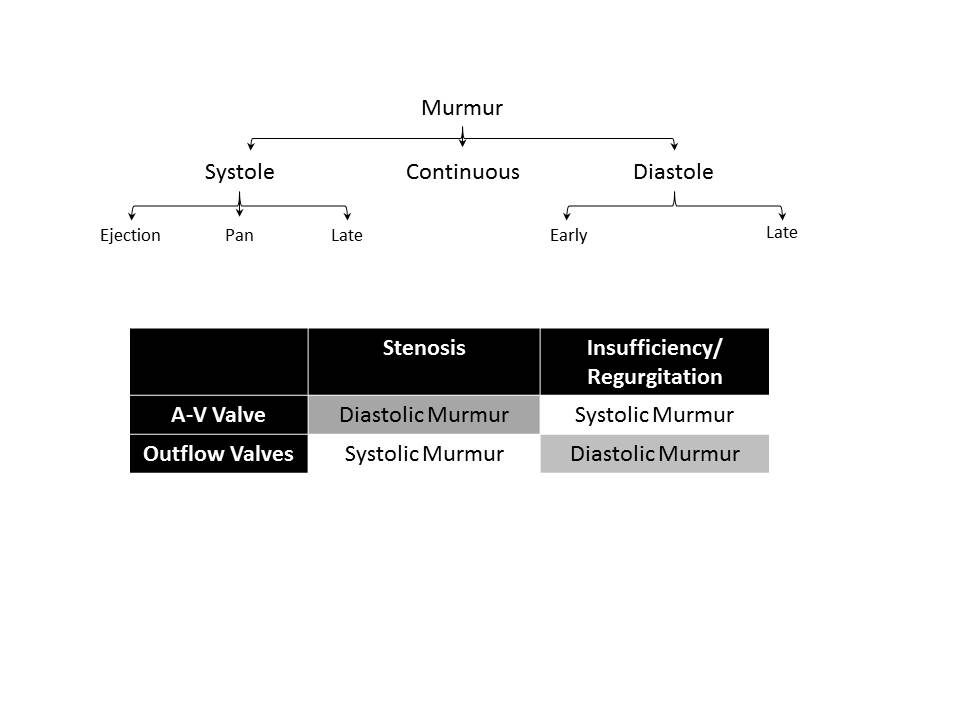
murmur types
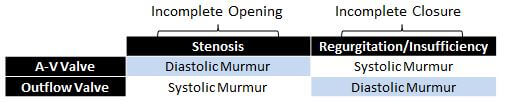
Table. 1 Timing of Murmurs in Valvular Disorders.

Location of the Murmur best heard: Towards the direction of the flow of blood. (In case of stenosis)

Valvular Heart Diseases and their Murmurs
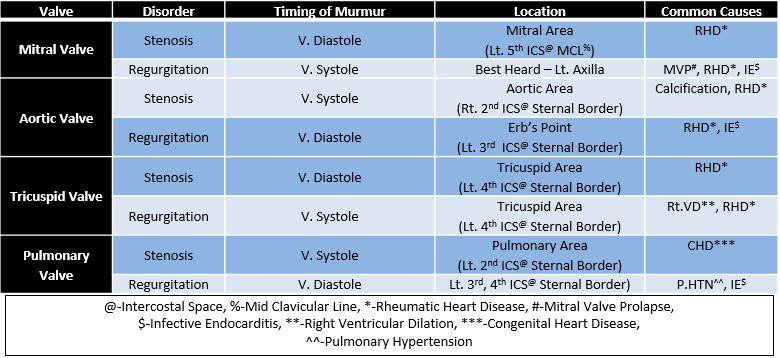
Table. 2 Types of Valvular disorders.

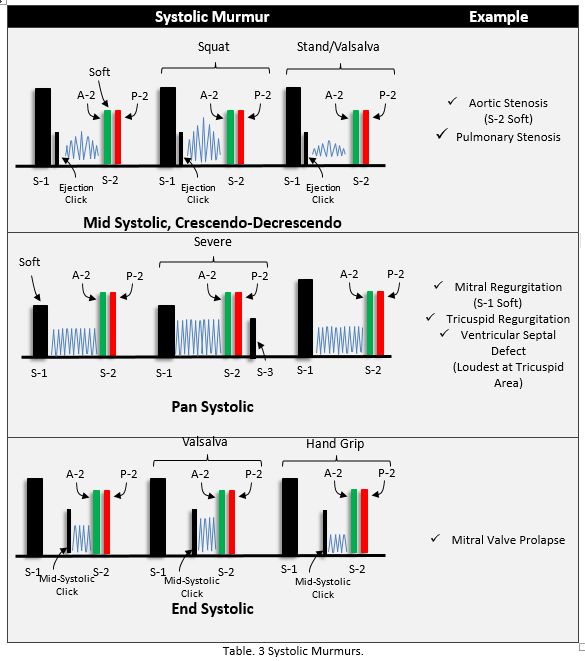
Systolic Murmur

systolic murmurs

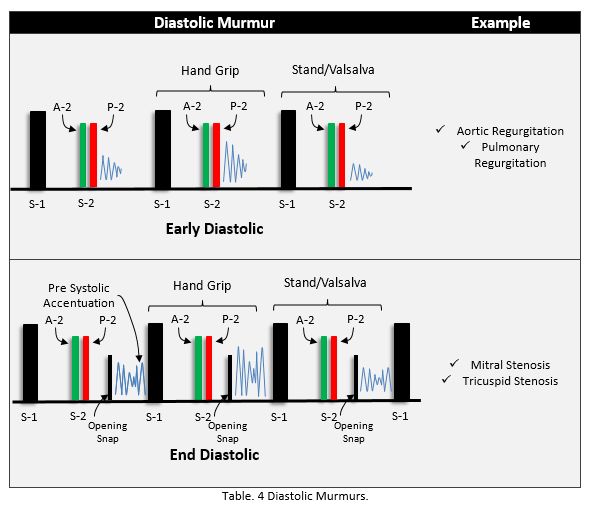
Diastolic Murmur

diastolic murmurs

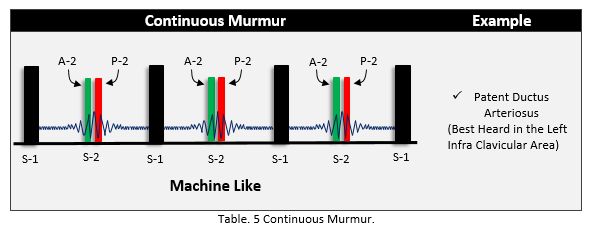
Continuous Murmur

Conclusion

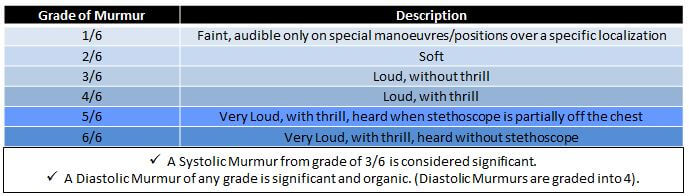
murmur grades
Table . 6 Grades of Murmurs
  • A systolic murmur from grade of 3/6 is considered significant.
  • A diastolic murmur of any grade is significant and organic. (Diastolic Murmurs are graded into 4).
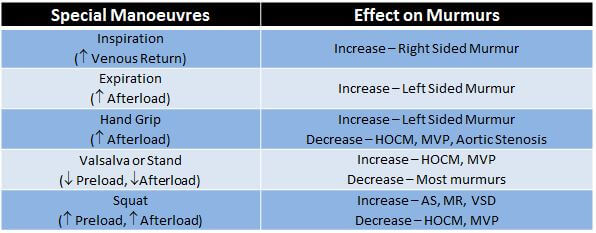
special maneuvers murmur
Table. 7 Variations in Loudness based on special manoeuvres.
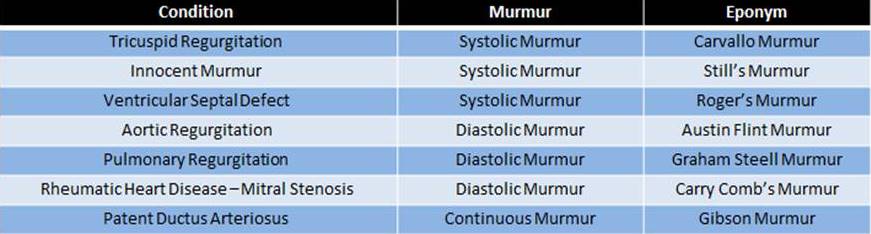
Table. 8 Few Murmurs with Eponyms.
Murmurs Made Easy

Summary

A murmur is the sound produced due to turbulent flow within the heart and great vessels.  If within the heart, it may be due to degenerative valves or developmental defects.

Murmur can be classified into Systolic Murmurs, Diastolic Murmurs and Continuous Murmurs.

They are graded from 1 to 6 based on the intensity they produce and few additional characteristics.

Murmurs are not always constant in nature, but change during the phases of respiration and few manoeuvres.

References

  1. Harrison’s Principles of Internal Medicine, 20th Edition.
  2. Bates’ Guide to Physical Examination and History Taking, 10th Edition.
  3. Hutchinson’s Clinical Methods, 23rd Edition.
  4. First Aid for USMLE Step 1, 2019.

vinay parepalli
Dr. Vinay Kumar Parepalli, MS General Surgery

Graduated from one of the famous institutions in Telangana, Kamineni Institute of Medical Sciences. He has always been fond of writing articles in Medicine.  Since the undergraduate years was interested in making creative Presentations and taking seminars.
10 shares
  • Facebook10
  • Twitter
PGMEE, MRCS, USMLE, MBBS, MD/MS Cardiovascular systemInternal medicinePediatrics

Post navigation

Previous post
Next post

Related Posts

PGMEE, MRCS, USMLE, MBBS, MD/MS unstable plaque

Ischemic Heart Disease Pathophysiology

Jul 9, 2016Jul 9, 2016

Definitions of Related Terms A) Ischemic Heart Disease (IHD): It is the imbalance between myocardial oxygen supply and demand, resulting in myocardial hypoxia and accumulation of waste metabolites. The components of IHD are: Stable Angina Acute Coronary Syndrome (ACS) B) Stable Angina: Pattern of chronic, predictable, transient chest discomfort during…

Read More
PGMEE, MRCS, USMLE, MBBS, MD/MS

Inferior Venacava (IVC) Tributaries and Abdominal Aorta Branches : Mnemonic

May 11, 2024May 11, 2024

Inferior Venacava (IVC) Tributaries Mnemonic: I Like To Rise So Incredibly High 1. common Iliac veins (L5) – Origin or Formation 2. Lumbar veins (L1-L5) 3. Testicular/gonadal veins – right (L2) 4. Renal veins (L1) 5. Suprarenal veins – right (L1) 6. Inferior phrenic veins (T8) 7. Hepatic veins (T8)…

Read More
PGMEE, MRCS, USMLE, MBBS, MD/MS

Medical Ethics : Mnemonics

Nov 21, 2020Nov 21, 2020

4 D’s of Medical Negligence Duty Deviation/Dereliction Damage Direct cause 4 Core Principles of Medical Ethics Mnemonic: BAN Justice Beneficence Autonomy Non-maleficence Justice Some even add “Veracity or Truthfulness” and “Confidentiality” to make 6 Ethical Principles. BRAIN of Informed Consent Benefits Risks Alternatives Indications Nature 5 Cs of the Exceptions…

Read More

Comments (4)

  1. sanjoy says:
    Apr 30, 2020 at 5:26 pm

    Why standing increases HOCM murmur?

    Reply
    1. Dr. Vinay Kumar Parepalli says:
      May 1, 2020 at 6:55 am

      Hypertrophic Obstructive Cardiomyopathy (HOCM) is a type of Myofibre Disarray, one of the common conditions causing sudden death. Majority of people suffering from this have a septal hypertrophy than ventricular hypertrophy. Apart from this HOCM is invariably accompanied with Mitral Valve Prolapse (due to papillary muscle dysfunction) which during ventricular emptying, the outlet becomes marrow leading to the Systolic Murmur. (Bernoulli’s Principle)
      According to cardiac and hemodynamic principles, on standing preload decreases since there is reduction on venous return hence there is less ventricular filling. This causes the Hypertrophic Septum and the Prolapsed Valve to come in proximity leading to an increased intensity of murmur.
      On the other hand, if one squats, there is increase in preload leading to increased venous return and hence more ventricular filling. This leads to widening of the distance between septum and prolapsed valve reducing the intensity of the murmur.
      Hope this clears your query…:)

      Reply
  2. Benard says:
    Aug 15, 2020 at 3:02 am

    On pulmonary stenosis and regurgitation l think u switched the disorder part …p.s should be v.systolic disorder and p.r v.diastolic disorder

    Reply
    1. Dr. Vinay Kumar Parepalli, MBBS says:
      Aug 17, 2020 at 1:16 pm

      Thank you Dr. Benard for the correction. It has been updated.
      Happy Reading.

      Reply

Leave a Reply Cancel reply

Your email address will not be published. Required fields are marked *

This site uses Akismet to reduce spam. Learn how your comment data is processed.

Parepalli VK. Heart Sounds – Murmurs [Internet]. Epomedicine; 2020 Feb 12 [cited 2026 Aug 20]. Available from: https://epomedicine.com/medical-students/heart-sounds-murmurs/.

Pre-clinical (Basic Sciences)

Anatomy

Biochemistry

Community medicine (PSM)

Embryology

Microbiology

Pathology

Pharmacology

Physiology

Clinical Sciences

Anesthesia

Dermatology

Emergency medicine

Forensic

Internal medicine

Gynecology & Obstetrics

Oncology

Ophthalmology

Orthopedics

Otorhinolaryngology (ENT)

Pediatrics

Psychiatry

Radiology

Surgery

RSS feed: Ask Epomedicine Ask Epomedicine

  • What to study for Clinical examination in Orthopedics?
  • What is the mechanism of AVNRT?

Epomedicine weekly

  • About Epomedicine
  • Contact Us
  • Author Guidelines
  • Submit Article
  • Editorial Board
  • USMLE
  • MRCS
  • Thesis
©2026 Epomedicine | WordPress Theme by SuperbThemes