Skip to content
Epomedicine

Mnemonics, Simplified Concepts & Thoughts

Epomedicine

Mnemonics, Simplified Concepts & Thoughts

Hawkin’s Classification for Talus Fractures : Mnemonic

Dr. Sulabh Kumar Shrestha, MS Orthopedics, Jun 28, 2022
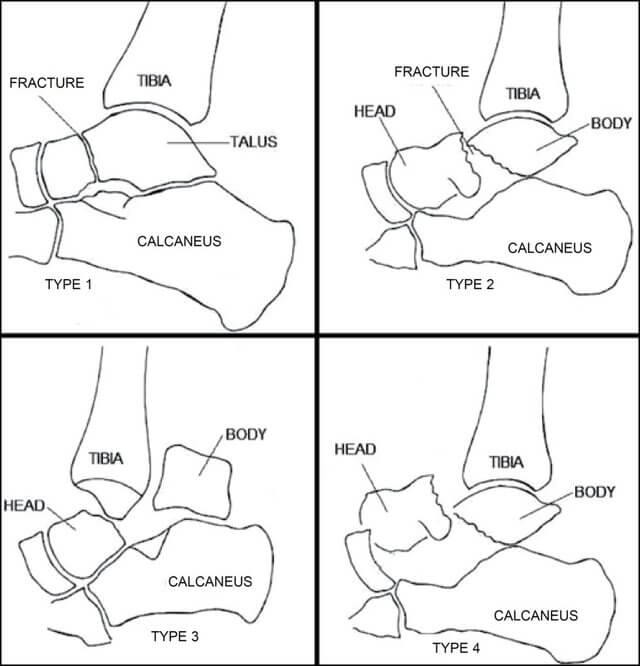
hawkins classification talus
Drummond Filho ML, Verzani MA, Rosa AF, Pimenta CJ, Grynwald J, Cliquet Junior A. Fraturas do colo do talus: avaliação da reprodutibilidade da classificação de Hawkins. Acta Ortopédica Brasileira. 2012;20:170-3.

Mnemonic: NISA 10-50-90-100

Type I – Non-displaced Neck fracture (upto 10% risk of AVN)

  • 1 blood vessel damaged (entering talar neck)
  • Management: 8 weeks in cast and 4 weeks in CAM cast

Type II – Type I + Inferior (subtalar) subluxation/dislocation (upto 50% risk of AVN)

  • 2 blood vessels damaged
  • Management: Immediate closed reduction and management as type I

Type III – Type II + Superior (tibiotalar) subluxation/dislocation (90% risk of AVN)

  • 3 (all sources) blood vessels damaged
  • Management: ORIF using combined anterolateral and anteromedial approach

Type IV – Type III + Anterior (talonavicular) subluxation/dislocation (100% risk of AVN)

  • AVN not related to blood supply damage
  • Management: As type III
dr. sulabh kumar shrestha
Dr. Sulabh Kumar Shrestha, MS Orthopedics

He is the section editor of Orthopedics in Epomedicine. He searches for and share simpler ways to make complicated medical topics simple. He also loves writing poetry, listening and playing music. He is currently pursuing Fellowship in Hip, Pelvi-acetabulum and Arthroplasty at B&B Hospital.
  • Facebook
  • Twitter
PGMEE, MRCS, USMLE, MBBS, MD/MS Musculoskeletal systemOrthopedics

Post navigation

Previous post
Next post

Related Posts

PGMEE, MRCS, USMLE, MBBS, MD/MS development milestones

Developmental Milestones : Mnemonic

Mar 4, 2018Apr 12, 2020

Principles of development Development proceeds from the head downward (cephalocaudal principle). Development proceeds from the center of the cody outward (proximodistal development). Development depends on maturation and learning. Development proceeds from the simple to the more complex. Growth and development is a sequential and continuous process. Growth and development proceed…

Read More
PGMEE, MRCS, USMLE, MBBS, MD/MS lactational amenorrhea mechanism

Management of Puerperium

Apr 3, 2016

Normal puerperium has been already discussed earlier here. A) Immediately after labor within 1 hour Blood pressure and heart rate atleast every 15 minutes Monitor amount of vaginal bleeding Palpate fundus to ensure amount adequate contractions (if relaxed – massage uterus to enhance oxytocin release) B) 1st several hours 1….

Read More
PGMEE, MRCS, USMLE, MBBS, MD/MS multiple myeloma features

Multiple Myeloma : Quick Approach

Mar 7, 2016Jun 12, 2016

Plasma cell dyscrasia refers to an abnormal proliferation of plasma cells that usually secrete a monoclonal immunoglobulin. A) CLINICAL FEATURES Features vary among various conditions: Mnemonic: CRAB Infection 1. Calcium increased: Hypercalcemia Nephrocalcinosis and

Read More

Leave a Reply Cancel reply

Your email address will not be published. Required fields are marked *

This site uses Akismet to reduce spam. Learn how your comment data is processed.

Shrestha SK. Hawkin’s Classification for Talus Fractures : Mnemonic [Internet]. Epomedicine; 2022 Jun 28 [cited 2026 Jun 23]. Available from: https://epomedicine.com/medical-students/hawkins-classification-for-talus-fractures-mnemonic/.

Pre-clinical (Basic Sciences)

Anatomy

Biochemistry

Community medicine (PSM)

Embryology

Microbiology

Pathology

Pharmacology

Physiology

Clinical Sciences

Anesthesia

Dermatology

Emergency medicine

Forensic

Internal medicine

Gynecology & Obstetrics

Oncology

Ophthalmology

Orthopedics

Otorhinolaryngology (ENT)

Pediatrics

Psychiatry

Radiology

Surgery

RSS Ask Epomedicine

  • What to study for Clinical examination in Orthopedics?
  • What is the mechanism of AVNRT?

Epomedicine weekly

  • About Epomedicine
  • Contact Us
  • Author Guidelines
  • Submit Article
  • Editorial Board
  • USMLE
  • MRCS
  • Thesis
©2026 Epomedicine | WordPress Theme by SuperbThemes