Skip to content
Epomedicine

Mnemonics, Simplified Concepts & Thoughts

Epomedicine

Mnemonics, Simplified Concepts & Thoughts

goodsall rule

Goodsall’s rule : Mnemonic

Epomedicine, Apr 17, 2020Oct 1, 2020

Synonym: Goodsall-Salmon’s law

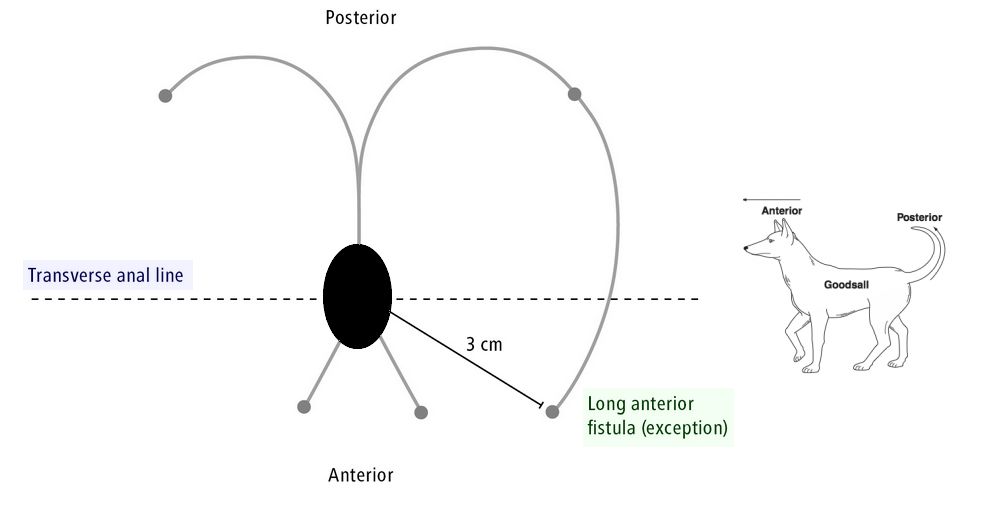
In anal fistula, goodsall’s rule predicts the type of track and location of internal opening.

An anterior external opening is more likely to have a straight track while a psoteriorly placed external opening is more likely to have a curved track.

Mnemonic: Think of a dog with a straight nose anteriorly and a curved tail posteriorly.
goodsall rule

However, exception exists. With the patient lying supine, an imaginary transverse, or “trans-anal” line is drawn through the ischial tuberosities. The exception to Goodsall’s rule occurs when the external opening lies anterior to the line but >3 cm from the anal verge. In this case, the tract tends to follow the rule for posterior external openings with an indirect,curved path that ends at the posterior midline (similar to posterior fistula).

  • Facebook
  • Twitter
PGMEE, MRCS, USMLE, MBBS, MD/MS Gastrointestinal systemGeneral Surgery

Post navigation

Previous post
Next post

Related Posts

PGMEE, MRCS, USMLE, MBBS, MD/MS cruciate knee mnemonic

Cruciate ligaments of Knee : Mnemonics

Apr 15, 2020Sep 18, 2022

Mnemonic: Cross your long fingers over the index finger and superimpose this hand over your ipsilateral knee. This will help us to remember the orientation of the anterior cruciate ligament (ACL) and posterior cruciate ligament (PCL) of knee. Also remember the mnemonic “LAMP” which means Lateral ACL and Medial PCL….

Read More
PGMEE, MRCS, USMLE, MBBS, MD/MS

Pressure Sores and Bed Sores

Oct 22, 2022Oct 22, 2022

A pressure injury is localized damage to the skin and underlying soft tissue usually over a bony prominence or related to a medical or other device. Normal capillary refill is 16-33 mmHg. Ischemia occurs with prolonged pressure >33 mmHg: Ischial tuberosity: >100 mmHg during sitting Sacral region: 40-60 mmHg in…

Read More
PGMEE, MRCS, USMLE, MBBS, MD/MS

Perkin’s Timetable for Fracture Healing

Oct 19, 2022

One needs to understand the difference between bone union and consolidation first Union Consolidation Definition Partial/Incomplete repair Full/Complete repair Callus Calcified Ossified Attempted angulation Painful Painless Fracture line in X-ray Still visible Obliterated and crossed by bony trabeculae Full weight bearing Cannot be undertaken Can be undertaken Reference: Physiotherapy in…

Read More

Comments (2)

  1. Muhammad waqas khan says:
    Sep 30, 2020 at 5:33 pm

    Why is this 3 cm necessary for anal fistula classification and why anteriorly placed anal fistula take curved posterior position when it is greater than 3cm of anal margin

    Reply
    1. Epomedicine says:
      Oct 1, 2020 at 3:49 am

      Anococcygeal raphe is a fibrous median raphe in the floor of the pelvis, which extends between the coccyx and the margin of the anus. This prevents fistula from directly opening in the midline posterior anal orifice. Cutaneous openings which lie anterior, or ventral, to transverse anal line typically are connected to the anal canal via a radial tract. The reason for exception of long anterior fistula opening posteriorly might be because of these often being high transsphincteric and suprasphincteric fistulas, which have their internal openings and primary abscesses located posteriorly and penetrate the external anal sphincter.

      Reply

Leave a Reply Cancel reply

Your email address will not be published. Required fields are marked *

This site uses Akismet to reduce spam. Learn how your comment data is processed.

Pre-clinical (Basic Sciences)

Anatomy

Biochemistry

Community medicine (PSM)

Embryology

Microbiology

Pathology

Pharmacology

Physiology

Clinical Sciences

Anesthesia

Dermatology

Emergency medicine

Forensic

Internal medicine

Gynecology & Obstetrics

Oncology

Ophthalmology

Orthopedics

Otorhinolaryngology (ENT)

Pediatrics

Psychiatry

Radiology

Surgery

RSS Ask Epomedicine

  • What to study for Clinical examination in Orthopedics?
  • What is the mechanism of AVNRT?

Epomedicine weekly

  • About Epomedicine
  • Contact Us
  • Author Guidelines
  • Submit Article
  • Editorial Board
  • USMLE
  • MRCS
  • Thesis
©2026 Epomedicine | WordPress Theme by SuperbThemes