Skip to content
Epomedicine

Mnemonics, Simplified Concepts & Thoughts

Epomedicine

Mnemonics, Simplified Concepts & Thoughts

gastric glands

Gastric glands and cells

Epomedicine, Jul 15, 2018Jun 16, 2023

Anatomically, stomach can be divided into 3 parts from above to below:

  1. Cardiac
  2. Fundus and body/corpus
  3. Pyloric/Antral

Gastric pits deepen as we move below from cardiac to pyloric glands.

Mucus secreting cells: Present in all 3 glands – cardiac, fundic and pyloric but predominate in cardiac and pyloric glands.

Pyloric glands have 1 more cell – G cells which secrete Gastrin.
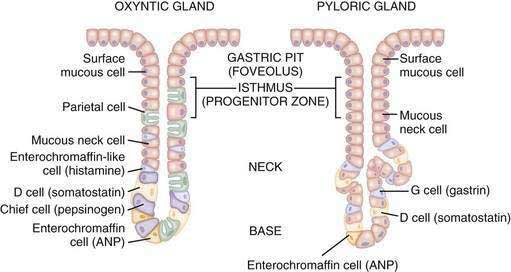
gastric glands

Fundic glands (gastric glands of fundus and body) can be divided into 3 parts from above (towards gastric pit) to downwards:

  1. Isthmus (Outer zone) – Mucus cells and Stem cells
  2. Neck (Middle zone) – Parietal (Oxyntic) cells
  3. Fundus (Basal zone) – Chief (Zymogen) cells and Enteroendocrine cells (Mnemonic: ECF)

Parietal (Oxyntic) cells secrete:

  1. Hydrochloric acid
  2. Intrinsic factor
  3. Ghrelin

Mnemonic: Parietal cells are Pink (Eosinophilic).

Chief (Zymogen/Peptic) cells secrete:

  1. Pepsin
  2. Gastric lipase

Mnemonic: Basal cheif cells are Blue (Basophilic). These have a lot of rough endoplasmic reticulum (rER).

Enteroendocrine cells:

  • G cells = Gastrin
  • D cells = Somatostatin
  • ECL cells = Histamine
6 shares
  • Facebook6
  • Twitter
PGMEE, MRCS, USMLE, MBBS, MD/MS AnatomyGastrointestinal systemPhysiology

Post navigation

Previous post
Next post

Related Posts

PGMEE, MRCS, USMLE, MBBS, MD/MS chemotherapy action

Principles of Chemotherapy

Dec 26, 2015Jul 2, 2016

Master the knowledge of clinically relevant cell cycle to understand the principles of chemotherapy. Tumors that are highly responsive to chemotherapeutic agents (e.g., testicular cancer, lymphomas) tend to have a very rapid doubling time compared to tumors that are less responsive to chemotherapy (e.g., pancreatic and prostate cancers). The tumor doubling time of metastases…

Read More
PGMEE, MRCS, USMLE, MBBS, MD/MS Child Pugh Score

Hepatorenal syndrome (HRS) – Quick revision

Apr 18, 2017

New Criteria for HRS 1. Cirrhosis with ascites 2. Serum creatinine >1.5mg/dl 3. No sustained improvement in renal function after 2 days of diuretic withdrawl (if on diuretics) and volume expansion with albumin infusion at 1 gm/kg/day upto a maximum of 100 gm/day. 4. No evidence of shock 5. No…

Read More
PGMEE, MRCS, USMLE, MBBS, MD/MS esr

ESR and CRP in Musculoskeletal infection

Aug 5, 2020Jan 27, 2022

ESR (Erythrocyte Sedimentation Rate) Usually elevated within 48-72 hours of the infection onset (less reliable in the first 48 hours of infection) Continues to rise for 3-5 days after institution of successful therapy and continuing rise beyond 4th-5th day of treatment can be an indication of treatment failure (not good…

Read More

Leave a Reply Cancel reply

Your email address will not be published. Required fields are marked *

This site uses Akismet to reduce spam. Learn how your comment data is processed.

Pre-clinical (Basic Sciences)

Anatomy

Biochemistry

Community medicine (PSM)

Embryology

Microbiology

Pathology

Pharmacology

Physiology

Clinical Sciences

Anesthesia

Dermatology

Emergency medicine

Forensic

Internal medicine

Gynecology & Obstetrics

Oncology

Ophthalmology

Orthopedics

Otorhinolaryngology (ENT)

Pediatrics

Psychiatry

Radiology

Surgery

RSS Ask Epomedicine

  • What to study for Clinical examination in Orthopedics?
  • What is the mechanism of AVNRT?

Epomedicine weekly

  • About Epomedicine
  • Contact Us
  • Author Guidelines
  • Submit Article
  • Editorial Board
  • USMLE
  • MRCS
  • Thesis
©2026 Epomedicine | WordPress Theme by SuperbThemes