Skip to content
Epomedicine

Mnemonics, Simplified Concepts & Thoughts

Epomedicine

Mnemonics, Simplified Concepts & Thoughts

medulla drawing

How to draw Medulla Oblongata Cross-section ?

Dr. Sulabh Kumar Shrestha, MS Orthopedics, Jul 24, 2016Jul 24, 2016

Like in Midbrain and Pons:

  1. Corticospinal tract passes ventrally
  2. Ventricular system is located dorsally in midline
  3. Cranial nerve nuclei are located just anterior to the ventricle
  4. Medial longitudinal fasciculus is present around the center

Another important thing to remember is that, the caudal medulla resembles “spinal cord“:

  1. Circular in shape
  2. Have central canal instead of 4th ventricle
  3. Have nucleus gracilis and nucleus cuneatus dorsally
  4. Site where pyramids and medial lemnisci decussate
medulla drawing

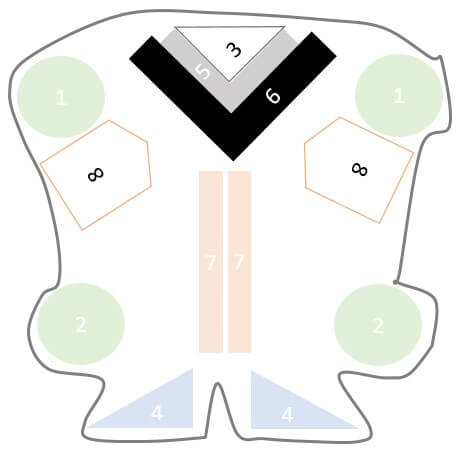
How to draw medulla cross-section ?

  1. Draw a pair of circles
    • Represents inferior cerebellar peduncle
  2. Draw another pair of circles anteriorly
    • Represents inferior olivary nucleus
  3. Draw a triangle in the center between 2 posterior circles
    • Represents 4th ventricle
  4. Draw a pair of triangles anterior to the 2 anterior circles
    • Represents pyramids
  5. Draw a boomerang just anterior to the triangle representing 4th ventricle
    • Represents periventricular gray
  6. Draw another boomerang anterior to the previous boomerang
    • Represents cranial nerve nucleii (from medial to lateral)
      • CN XII
      • Dorsal vagal nucleus
      • Nucleus tractus solitarius
      • Medial vestibular nucleus
      • Posterior cochlear nucleus
  7. Draw a pair of rectangles in the center
    • Represents medial lemniscus (anteriorly) and Medial Longitudinal Fasciculus (MLF) posteriorly
  8. Draw a pentagon with apex tilted medially, just anterior to the posterior pair of circles – the 5 points of the pentagon represents 5 structures (starting from apex in clockwise fashion)
    • Nucleus ambiguus
    • Trigeminal nerve nucleus and spinal tract
    • Anterior cochlear nucleus
    • Anterior spinocerebellar tract
    • Lateral spinocerebellar tract
    • Lateral spinothalamic tract inside the pentagon

Now, look how a real cross-section would look like:
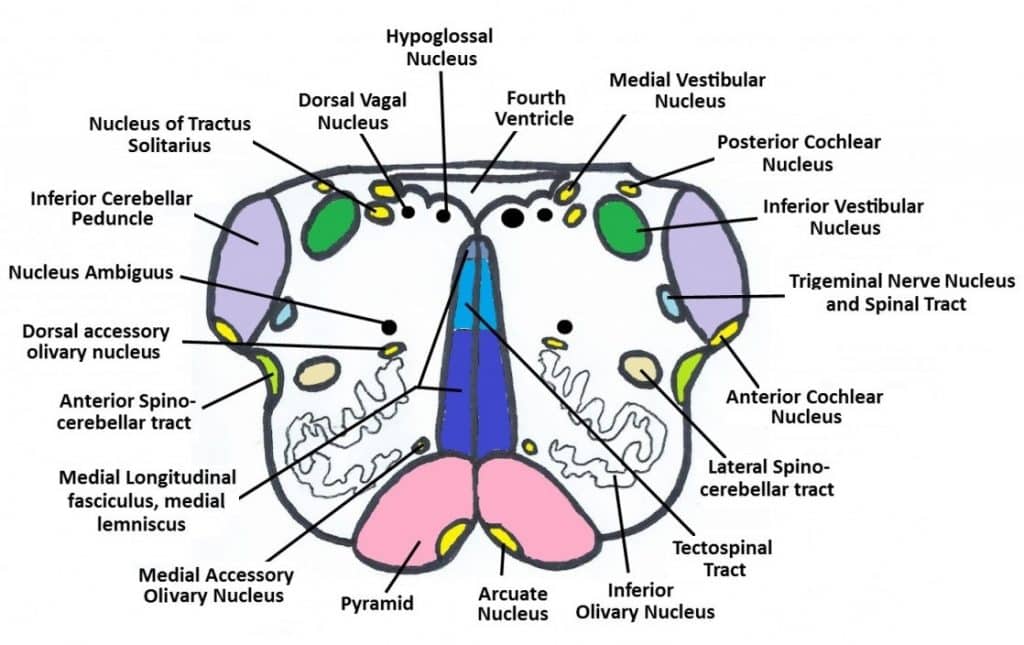
medulla cross section
From teachmeanatomy.info
dr. sulabh kumar shrestha
Dr. Sulabh Kumar Shrestha, MS Orthopedics

He is the section editor of Orthopedics in Epomedicine. He searches for and share simpler ways to make complicated medical topics simple. He also loves writing poetry, listening and playing music. He is currently pursuing Fellowship in Hip, Pelvi-acetabulum and Arthroplasty at B&B Hospital.

25 shares
  • Facebook25
  • Twitter
PGMEE, MRCS, USMLE, MBBS, MD/MS AnatomyNervous system

Post navigation

Previous post
Next post

Related Posts

PGMEE, MRCS, USMLE, MBBS, MD/MS infective endocarditis

Modified Duke’s Criteria for Infective Endocarditis : Mnemonic

Oct 22, 2017

Bacterial Endocarditis FIVE PM, i.e. BE FIVE PM Blood culture positive for IE Endocardial involvement Fever Immunologic phenomena Vascular phenomena Echocardioraphy minor criteria (eliminated) Predisposition Microbiologic evidence Definite Diagnosis from Clinical Criteria: 2 (major) + 0 (minor) or 1 (major) + 3 (minor) or 0 (major) + 5 (minor) Look:…

Read More
PGMEE, MRCS, USMLE, MBBS, MD/MS

Micturition reflex

Jun 13, 2020Sep 24, 2022

Micturition (Urination) is the ejection of urine from the urinary bladder through the urethra to the outside of the body. It is a type of reflex with voluntary control. The micturition cycle occurs in 2 phases: Urinary Storage Mnemonic: Storage = Sympathetic 1. Stimulus: Urine filling until tension in the…

Read More
PGMEE, MRCS, USMLE, MBBS, MD/MS

SIMPLE approach to Nutritional Care in Elderly Patients

Jul 4, 2025Jul 4, 2025

The essence of this approach is that, rather than requiring a highly specialized nutritionist, a systematic assessment on the part of all the disciplines that are interacting with the patients can achieve what is needed for the nutritional care of the older patient with a fragility fracture, regardless of setting…

Read More

Leave a Reply Cancel reply

Your email address will not be published. Required fields are marked *

This site uses Akismet to reduce spam. Learn how your comment data is processed.

Pre-clinical (Basic Sciences)

Anatomy

Biochemistry

Community medicine (PSM)

Embryology

Microbiology

Pathology

Pharmacology

Physiology

Clinical Sciences

Anesthesia

Dermatology

Emergency medicine

Forensic

Internal medicine

Gynecology & Obstetrics

Oncology

Ophthalmology

Orthopedics

Otorhinolaryngology (ENT)

Pediatrics

Psychiatry

Radiology

Surgery

RSS Ask Epomedicine

  • What to study for Clinical examination in Orthopedics?
  • What is the mechanism of AVNRT?

Epomedicine weekly

  • About Epomedicine
  • Contact Us
  • Author Guidelines
  • Submit Article
  • Editorial Board
  • USMLE
  • MRCS
  • Thesis
©2026 Epomedicine | WordPress Theme by SuperbThemes