Skip to content
Epomedicine

Mnemonics, Simplified Concepts & Thoughts

Epomedicine

Mnemonics, Simplified Concepts & Thoughts

Antiarrhythmics Classification (Vaughan Williams)

Epomedicine, May 27, 2024May 27, 2024

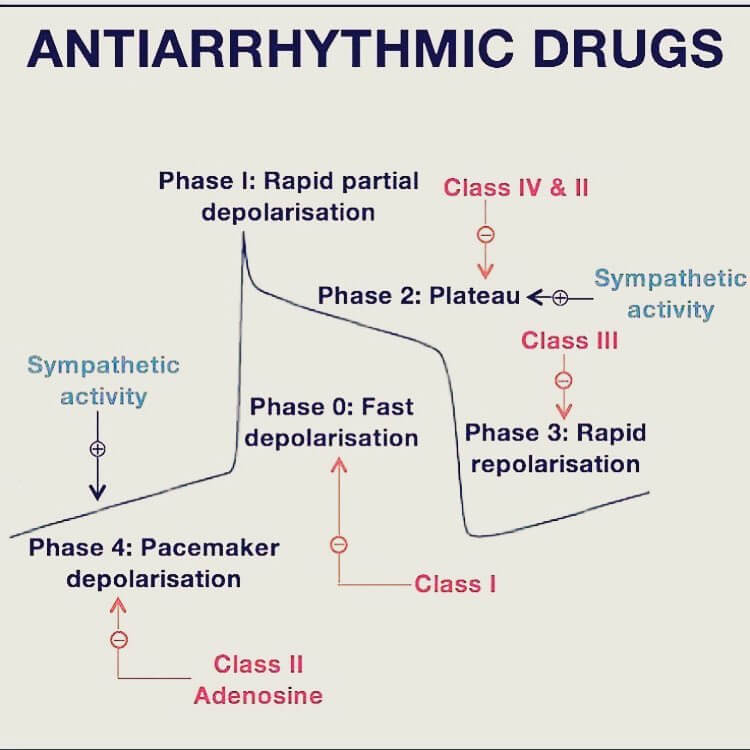
Understand the conducting system of heart, cardiac action potential and pacemaker action potential.

Physiology of Conducting System of Heart

Mnemonic to remember Vaughan Williams classification for anti-arrhythmic – Some Block Potassium Channel DAAM!
MnemonicClassMechanism of actionCommentsExampleUse
SomeIASodium channel blocker (moderate)
Intermediate action
Moderate ↓ phase 0 slope
↑ EFR & AP duration
Additional class III action
Quinidine, Procainamide, DisopyramideVentricular arrhythmias, WPW (procainamide)
IBSodium channel blocker (weak)
Fast action
Small ↓ phase 0 slope
↓ EFR & AP duration
Lidocaine, MexiletineVT
ICSodium channel blocker (strong)
Slow action
Pronounced ↓ phase 0 slope
= EFR & AP duration
Flecainide, PropafenoneParoxysmal AF, recurrent SVT
BlockIIBeta blocker↓ phase 4 slope in nodes (pacemaker potential)
Prolong AV node repolarization
Atenolol, Bisoprolol, Carvedilol, Esmolol, Metoprolol, Propranolol, SotalolRecurrent tachyarrhythmias
PotassiumIIIPotassium channel blockerDelay phase 3 (repolarization)Amiodarone (also class I, II & IV action), Sotalol (also class II action), Dofetilide, IbutilideAtrial fibrillation & flutter, Ventricular tachycardia
ChannelIVCalcium channel blockerProlongs phase 2
↓ slope phase 0 & 4 in node (pacemaker potential)
Prolong AV node repolarization
Verapamil, DiltiazemParoxysmal SVT, AF with RVR
DAAMV/OthersDirect nodal inhibitionDigoxin
Atropine
Adenosine
Magensium sulphate
SVT (Adenosine), Torsades de pointes (Magnesium), Rate control in AF (Digoxin)
  • Facebook
  • Twitter
PGMEE, MRCS, USMLE, MBBS, MD/MS Cardiovascular systemPharmacology

Post navigation

Previous post
Next post

Related Posts

PGMEE, MRCS, USMLE, MBBS, MD/MS

Foot Drop : Differentials

Jun 8, 2023Jun 8, 2023

Foot drop can result from: L5 radiculopathy Lumbar plexopathy Sciatic neuropathy Peroneal neuropathy Causes Disc herniation, Spinal canal stenosis Pelvic surgery, hematoma, prolonged labor Hip surgery, Injection injury Compression/trauma Motor Weakness includes muscles and hip abductors Weakness includes hip abductors and anal sphincter Weakness includes tibial and hamstring muscles Weakness…

Read More
PGMEE, MRCS, USMLE, MBBS, MD/MS

Tendon Transfer Principles : Mnemonic

Mar 2, 2021Nov 2, 2022

Tendon transfer is the use of the power of a functioning muscle unit to activate a non-functioning nerve/muscle/tendon unit. The transferred tendon remains attached to its parent muscle with an intact neurovascular pedicle. Mnemonic: SEACOAST-1 a. Synergistic: act together to produce a single composite movement (facilitate each other). e.g. b….

Read More
PGMEE, MRCS, USMLE, MBBS, MD/MS

Parasympathetic ganglia of Head and Neck

Aug 25, 2023Aug 26, 2023

Important points: Mnemonics: 1. COPS 3977 2. C is 3rd letter hence related to cranial nerve III 3. S for Sphenopalatine and Submandibular and S for Seven and is related to Superior Salivatory nucleus 4. All postganglionic fibers are carried by trigeminal nerve (Cranial nerve V) Ganglion Nucleus Pre-ganglionic Post-ganglionic…

Read More

Leave a Reply Cancel reply

Your email address will not be published. Required fields are marked *

This site uses Akismet to reduce spam. Learn how your comment data is processed.

Epomedicine. Antiarrhythmics Classification (Vaughan Williams) [Internet]. Epomedicine; 2024 May 27 [cited 2025 Dec 15]. Available from: https://epomedicine.com/medical-students/antiarrhythmics-classification-vaughan-williams/.

Pre-clinical (Basic Sciences)

Anatomy

Biochemistry

Community medicine (PSM)

Embryology

Microbiology

Pathology

Pharmacology

Physiology

Clinical Sciences

Anesthesia

Dermatology

Emergency medicine

Forensic

Internal medicine

Gynecology & Obstetrics

Oncology

Ophthalmology

Orthopedics

Otorhinolaryngology (ENT)

Pediatrics

Psychiatry

Radiology

Surgery

RSS Ask Epomedicine

  • What to study for Clinical examination in Orthopedics?
  • What is the mechanism of AVNRT?

Epomedicine weekly

  • About Epomedicine
  • Contact Us
  • Author Guidelines
  • Submit Article
  • Editorial Board
  • USMLE
  • MRCS
  • Thesis
©2025 Epomedicine . All rights reserved.